Haircut Finder
Stop guessing which haircut suits you. Upload a photo and this free AI hairstyle finder detects your face shape from 478 landmarks — entirely in your browser — then shows the haircuts and styles that balance your proportions, for men and women.
Loading haircut finder…
From Photo to Haircut Suggestions in Seconds
The AI runs entirely in your browser — no server, no sign-up, no data stored
Upload a photo or use your camera
Upload a clear, front-facing photo or take one live with your camera. Even lighting and a neutral expression give the most accurate reading. No account required.
AI maps 478 facial landmarks
MediaPipe's face landmark model runs entirely in your browser, mapping 478 points across your forehead, cheekbones, and jawline. No image data ever leaves your device.
Your face shape is measured
Forehead width, cheekbone width, jaw width, and face length are compared as ratios and matched against the 7 standard face shape profiles.
See haircuts that suit your shape
Your detected face shape comes with curated haircut and hairstyle suggestions for men and women, plus a link to the full styling guide for that shape.
Best Haircuts for Women by Face Shape
The balance principle behind every recommendation: add visual width where a face is narrow, length where it's wide, and softness where it's angular. Upload a photo above to see which one is yours.
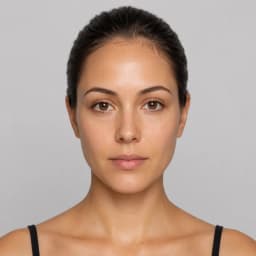
Oval
The most balanced and versatile face shape
Best styles
Blunt lob (long bob) at collar length · Curtain bangs · Layered waves past the shoulder
Full oval face guide →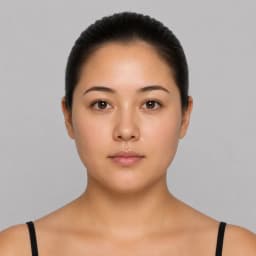
Round
Soft curves with similar width and length
Best styles
Long layers past the collarbone — creates vertical lines that elongate the face and draw the eye downward rather than sideways; the more length, the stronger the elongation effect · Side-swept bangs or off-centre part — asymmetry immediately breaks the circular silhouette and draws the eye vertically; even a slight off-centre part makes a significant difference · Angular lob (A-line cut, longer in front than back) — the angled front creates diagonal lines that directly counter round proportions; avoid a blunt, even-length lob which widens the face
Full round face guide →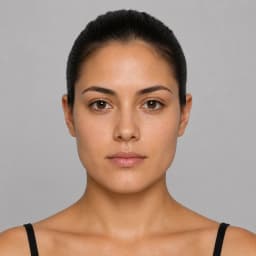
Square
Strong jawline with bold, angular features
Best styles
Soft layered waves past the jaw — the movement and curved lines directly contrast with the angular jaw; ending below the jaw level is key so the hair does not cut off at the jaw's widest, most angular point · Side part with layers — asymmetry reduces the visual symmetry of the broad jaw and forehead simultaneously; layers add softness that the square jaw lacks naturally · Long curtain bangs — the face-framing pieces and centre part soften the forehead without adding width, making the jaw appear less prominent by drawing attention upward
Full square face guide →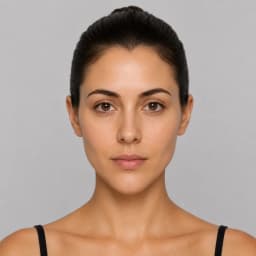
Heart
Wide forehead tapering to a narrow, pointed chin
Best styles
Chin-length bob with side part — adds visual width at the jaw level while the side part reduces the visual width of the forehead simultaneously; the most consistently recommended cut for heart faces · Lob with curls or waves at the ends — volume concentrated at the ends rather than the crown adds weight at exactly the right zone, below the already-wide cheekbones · Side-swept bangs that cover part of the forehead — directly reduces the visual width of the forehead, which is the heart face's widest and most prominent measurement
Full heart face guide →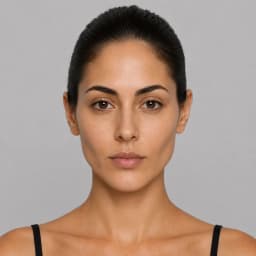
Diamond
High cheekbones with narrow forehead and jawline
Best styles
Side-swept fringe that covers one side of the forehead — adds width across the narrow forehead while partially concealing the narrowest zone; the asymmetry also adds visual interest · Chin-length styles with soft waves — volume at the chin adds width to the narrow jaw, balancing the prominent cheekbones above; the most corrective length for diamond faces · Medium-length textured layers (between chin and shoulder) — the most balanced overall length; layers at cheek level add visual width where needed without overwhelming the prominent midface
Full diamond face guide →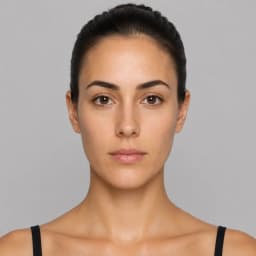
Oblong
Longer than wide with straight cheek lines
Best styles
Full blunt fringe — creates the strongest horizontal line possible, visually shortening the face more than any other single change; the most effective cut for oblong faces · Chin-length bob with volume at the sides — adds horizontal width and ends at the face's midpoint rather than extending the elongation further downward · Waves and curls with side volume — the horizontal movement of waves adds width perception; styles with volume at the sides rather than the top are the critical distinction
Full oblong face guide →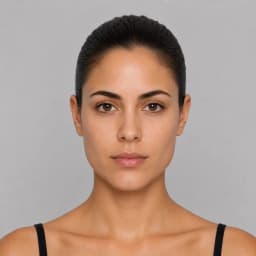
Triangle
Narrow forehead widening to a broad jawline
Best styles
Volume at the crown — any style with lift at the roots and fullness at the top balances the wide jaw by adding visual width to the narrow forehead; the most important principle for triangle faces · High bun or updo with volume — gathered height at the crown is the single most effective tool for triangle faces; the higher the volume, the stronger the corrective effect · Textured pixie with volume at the top — the short sides and tall, textured top create exactly the balance triangle faces need; one of the few face shapes where a high-volume pixie is the most flattering choice
Full triangle face guide →Hairstyles for Men by Face Shape
The face-shape rules are the same for everyone — what differs is the style vocabulary. These are barbershop-standard picks per shape.
Classic side part with pomade · Textured quiff · French crop with mid fade · Curtain hair (medium length)
Textured quiff with high skin fade — height at the crown elongates; the tight sides prevent additional cheek width; the 2026 textured finish adds angular definition simultaneously · Hard side part with mid-high fade — asymmetry immediately counteracts the circular silhouette; a defined part creates angular lines that round faces respond to strongly · French crop with high fade — the horizontal fringe adds a visual line while the high fade keeps the sides tight; net effect is more defined and less circular than most alternatives · Undercut with longer textured top — the stark transition between shaved sides and longer top emphasises face length; style the top upward rather than flat for maximum effect
Textured crop with soft, less structured top — the 2026 textured crop with more natural movement on top softens the angular jaw through contrast between hard jaw and soft hair · Curtain hair (medium length) — the centre part and face-framing lengths draw attention away from the jaw corners through movement; one of 2026's strongest trends for square-faced men · Low to mid fade with longer, wave-textured top — length on top adds perceived face length; keeping the fade lower preserves some side width to avoid over-emphasising jaw corners by stark contrast · Loose, natural waves with minimal product — curved lines in the hair directly contrast the jaw's hard angles; avoid heavy pomades that create stiff lines which repeat the jaw's rigidity
Low to mid fade with volume retained at the sides — unlike most other face shapes, heart-shaped faces benefit from some side width above jaw level to balance the narrow lower face · Side part with close sides (not a high skin fade) — the asymmetry reduces forehead width visually, and keeping some side volume above jaw level helps balance the narrow chin area · Medium-length curtain hair — kept relatively flat at the crown rather than pushed upward; avoid adding crown height to the already-wide upper face · Textured styles swept sideways at the fringe rather than upward — horizontal movement at the fringe level reduces forehead emphasis without adding crown height
French crop — the horizontal fringe specifically adds width across the narrow forehead; 2026's strongest and most recommended cut for diamond-faced men · Textured fringe swept forward rather than upward — forward movement adds forehead width directly; upward styling adds height without the corrective horizontal width the narrow forehead needs · Side-swept styles with volume at the hairline — sweeping hair across the forehead adds horizontal width to the narrowest zone without requiring a full fringe · Volume at the crown — height at the top adds perceived width to the upper face, helping balance the prominent midface; combine with lower fade to keep the sides in proportion
French crop — arguably the most effective single cut for oblong faces; the horizontal fringe directly and aggressively shortens the apparent face length · Low to mid fade with textured sides — retaining volume at the sides adds horizontal width; the main styling error for oblong men is high skin fades that remove all side volume · Side part swept sideways, not upward — horizontal direction of the part creates width impression rather than adding the height that oblong faces already have too much of · Horizontal fringe of any style — any cut that pushes some hair forward and down across the forehead shortens the long face; the exact style matters less than having a fringe element
How the Finder Measures Your Face Shape
This finder uses the same AI face shape detector that powers the rest of this site: Google's open-source MediaPipe Face Landmarker maps 478 points on your face entirely in your browser, then computes the ratios that define face shape — forehead width, cheekbone width, jaw width, and face length relative to each other. Your measurements are compared against all 7 shape profiles and the closest match wins — with a confidence level and a runner-up shape shown when you're near a boundary, because most real faces are blends, not textbook categories. Everything runs on your device; the photo is never uploaded for this step.
Frequently Asked Questions
How does this haircut finder work?
It uses the same AI face shape detector as our homepage: 478 facial landmarks are mapped from your photo entirely in your browser, and the ratios between your forehead, cheekbone, and jaw width (plus face length) determine your face shape — oval, round, square, heart, diamond, oblong, or triangle. Each shape comes with curated haircut and hairstyle suggestions for men and women.
Is this haircut finder free?
Yes, completely free with no sign-up, account, or payment required, and no limit on how many times you can retake it.
Does this haircut finder work for men and women?
Yes. Face shape detection works identically regardless of gender — it's pure geometry. Once your shape is detected, you'll see separate hairstyle suggestion lists for men and women so you can pick the relevant one.
Is my photo uploaded or stored anywhere?
No. The AI model downloads once to your browser and every measurement happens locally on your device. Your photo is never uploaded to a server, and nothing is stored once you clear your selection or close the tab.
Can I see what a hairstyle actually looks like on my photo?
This finder tells you which categories of haircut suit your face shape. For a visual preview of specific hairstyles directly on your own photo, try our AI Hairstyle Try-On tool.
What if I'm between two face shapes?
Most real faces are. The detector reports a confidence level and a runner-up shape whenever your measurements are close to a boundary between two shapes — in that case, style advice for both shapes is worth reading, since shape categories are descriptive conventions, not strict biological lines.
How accurate is the haircut finder?
Accuracy depends on photo quality — a clear, front-facing photo in even lighting with your hair pulled back from your forehead and jawline gives the most reliable measurement. Hair, heavy shadows, or an angled photo can shift the detected landmark positions and change the result.
Related Tools and Guides
Face Shape Detector
This tool's measurement engine, on its own
AI Hairstyle Try-On
Preview specific hairstyles on your own photo
Face Shape & Hairstyle Guide
The complete guide to every shape and style, with photos
Hair Type Finder
Straight, wavy, curly, or coily? Find your texture
Face Shape Quiz
7 questions to find your face shape — no photo
Best Hairstyles for Every Face Shape in 2026
In-depth styling guide across all 7 shapes
Disclaimer
This tool detects facial proportions using automated AI landmark detection and suggests haircut categories based on general styling principles. It is affected by photo angle, lighting, and hair covering the forehead or jawline. Results are for styling inspiration and educational purposes only — personal taste, hair texture, density, and a stylist's in-person judgment all matter as much as face shape.