Attractiveness Test
Am I attractive? This free test of attractiveness uses AI to measure five facial proportion ratios from a photo and return an instant score — free, private, and entirely in your browser. This facial attractiveness test is also an AI rater, an attractiveness rating tool, and a beauty tester rolled into one, all powered by the same on-device geometry engine. Whether you'd phrase it as how pretty, beautiful, or hot you are, or just how good your looks are, it's measuring the same proportional geometry either way.
AI Facial Attractiveness Test
Upload a front-facing photo. The AI measures your facial proportions and returns a score — in seconds, right in your browser as a free face-rating web app, no download required.
Loading attractiveness test…
Free, private, no sign-up. This test is free to use. Your photo is processed entirely in your browser and is never uploaded to a server — no account, no download, no app to install.
From Photo to Score in Seconds
The AI runs entirely in your browser — no server, no sign-up, no data stored
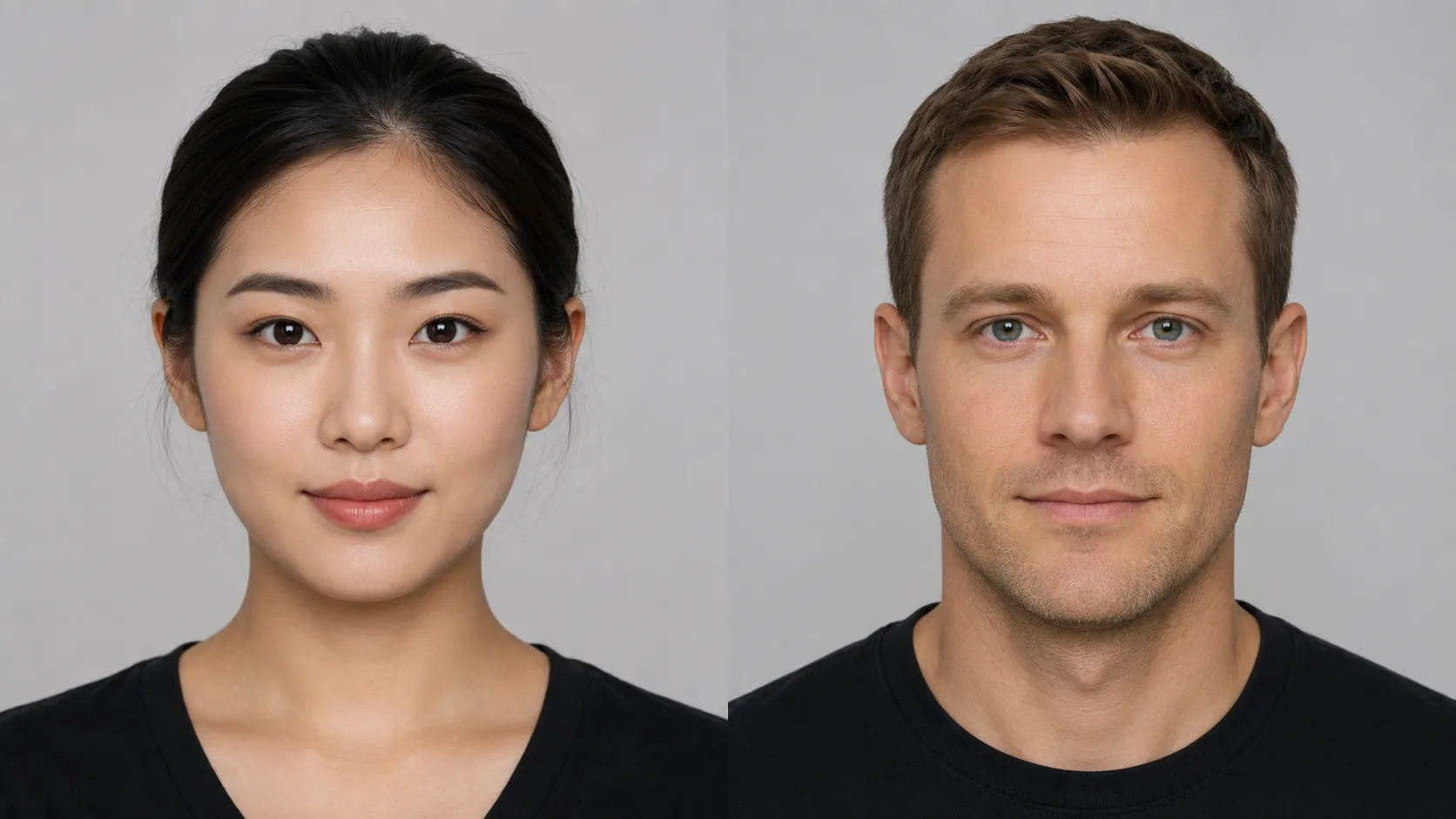
Upload a photo or use your camera
Upload a clear, front-facing photo or take one live with your camera. Even lighting and a neutral expression give the most accurate reading. No account required.
AI maps 478 facial landmarks
MediaPipe's face landmark model runs entirely in your browser, mapping 478 precise points across your eyes, nose, mouth, and jawline. No image data ever leaves your device. Think of it as a facial scanner that reads geometry, not a camera filter that changes your photo.
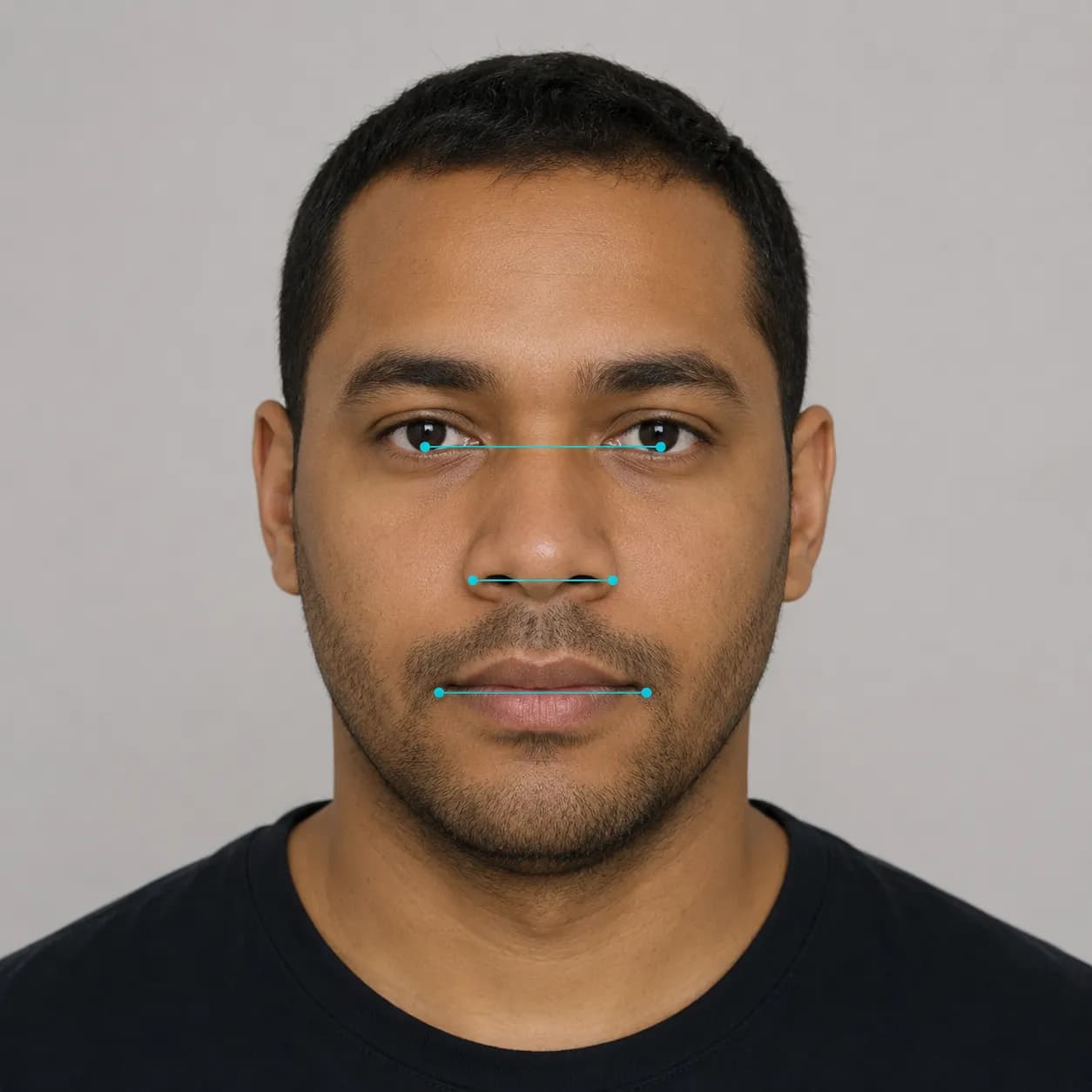
Five proportion ratios are measured
Eye spacing, nose breadth, mouth width, face height-to-width ratio, and facial-thirds balance are each compared against established aesthetic reference ranges used in facial analysis research.
Get your proportional score
Your overall score (0–100) plus a full per-metric breakdown appears instantly, with an option to share or download your result card.
What Your Facial Attractiveness Test Score Measures
Five weighted proportion ratios, each scored against a typical reference range
| Metric | Weight | What it measures |
|---|---|---|
| Eye Spacing | 25% | Inter-ocular distance relative to face width |
| Mouth Width | 25% | Mouth width relative to eye span |
| Nose Breadth | 20% | Alar (nostril) width relative to face width |
| Face Ratio | 15% | Height-to-width proportion of the whole face |
| Facial Thirds | 15% | Balance across the upper, mid, and lower face |
The 0–100 Face Rating Scale
The five weighted ratios above combine into a single face rating out of 100. Here's what each band on that attractiveness scale means:
Exceptional Proportions — every measured ratio falls inside its reference range, indicating unusually balanced facial geometry.
Balanced Proportions — most ratios sit within range, with one or two just outside it. This is a common, healthy result.
Near-Balanced — several ratios deviate moderately from the reference ranges; still a typical, normal-range face shape.
Outside Typical Ranges — proportions diverge more from the reference set. This reflects a different facial structure, not a lower score of worth.
This face rating scale measures proportional balance only. For left-right balance instead, try the Face Symmetry Test — or for a score based on proximity to the classical golden ratio (φ = 1.618) rather than reference ranges, see the Golden Ratio Face Calculator.
Attractiveness Test vs. Asking ChatGPT
A lot of people try asking a general-purpose chatbot like ChatGPT, Gemini, or Grok to rate their attractiveness first. These assistants often decline to give a direct rating, since scoring someone's appearance sits close to their content guidelines, and when they do answer, the response can vary between runs on the exact same photo — because it's a written impression from a language model, not a fixed calculation.
This tool takes a different approach: it plots 478 facial landmarks with MediaPipe and computes five fixed proportion ratios directly from those coordinates, entirely in your browser. Run the same photo through it twice and you get the same score both times, because the result is arithmetic on measured points rather than a model restating an impression.
| General chatbot | This tool | |
|---|---|---|
| Consistency | May vary between runs on the same photo | Same photo, same score every time |
| Privacy | Photo typically sent to a third-party server | Processed on-device, never uploaded |
| Method | Language-based impression | 478-point landmark geometry, 5 measured ratios |
| Cost | Often requires an account or paid tier | Free |
| Sign-up | Usually required | None |
How Attractive Am I? Taking the Picture Test
Because this test measures your actual facial geometry from the pixels in your photo, the photo itself changes what gets measured. A few things to get right before you upload:
- Face the camera directly. An angled or tilted photo distorts the distances between landmarks, which shifts every ratio.
- Use even, front-facing lighting. Harsh shadows can obscure jaw and nose edges the landmark model relies on.
- Keep a neutral expression. A wide smile or raised brows shift the position of the mouth and brow landmarks used in the ratios.
- Skip filters and heavy retouching. Any filter that reshapes your face changes the very geometry being measured — the score will reflect the filtered geometry, not your natural proportions.
None of this is about getting a "better" score — it's about getting an accurate one. A well-lit, neutral, front-facing photo gives the landmark model its clearest read on your actual proportions.
AI Face Rater & Face Rating Tools Compared
"AI attractiveness rater," "AI face scanner," and "AI mog rating" all describe the same broad category: a tool that takes a photo and returns some kind of attractiveness output using AI. In practice, tools in this category split into two different approaches, and it matters which one you're using.
Some tools run your photo through a general-purpose vision-language model and get back a written impression — fast to build, but the output is a language guess, not a measurement, and can vary between runs on the identical photo. Others — including this one — extract actual coordinate data (478 facial landmarks via MediaPipe) and compute fixed geometric ratios from those coordinates. The same photo run twice returns the same score, because it's arithmetic on measured points, not a model's impression restated.
"Mog rating" specifically comes from looksmaxxing slang for how much one face "outshines" (mogs) another in a hierarchy — it's a comparative, community-driven concept rather than a standardized metric. This tool doesn't do face-vs-face comparison or hierarchy ranking; it scores your proportions against reference ranges independent of any other face, so there's no direct "mog score" here — the closest equivalent is your overall 0–100 proportion score. For a deeper geometric breakdown across every facial feature at once, see the Face Analyzer.
Is Beauty Really Measurable?
What proportion-based scoring can and can't tell you
Facial-proportion research has a long history — from the classical idea of the golden ratio to modern psychology studies on "averageness" and symmetry. Studies have found that faces closer to population-average proportions, and faces with more symmetric features, tend to be rated as more attractive on average across large groups of raters.
But "on average across a study population" is very different from "objectively true for every viewer." Perception of attractiveness is also shaped by culture, personal preference, familiarity, expression, and countless factors no geometry-based tool can capture. Two people can have near-identical proportion scores and be perceived completely differently by different people — and that's normal, not a flaw in either face.
This tool reports a genuine geometric measurement — five real proportion ratios extracted from AI-detected facial landmarks — using the same class of reference ranges researchers use in facial analysis studies. What it deliberately does not do is claim to know how attractive you are to any specific person, or reduce your worth to a number. Treat your result as an interesting data point about your facial geometry, not a verdict.
Related Facial Measurements
If proportional balance is interesting to you, other tools on this site measure related but distinct facial properties: Face Symmetry Test (left-right balance), Golden Ratio Face Calculator (classical phi proportions), and age estimation from the same kind of facial landmarks — curious what age you look? Try our AI Age Detector, or for a precise calculated estimate, our Age Calculator.
PSL, Chadlite, and Blackpill Scale: What These Terms Mean
Search around "attractiveness test" long enough and you'll run into a specific vocabulary — PSL scale, chadlite, blackpill — that comes from online looksmaxxing communities rather than facial-analysis research. If you landed here looking for one of those terms, here's how they map to what this tool actually does.
PSL scale (short for a 1–10 community rating system) is a subjective peer-rating convention: other people assign you a number, usually with no fixed methodology behind it. Chadlite and blackpill are informal tiers within that same framework — chadlite describing a rating just below the community's top tier, blackpill referring to a broader worldview within those communities about how much facial appearance determines social outcomes. None of these are measurements; they're social labels applied by other users.
This tool works differently. It doesn't rate you against other people's opinions — it measures five facial-proportion ratios (eye spacing, mouth width, nose breadth, face ratio, facial thirds) against reference ranges used in facial-analysis research, and returns a 0–100 score. It doesn't score jawline definition specifically — for that, see the Face Symmetry Test, which includes a jawline rating as part of its symmetry breakdown. Same general idea — a number for your face — but the number comes from geometry you can see and re-check, not from a stranger's subjective vote.
| PSL / chadlite / blackpill | This tool | |
|---|---|---|
| Scale | 1–10, community-assigned | 0–100, geometry-derived |
| Who scores it | Other forum users | AI landmark detection, on-device |
| Repeatable? | No — varies by rater | Yes — same photo, same score |
| What it reflects | Subjective peer opinion | Measured proportional ratios |
If you came here through "what does looksmaxxing mean" — it's the umbrella term for that community's practices around trying to improve perceived facial attractiveness. We're not affiliated with those communities and don't endorse their rating culture; we're just clarifying the terminology since people search both phrasings for related things. See the disclaimer at the bottom of this page — your score here is a geometric data point, not a verdict on your worth.
Frequently Asked Questions
Everything about the attractiveness test, accuracy, and privacy
How accurate is this attractiveness test?
The test measures real facial geometry — five proportion ratios extracted from 478 AI-detected landmarks — and compares them to reference ranges used in facial analysis research. It is a genuine geometric measurement, but "attractiveness" itself is not a single measurable quantity: this tool reports proportional balance, not a verdict on how attractive you are. Photo angle, lighting, and expression all affect the score.
Does this test store or upload my photo?
No. The AI model downloads once to your browser and every measurement happens locally on your device. Your photo is never uploaded to a server, and nothing is stored once you clear your selection or close the tab.
What does my attractiveness score actually measure?
Five ratios: eye spacing relative to face width, nose breadth relative to face width, mouth width relative to eye span, overall face height-to-width ratio, and the balance across the upper/mid/lower thirds of your face. Each is scored against a typical reference range, then combined into one overall number.
Is beauty really something an AI can measure?
Not fully, and we want to be upfront about that. Facial-proportion research (going back to classical ideas like the golden ratio) has found statistical links between certain proportion ranges and average perceived attractiveness in study populations — but perception of beauty is also shaped by culture, individual preference, personality, and context in ways no geometry-based tool can capture. Treat this score as a fun proportional measurement, not a definitive rating of your appearance.
Is this the same as a "face attractiveness test," "facial attractiveness test," or "facial beauty analysis test"?
Yes — "attractiveness test," "face attractiveness test," "facial attractiveness test," "facial test beauty," "facial beauty analysis test," and "AI attractive test" all describe the same kind of tool: an AI system that scores facial proportions from a photo. This page is that tool, built specifically around facial-geometry ratios rather than a generic beauty filter. The same tool also covers related searches like "ai beauty rating," "attractiveness calculator," "beauty calculator," "attractiveness scale," "beauty scale," and "looks scale" — different names, same five-ratio measurement.
What is a good attractiveness test score?
Scores of 85+ fall in the "Exceptional Proportions" band, 70–84 is "Balanced Proportions," 55–69 is "Near-Balanced," and below 55 is "Outside Typical Ranges." Most real faces land in the 55–85 range — facial proportions vary naturally across individuals, genders, and ethnicities, and a lower score reflects a different structural shape, not a lower worth or attractiveness.
Is this the same as a PSL scale or rating?
In spirit, yes — both give you a numeric attractiveness estimate. The difference is method and scale: this tool scores you out of 100 rather than the 1–10 scale used for what's sometimes called PSL, chadlite, or blackpill scale in some online communities, and the number comes from measured facial-proportion ratios rather than a subjective community rating. Same basic idea — a score for your face — just calculated geometrically instead of judged by other people.
How is this different from a beauty filter or beauty-tester app?
Beauty filters modify your photo (smoothing skin, reshaping features) to change how you look. This tool does the opposite — it never alters your image. It only measures the geometry that's already there and reports the result as a number, with your original photo untouched.
Can I retake the test with a different photo?
Yes, as many times as you like. Different photos — different angles, lighting, or expressions — can shift the measured ratios slightly, which is normal and expected for any geometry-based analysis.
What's the difference between this and the Face Symmetry Test?
The Face Symmetry Test measures left-right balance — how closely the two halves of your face mirror each other. This Attractiveness Test measures proportional harmony — how your face's features are sized and spaced relative to each other. They're related but distinct: a face can be highly symmetric with atypical proportions, or well-proportioned with some asymmetry. The Golden Ratio Face Calculator is a third variant: instead of scoring proportions against typical reference ranges the way this test does, it compares five facial ratios directly to the mathematical constant φ = 1.618 and reports how close each comes to that fixed target. Both tools measure real geometry from AI-detected landmarks — the difference is the math and the kind of number you get back: a 0–100 proportional score here versus a proximity-to-phi result there.
Is there a ChatGPT attractiveness test?
Not a reliable one. General-purpose chatbots like ChatGPT often decline to rate a photo directly, and when they do respond, the answer can vary between runs on the exact same image, since it's a written impression rather than a fixed calculation. This tool takes a different approach — see "Attractiveness Test vs. Asking ChatGPT" above for the full comparison — plotting 478 facial landmarks with MediaPipe and computing five specific proportion ratios directly from the pixel coordinates, entirely in your browser, without sending your photo to any AI model or server.
Am I pretty / attractive / hot / beautiful? Does this test tell me?
Not directly — and no photo-based tool honestly can. What this test tells you is how your facial proportions compare to reference ranges used in facial-analysis research: your eye spacing, mouth width, nose breadth, overall face ratio, and facial-thirds balance, combined into a 0–100 score. Whether that translates to "pretty," "hot," "beautiful," or "attractive" depends on the viewer, culture, context, and factors entirely outside facial geometry — this tool doesn't and can't answer that question, only the proportional-geometry part of it. If you're looking for a quick proportional read rather than a definitive verdict, that's what the score above gives you.
Is this the same as a facescore, face rating app, beauty calculator, or "am I ugly" test?
Yes — "facescore," "face rating," "face valuation," "beauty calculator," "beauty analysis," "attractive AI," and "am I ugly test" all describe tools that return some kind of numeric or categorical attractiveness output from a photo. This page is that category of tool: upload a photo, get a 0–100 proportional score with a per-metric breakdown, calculated the same way regardless of which of those phrases you searched. There's no separate "ugly" or "attractive" label applied — you get the same proportion-ratio methodology and the same score bands (below 55 to 85+) described above, whatever the framing of your search.
Is this face rater free?
Yes, this face rater is completely free to use, with no limit on how many times you can retake it.
Do I need to sign up or download an app?
No. There's no account, no email, and no app to install — it runs directly in your browser as a web page. Upload a photo or use your camera and the score appears in seconds.
Related Tools
Face Shape Detector
Identify your oval, round, square, heart, or diamond shape
Face Symmetry Test
Measure left-right facial balance
Golden Ratio Face Calculator
Measure your phi proportion ratios
AI Age Detector
Curious what age you look? Guess your age from a photo
Age Calculator
Want a precise calculated estimate instead? Try our calculator
Celebrity Look Alike Finder
Find your celebrity doppelganger
Eye Shape Detector
Identify your eye shape type
Nose Shape Detector
Find your nose shape from 12 types
Skin Tone Analyzer
Find your skin tone & undertone
AI Skin Analysis
Find your skin type & concerns
Face Rating Test
A different AI geometry breakdown
Face Analyzer
Run every face analysis in one place
Disclaimer
This score compares your facial proportions to established aesthetic reference ranges using automated AI landmark detection. It is affected by photo angle, lighting, expression, and image resolution. Results are for entertainment and educational purposes only and are not an assessment of attractiveness, health, or worth. Natural variation in facial proportions is universal and normal across every ethnicity and individual. Do not make personal, cosmetic, or medical decisions based on these results.