Face Symmetry Test
Upload a photo to check your facial asymmetry — our free facial symmetry checker instantly scores how balanced your eyes, nose, mouth, jaw, and brows are, and shows whether you have an asymmetrical face or a naturally balanced one. Scroll the results panel to also run the beauty symmetry test, face rater, and jawline rating — all from the same photo, no sign-up, fully private.
Face Symmetry Checker: Is My Face Symmetrical?
Five steps from photo to score — all processed locally on your device.
This face symmetry checker answers “is my face symmetrical?” by comparing your left and right sides directly. It maps your facial landmarks, computes a vertical midline, then measures how far each left–right pair sits from that line across five feature groups — eyes, eyebrows, nose, mouth, and jaw.
Upload or take a photo
Upload a clear, front-facing photo or use your device camera directly in the browser. No sign-up or account needed.
AI maps 478 facial landmarks
MediaPipe Face Landmarker runs entirely in your browser and plots 478 precise points across your face — all processing stays on your device.
Auto-level corrects head tilt
The analyzer detects any roll angle and rotates the landmark map so measurements are taken from a perfectly level baseline.
Per-feature symmetry is computed
Each left–right landmark pair is compared for horizontal distance from your facial midline and vertical alignment. Deviations are combined into feature scores for eyes, eyebrows, nose, mouth, and jaw.
Your score report is ready
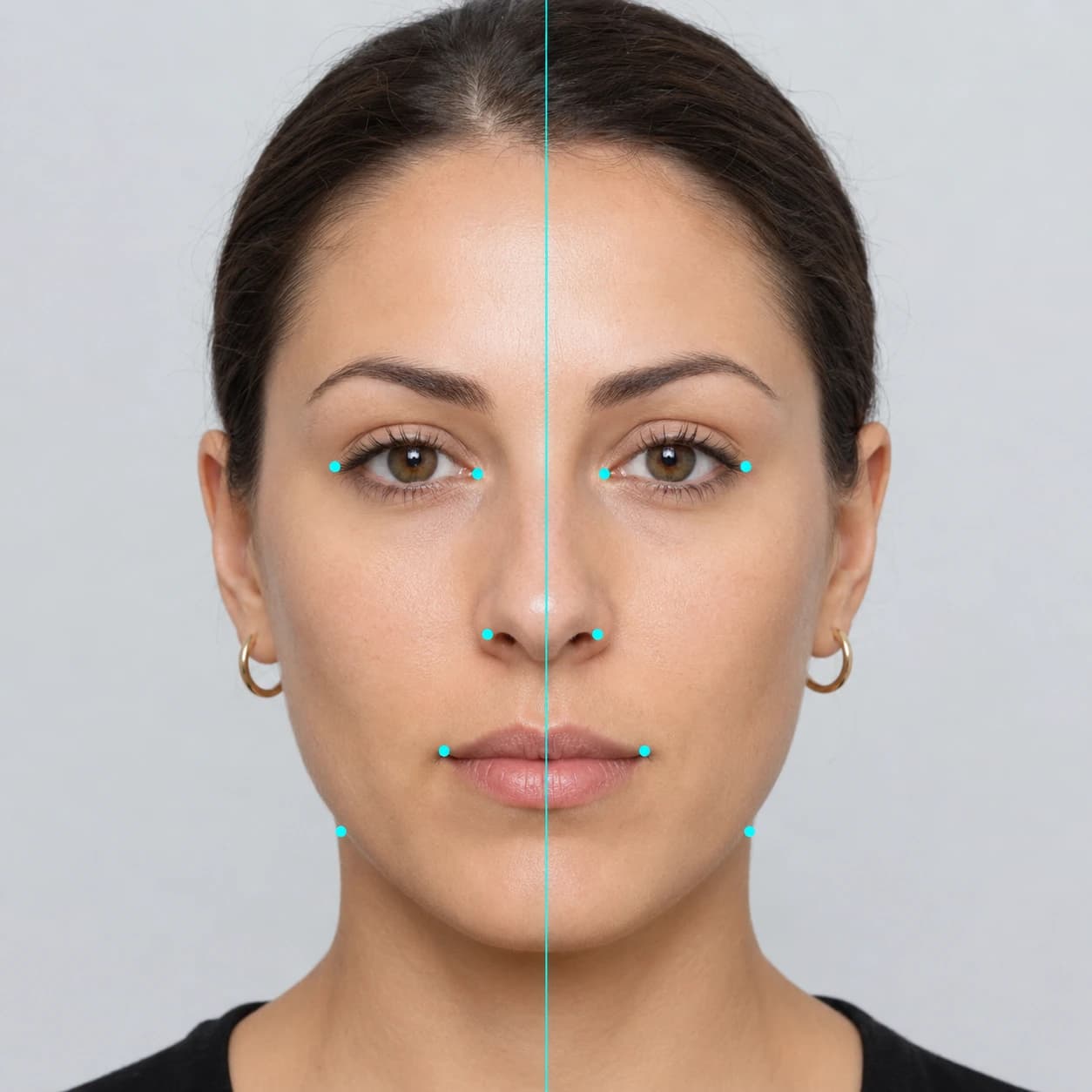
A weighted overall score and per-feature breakdown appear alongside a midline overlay showing exactly which points were compared.
Reading your results: each group gets its own percentage, so a low overall score doesn't mean every feature is off — check each group against the score bands below.
What the Test Actually Analyzes
Five feature groups — each scored independently then combined into a weighted overall result.
Eyes
- ·Inner corner horizontal offset from midline
- ·Outer corner horizontal offset from midline
- ·Upper and lower eyelid openness (vertical)
- ·Eye width balance (left vs right)
Eyebrows
- ·Arch peak height above each eye
- ·Brow start position (inner end)
- ·Brow end position (outer tail)
- ·Overall brow elevation difference
Nose
- ·Nose tip deviation from facial midline
- ·Left and right alar (nostril) base width
- ·Alar base horizontal balance
- ·Nasal bridge alignment to midline
Mouth
- ·Left and right mouth corner heights
- ·Mouth corner horizontal symmetry from midline
- ·Lip width balance (left vs right of center)
- ·Philtrum alignment
Jaw & Chin
- ·Paired cheek outline points (left vs right)
- ·Jaw angle positions (horizontal offset)
- ·Chin tip deviation from midline
- ·Lower face contour balance
Score Weights
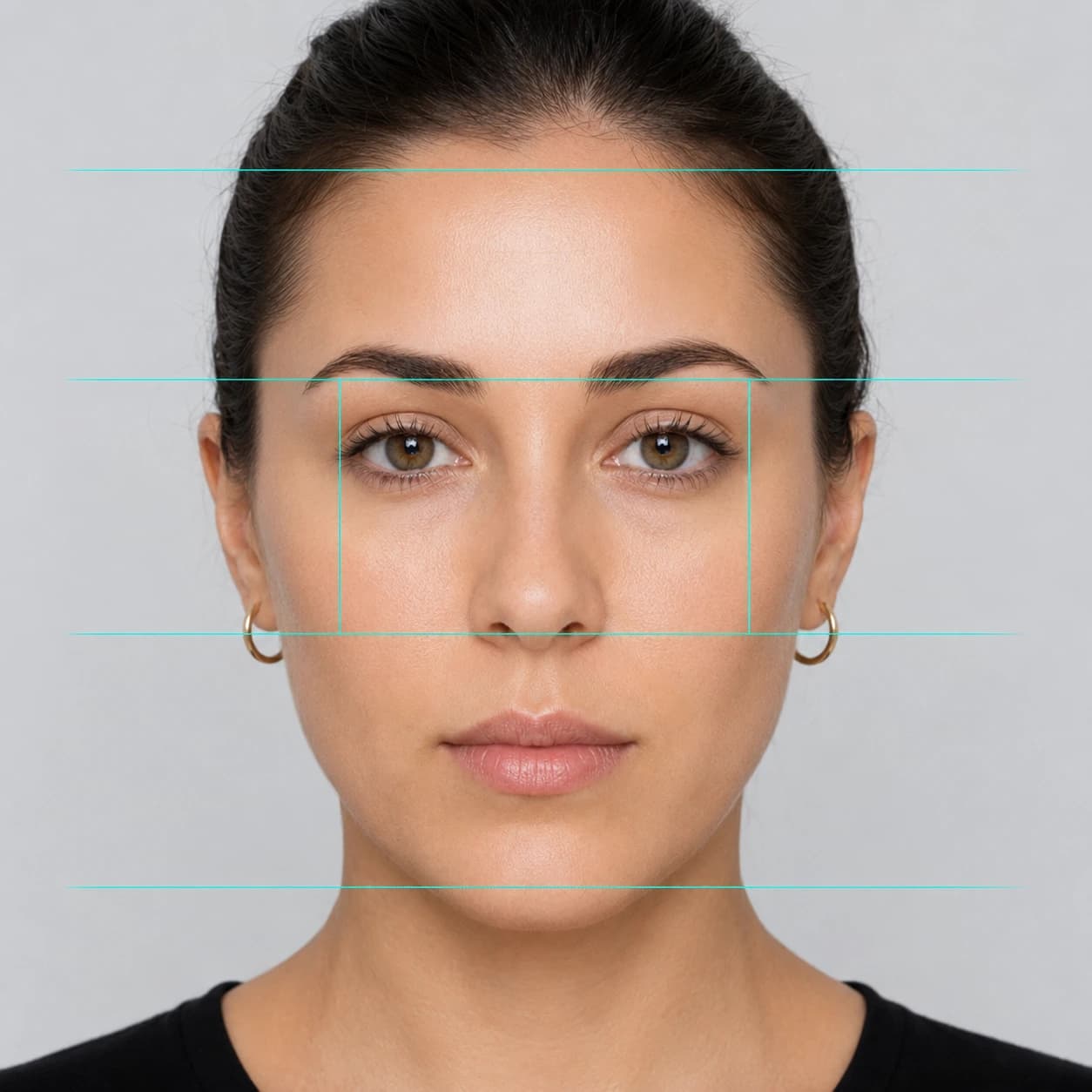
This left-right breakdown is one way to check symmetry of face proportions — but it's not the only dimension. A separate concept, facial thirds, looks at vertical balance instead: dividing the face into upper (hairline to brow), middle (brow to nose base), and lower (nose base to chin) zones and comparing their heights. A face can be left-right symmetric while having uneven facial thirds, or vice versa. This page focuses on left-right symmetry; a dedicated facial thirds test is part of the facial thirds measurement in our Attractiveness Test.
What Your Symmetry Score Means
Context for each score range — and what to do if your result surprises you.
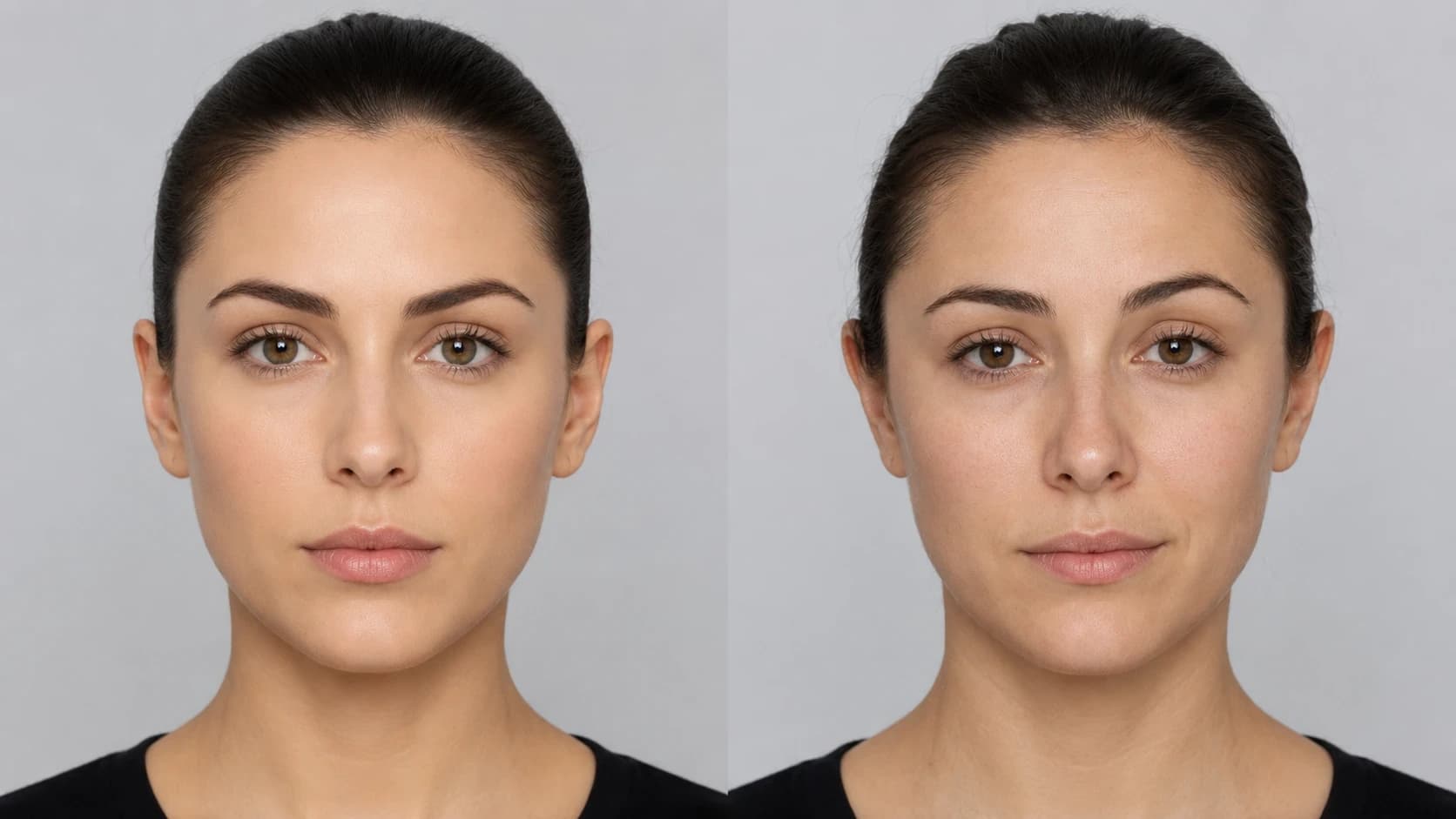
Features are exceptionally balanced on both sides. This range is rare — estimated at fewer than 10% of people. A clear, well-lit, front-facing photo is needed to confirm this score.
The most common range — the majority of people score here. Minor natural variation is present but imperceptible to others in conversation. This is the normal human baseline.
Measurable imbalance detected. This is often caused by photo conditions: angled shot, side lighting, or a strong expression shifting landmark positions. Re-test with a better photo before drawing conclusions.
Strong imbalance detected. Most cases in this range are caused by photo quality — off-angle, side lighting, or heavy expression. If consistent across multiple good photos, consider noting for a healthcare provider if concerned.
How to Take the Perfect Photo
Most unexpected results come from photo conditions, not actual facial asymmetry. Follow these tips for an accurate score.
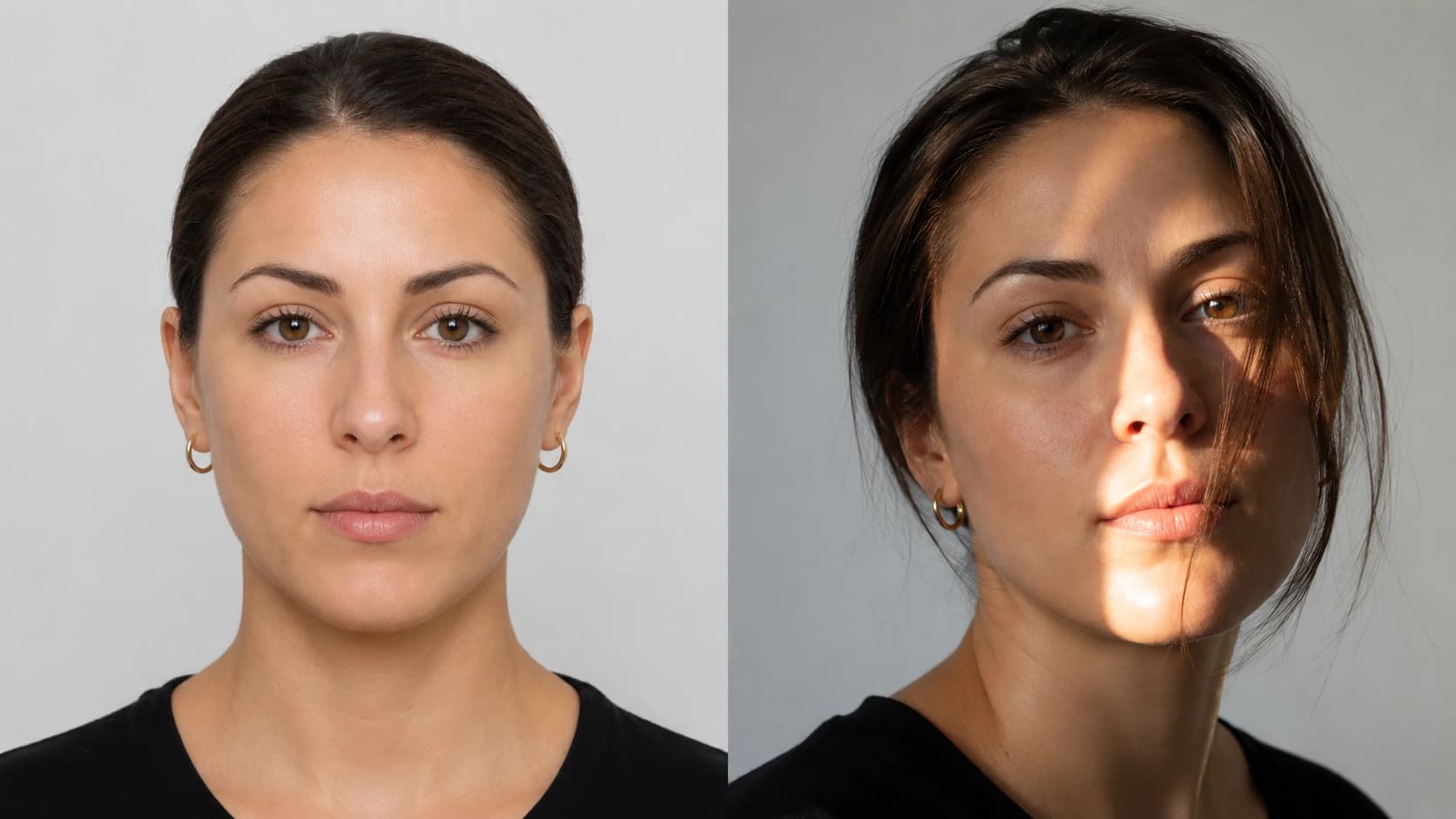
Face the camera directly
Full frontal — chin level, not tilted up or down. Even small angles skew all left–right comparisons.
Keep eyes level
Avoid tilting your head sideways. The auto-level feature corrects minor tilts, but large tilts can mislead the landmark mapping.
Use a neutral expression
A relaxed face or very slight smile. Strong expressions (wide smile, frown, raised brows) shift landmark positions and lower accuracy.
Even, natural lighting
Soft daylight from in front is ideal. Hard side-lighting throws shadows across one half of the face and creates false asymmetry in the score.
Pull hair back
Hair covering one eyebrow, ear, or cheek introduces one-sided occlusion that the AI interprets as asymmetry.
Remove glasses
Glasses frames often overlap with eye corner landmarks. Remove them for the photo to get your eye measurements.
Use the front-facing camera
Selfie cameras on modern phones work well. Avoid very wide-angle lenses at close range — lens distortion can affect landmark positions at the image edges.
Avoid heavy contouring
Extreme contouring and heavy foundation can shift the perceived edge of the face, affecting jaw and cheek landmark positions.
If your score seems very low: retake the photo in natural light, facing the camera directly with a neutral expression. A score below 60% from a perfectly taken photo is unusual and worth investigating.
Frequently Asked Questions
Everything you need to know about facial symmetry and how this tool works.
What is a face symmetry test?
A face symmetry test uses AI to measure how balanced the left and right sides of your face are. It maps hundreds of facial landmarks and compares corresponding points — eye corners, brow positions, nose alae, mouth corners, and jaw contour — to produce a score from 0 to 100%.
What is a good face symmetry score?
Scores of 85% or above are considered highly symmetric. Most people score between 70% and 84% ("typically symmetric"), which is completely normal. Scores of 55–69% indicate noticeable asymmetry, and below 55% suggests significant asymmetry — though this can also result from photo angle or lighting.
Is facial asymmetry normal?
Yes — virtually every human face is asymmetric to some degree. In fact, perfect symmetry is extremely rare in nature. Natural asymmetry is caused by genetics, how we sleep, which side we chew on, dominant hand use, and many other factors. Slight asymmetry is a hallmark of a real, human face.
Does face symmetry equal attractiveness?
Research suggests a modest correlation, but it is far from deterministic. Many people with notable asymmetry are considered very attractive, and attractiveness is influenced by far more factors — expression, skin, character, proportion, and personal taste. This tool does not make any attractiveness judgments.
How accurate is this facial symmetry calculator?
Accuracy depends heavily on photo quality. A clear, well-lit, front-facing photo with a neutral expression will yield the most reliable score. Tilted heads, off-angle shots, shadows across one side of the face, strong expressions, or glasses can all reduce accuracy. The auto-level feature corrects for minor head tilts automatically.
Why does my score vary between photos?
Lighting direction, head angle, expression, and camera lens distortion all affect landmark positions and thus symmetry scores. For the most consistent results, use a front-facing photo in even, natural light with a neutral or slight-smile expression. Avoid strong side lighting or wide-angle lenses at close range.
Is my photo stored or shared?
No. All processing happens entirely in your browser using MediaPipe — your photo never leaves your device and is not uploaded to any server.
What facial features are analyzed?
The test analyzes five feature groups: Eyes (outer corners, inner corners, eyelid openness), Eyebrows (arch height and position), Nose (tip position relative to midline, alar base width), Mouth (corner heights and width balance), and Jaw / Chin contour (paired cheek and jaw outline points). Each group contributes to the overall weighted score.
What causes facial asymmetry?
Facial asymmetry has multiple causes. Genetic factors are primary — the genes guiding facial development produce inherently asymmetric results. Environmental factors during development (in-utero position, sleeping side preference, dominant chewing side) add to this. Injuries, dental changes, muscle overuse on one side, and ageing all contribute further asymmetry over time.
Can facial asymmetry be corrected?
Natural anatomical asymmetry can be addressed cosmetically through contouring makeup, strategic hairstyles, and glasses frames that balance proportions. Clinical options include orthodontics (which can affect jaw position), fillers (to balance volume), or surgical procedures for significant anatomical differences. This tool cannot advise on treatment — consult a qualified practitioner for clinical concerns.
Does asymmetry worsen with age?
Generally yes — subtle asymmetries become more pronounced with age as collagen loss, gravity, sun exposure, and repeated facial muscle use (which tends to be stronger on the dominant side) create different effects on each side of the face. Sleeping consistently on one side also increases asymmetry over decades.
Is a perfectly symmetric face actually more attractive?
Research is nuanced here. While high symmetry correlates modestly with attractiveness ratings on average, studies also show that perfectly mirrored faces often appear unsettling ("uncanny"). Character, expression, and individuality — all of which involve asymmetry — are strongly weighted in real-world attractiveness. This test measures geometry, not beauty.
Which side of the face is typically more symmetric?
Studies suggest the left side of the face (as viewed by the subject) tends to be perceived as more expressive and is used more often in emotional expression, while no side is consistently more "symmetric" across populations. Individual variation dominates — your score report breaks down which feature pairs showed the most deviation.
Can makeup or hairstyle affect my score?
Yes — heavy contouring reshapes perceived facial edges (affecting jaw and cheek landmarks), bold brow makeup shifts brow position readings, and hair covering one side of the face introduces artificial occlusion the AI may interpret as asymmetry. For the most accurate anatomical score, photograph your natural face in minimal makeup.
What does the midline overlay show?
The midline overlay draws the computed vertical axis of your face based on symmetrical reference points (brow centres, nose bridge, lip centre, chin). Left–right landmark pairs are then shown as dots, letting you see visually which features sit closer to or further from the midline on each side.
Can I use this to diagnose a medical condition?
No. This tool is for entertainment and educational use only. Facial asymmetry can sometimes be associated with medical conditions, but this AI tool cannot diagnose, detect, or rule out any health condition. If you are concerned about sudden or significant facial asymmetry, please consult a qualified healthcare professional.
How can I improve my symmetry score?
The score is a measurement, not a prescription. Natural asymmetry cannot be "fixed" from a photo. That said, improving photo conditions — even lighting, level head position, neutral expression, and a higher-quality front-facing camera — will give a score that more accurately reflects your natural symmetry.
What score counts as good facial symmetry?
70% and above is considered normal to good facial symmetry. 85%+ is highly symmetric and relatively rare. The most important thing to know is that almost no one scores 100%, and a score in the 70–84% range is the typical result for a healthy human face photographed correctly.
How do you do a face symmetry test?
To do a face symmetry test on this page: (1) take or upload a clear, front-facing photo in even lighting with a neutral expression; (2) drop it into the face symmetry checker above; (3) wait 2–3 seconds while AI maps 478 facial landmarks; (4) read your overall symmetry score and per-feature breakdown. The whole process takes just seconds, with no sign-up required.
How do you test face symmetry?
The most accurate way to test face symmetry is with an AI landmark tool like this one — it maps precise geometric coordinates across your face and computes left-to-right balance mathematically. A rough manual approach is to photograph your face straight-on and cover each half in a photo editor to compare the two sides. The AI test is more reliable because it measures actual coordinate distances rather than visual impression.
How do you test your face symmetry?
Upload a front-facing photo using the symmetry checker at the top of this page. For the most accurate result: use natural frontal lighting (not side-lit), keep your head level, use a neutral or slight-smile expression, and remove glasses. The tool auto-corrects for minor head tilt. Your symmetry score appears within seconds of uploading.
Can you rate my face?
Yes — scroll down to the Face Rater section on this page, or take the symmetry test above and scroll within the results panel. The face rater scores your facial proportions on a 0–100 scale using the same photo: interocular spacing, nose-to-face height ratio, mouth width, face length ratio, and facial thirds balance. This is a proportional geometry score, not a rating of attractiveness or beauty. The symmetry test and the face rater measure different things — symmetry is about left–right balance; the rater is about proportional harmony.
Is my face symmetrical if my score is below 70?
Not necessarily a cause for concern — a score below 70% is common and usually reflects photo conditions rather than unusual facial structure. Head tilt, side lighting, an off-center camera angle, or a strong expression can all pull a naturally typical face below the 70% "typically symmetric" band. Before drawing any conclusion, retake the photo following the guide below: front-facing, even lighting, neutral expression. If the score stays consistently low across several good photos, that reflects your natural asymmetry, which is itself completely normal — most faces have some.
What Is a Perfectly Symmetrical Face?
Facial symmetry describes how closely the left and right halves of a face mirror each other across its vertical midline. In measurement terms, perfect facial symmetry would mean every paired landmark — left and right eye corners, brow peaks, alar base points, mouth corners, jaw angles — sits at exactly zero deviation from that computed midline. No face achieves this. Minor genetic variation, developmental noise, and asymmetric muscle use over a lifetime mean a truly perfectly symmetrical face does not exist in nature, even among people who score highest on this test.
So what do faces that are symmetrical actually have in common? Not zero deviation, but consistently small deviation across most feature pairs — eyes that sit at similar heights and widths from the midline, a mouth with balanced corner heights, and a jaw contour that doesn't pull noticeably to one side. That is what is a symmetrical face in practice: not mathematically identical halves, but closely matched ones.
Researchers studying facial symmetry use the concept of fluctuating asymmetry — small, random deviations from perfect symmetry that accumulate during development. High fluctuating asymmetry is hypothesised to reflect developmental instability caused by genetic or environmental stress, while low asymmetry suggests developmental buffering and robustness. This is the basis of the proposed link between symmetry and health signals — though the effect in humans is modest and far from a reliable individual predictor.
Our tool uses Google MediaPipe's Face Landmarker, a machine-learning model trained on millions of diverse faces to locate 478 landmark points with sub-pixel precision. The symmetry score is computed geometrically: for each paired landmark, the tool measures how far each point sits from the computed facial midline and combines these deviations into the feature scores and weights shown above.
All computation is local — your photo never leaves your device. No image data is transmitted to any server. The result you see is generated entirely within your browser tab and discarded when you close it.
Bone structure and development
The skeleton sets the hard limits of facial symmetry. Jaw alignment, orbital depth, and zygomatic arch position are largely inherited traits. When the genetic programs guiding craniofacial development unfold identically on each side — and are undisturbed by developmental stress — the result is high skeletal symmetry that cosmetics and soft tissue cannot fundamentally change.
Muscle balance and sleeping posture
Repeated asymmetric muscle use is the most common driver of soft-tissue asymmetry in adults. Chewing predominantly on one side, sleeping with the face pressed to a pillow on the same side for years, and dominant-hand use all cause one side to develop slightly more than the other — compounding gradually across decades. This is why the facial symmetry test score often differs between a person in their twenties and their fifties.
Skin, volume, and ageing
Collagen loss, UV exposure, and gravity act on each half of the face at slightly different rates depending on posture habits, sleeping position, and cumulative sun exposure patterns. Volume shifts and skin laxity therefore rarely mirror each other perfectly in older adults, amplifying the underlying skeletal asymmetry that was always there.
Proportion vs symmetry
Symmetry (left–right balance) and proportion (feature size ratios) are related but distinct dimensions of facial aesthetics. A face can be highly symmetric yet have features that sit outside conventional proportional ranges — and vice versa. The face rater below measures the proportional dimension separately.
Facial structure goes hand-in-hand with symmetry. If you want to go further, our face shape detector uses the same MediaPipe landmarks to identify whether you have an oval, round, square, heart, diamond, oblong, or triangle face shape — then recommends the best hairstyles and glasses for your proportions.
Can You Make Your Face More Symmetrical?
Skeletal symmetry is fixed by adulthood, but some habits affect soft-tissue asymmetry and your score. If you're wondering how to make my face symmetrical, here are the levers:
- Sleep position: alternating sides avoids years of one-sided pressure on the jaw and cheek.
- Chewing habits: favoring one side builds jaw-muscle asymmetry over time; alternate sides.
- Posture: habitually tilting your head to one side can add perceived tilt in photos.
- Grooming: brow shaping, beard trimming, and hair parting can balance — or exaggerate — asymmetry.
- Photo factors: lens distortion, head tilt, and uneven lighting can make a face look more asymmetric than it is — see the photo guide below.
For more lasting changes, some explore orthodontics or fillers — consult a qualified professional for any procedure.
Face Rater
How the face rater scores your photo
The face rater measures something distinct from the facial symmetry test above. Where the symmetry test asks “how matched are my two halves?”, the face rater asks “how close are my facial proportions to classically balanced ratios?” — a separate and equally valid dimension of facial analysis.
Using the same 478-point landmark map from your photo — no second upload required — the rater computes five proportional ratios: interocular distance relative to total face width; nose breadth relative to face width; mouth width relative to interocular distance; face height-to-width ratio; and the balance of the face's horizontal thirds (upper, mid, and lower face). Each ratio is compared to established aesthetic reference ranges. The result is an overall proportional score from 0–100, plus a per-ratio breakdown.
This is a geometric measurement for curiosity and entertainment. It does not assess attractiveness, health, or aesthetic value, and should not be used to make personal or cosmetic decisions. Take the symmetry test above to see your face rater score in the results panel.
Want the full breakdown as a dedicated result page with a shareable score card? Take the standalone face rater →
Jawline Rating
How your jawline definition is scored
The jawline rating uses the same landmark data from your photo to assess the definition and angular sharpness of your jaw contour — no re-upload needed. Where symmetry and proportion measure balance and ratio, the jawline rating measures geometric definition: how clearly the jaw angles and chin point are expressed relative to the overall face structure.
Four sub-scores are computed: jaw width proportion (jaw span relative to cheek width); chin definition (chin prominence relative to the jaw-angle baseline and face height); jaw angle sharpness (the gonial angle approximated from jaw-corner and cheek landmarks); and jaw taper (how the jaw width relates to the face's widest point). These are combined into a single jawline definition score.
A higher score indicates a sharper, more angular jaw transition. Neither a high nor a low score is inherently better — jaw shape is a matter of individual proportion, not health or attractiveness. For context on how your jaw shape relates to your overall face outline, see the face shape detector.
Related Tools
Face Shape Detector
Discover your oval, round, square, or heart face shape
Eye Shape Detector
Find your eye shape — almond, round, hooded, and more
Lip Shape Analyzer
Identify your lip type with personalised styling tips
Golden Ratio Face Calculator
Calculate your face beauty ratio and phi proportions vs φ = 1.618
Color Season Analysis
Discover your seasonal color palette and best shades
AI Age Detector
Curious what age you look? Guess from a photo with AI
Age Calculator
Want a precise calculated estimate instead? Try our calculator
Attractiveness Test
Get your AI facial proportion score
Nose Shape Detector
Find your nose shape from 12 types
Best Sunglasses for Your Face Shape
Frame shapes that flatter your specific face shape
Best Earring Styles for Your Face Shape
Earring lengths and shapes that flatter your face shape
Best Glasses Frames for Your Face Shape
Eyeglasses frame shapes that flatter your specific face shape
Face Analyzer
Run every face analysis in one place