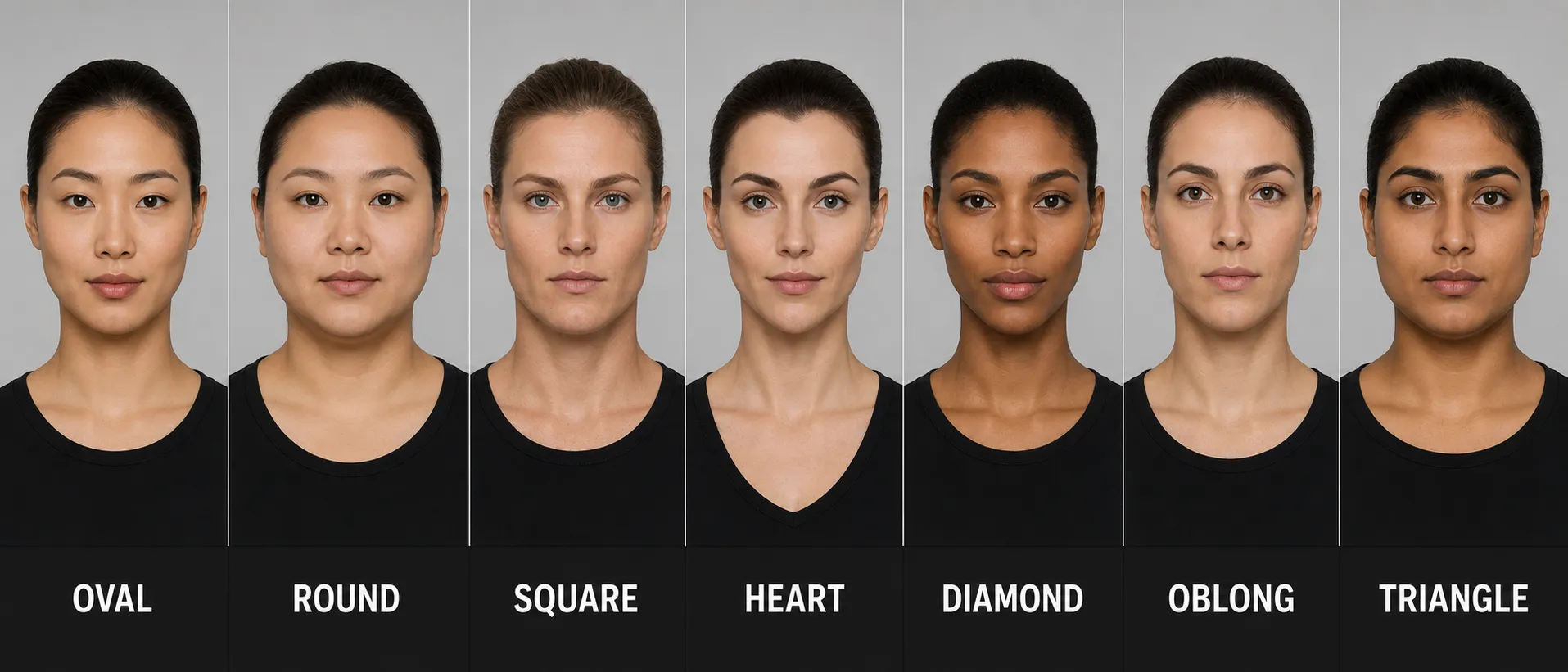
Understanding Face Shapes

Learn how different face shapes are identified and how proportions influence hairstyles, glasses, and overall appearance.

How Face Shapes Are Identified

Face shape is determined by comparing proportions between key facial landmarks rather than focusing on a single feature.

Manual methods such as mirrors or photos are often unreliable, while AI detection looks at relative ratios to give accurate identification.

Oval

Oval faces are considered the most balanced face shape. The face length is about one and a half times the width, with a gently rounded jawline and hairline.

Key Characteristics

  • Face length is greater than cheekbone width
  • Forehead is wider than the jawline
  • Balanced and proportionate features
  • Gently rounded chin and hairline

Suitable Styles

  • Most hairstyles and glasses frames work well
  • Can experiment with various looks
  • Angular frames add definition
  • Both long and short hairstyles are flattering

Round

Round faces have soft, curved lines with similar width and length measurements. The cheeks are often the widest part of the face with a rounded chin.

Key Characteristics

  • Face width and length are nearly equal
  • Full, rounded cheeks
  • Soft, curved jawline
  • Less prominent cheekbones

Suitable Styles

  • Angular frames add definition
  • Hairstyles with height on top elongate the face
  • Side-swept bangs create angles
  • Avoid round glasses that emphasize roundness

Square

Square faces have a strong, angular jawline and a broad forehead of similar width. The face length and width are approximately equal.

Key Characteristics

  • Strong, defined jawline
  • Broad forehead
  • Face width and length are similar
  • Angular features throughout

Suitable Styles

  • Round or oval frames soften angular features
  • Soft, layered hairstyles balance strong jaw
  • Side parts and waves add softness
  • Avoid geometric or square frames

Heart

Heart-shaped faces have a wider forehead and cheekbones that taper to a narrow, pointed chin. The face resembles an inverted triangle.

Key Characteristics

  • Wide forehead and cheekbones
  • Narrow, pointed chin
  • Face tapers from top to bottom
  • Prominent forehead

Suitable Styles

  • Bottom-heavy frames balance the forehead
  • Chin-length hairstyles add width to lower face
  • Side-swept bangs minimize forehead width
  • Avoid top-heavy glasses or styles

Diamond

Diamond faces have high, dramatic cheekbones with a narrow forehead and jawline. The face is widest at the cheekbones.

Key Characteristics

  • High, prominent cheekbones
  • Narrow forehead and jawline
  • Widest at cheekbones
  • Angular and sculpted appearance

Suitable Styles

  • Oval or cat-eye frames complement cheekbones
  • Hairstyles with width at chin level balance features
  • Side-swept styles soften angles
  • Highlight beautiful cheekbones

Oblong

Oblong faces are longer than they are wide, with a straight cheek line. The forehead, cheekbones, and jawline are approximately the same width.

Key Characteristics

  • Face length is notably longer than width
  • Forehead, cheeks, and jaw are similar width
  • Straight cheek lines
  • Long, narrow appearance

Suitable Styles

  • Wide frames add width to the face
  • Bangs or fringes shorten face length
  • Layered hairstyles at cheek level add width
  • Avoid narrow or small frames

Triangle

Triangle faces have a narrow forehead that widens at the cheeks and jawline. The jaw is the widest part of the face.

Key Characteristics

  • Narrow forehead
  • Wide jawline and chin
  • Face widens from top to bottom
  • Strong lower face

Suitable Styles

  • Top-heavy frames balance the jaw
  • Hairstyles with volume on top add width
  • Side parts create visual width at forehead
  • Avoid bottom-heavy glasses

Common Face Shape Misidentifications

  • Oval vs. Oblong: Both are longer than wide, but oblong faces are noticeably longer relative to width, while oval faces remain balanced.
  • Round vs. Square: These shapes share similar proportions, but square faces have sharper jawlines and straighter edges.
  • Heart vs. Triangle: Heart shapes are wider at the forehead, while triangle shapes are widest at the jawline.

Frequently Asked Questions

Can someone have more than one face shape?
Yes. Many people share traits from multiple face shapes.

Does weight affect face shape?
Weight can change facial fullness, but underlying bone structure usually remains.

Is AI detection more accurate?
AI-based detection reduces subjectivity by analyzing facial proportions.

Ready to Discover Your Face Shape?

Our AI-powered face shape detector helps you identify your closest matching face shape with accuracy and confidence.

Try Face Shape Detector