Golden Ratio Face Calculator
Upload a photo for an instant face beauty ratio test and golden ratio face test — powered by AI. Our free golden ratio face calculator measures five classical face phi ratios to calculate your face beauty ratio, facial harmony, and beautiful face ratio vs the divine proportion (φ = 1.618). Educational and historical — not a face rating or beauty verdict.
Golden Ratio Face — Definition
A golden ratio face is a face whose key proportion ratios — such as face length ÷ face width or mouth width ÷ nose width — are close to φ = 1.618, the golden ratio (also called the divine proportion or phi). This free golden ratio face calculator measures five such ratios from your photo and scores each against φ. It is a classical proportion guide based on Renaissance art theory — not a measure of beauty or attractiveness.
Classical Proportion Analysis
AI-mapped facial grid · front, ¾ & profile angles
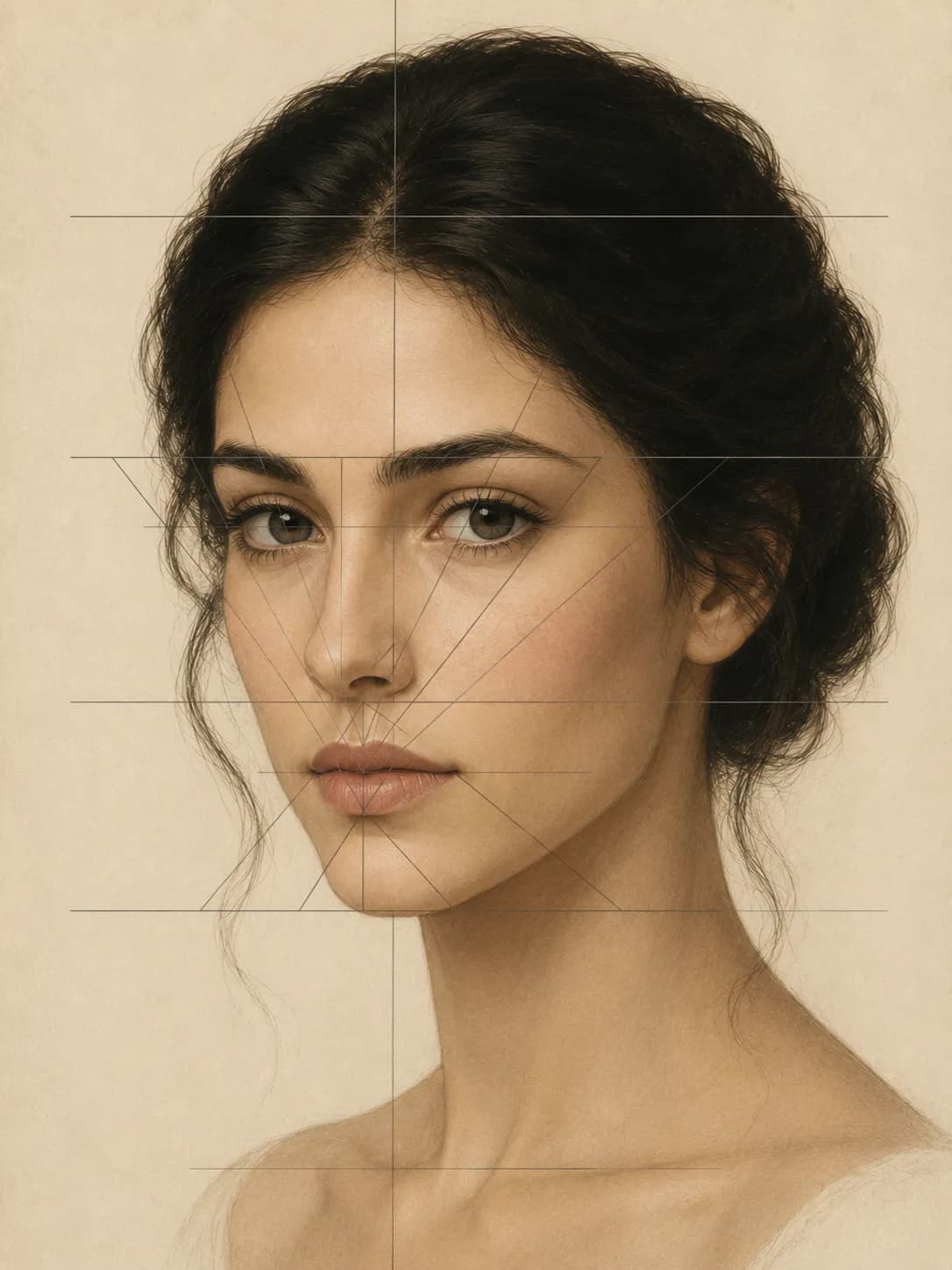
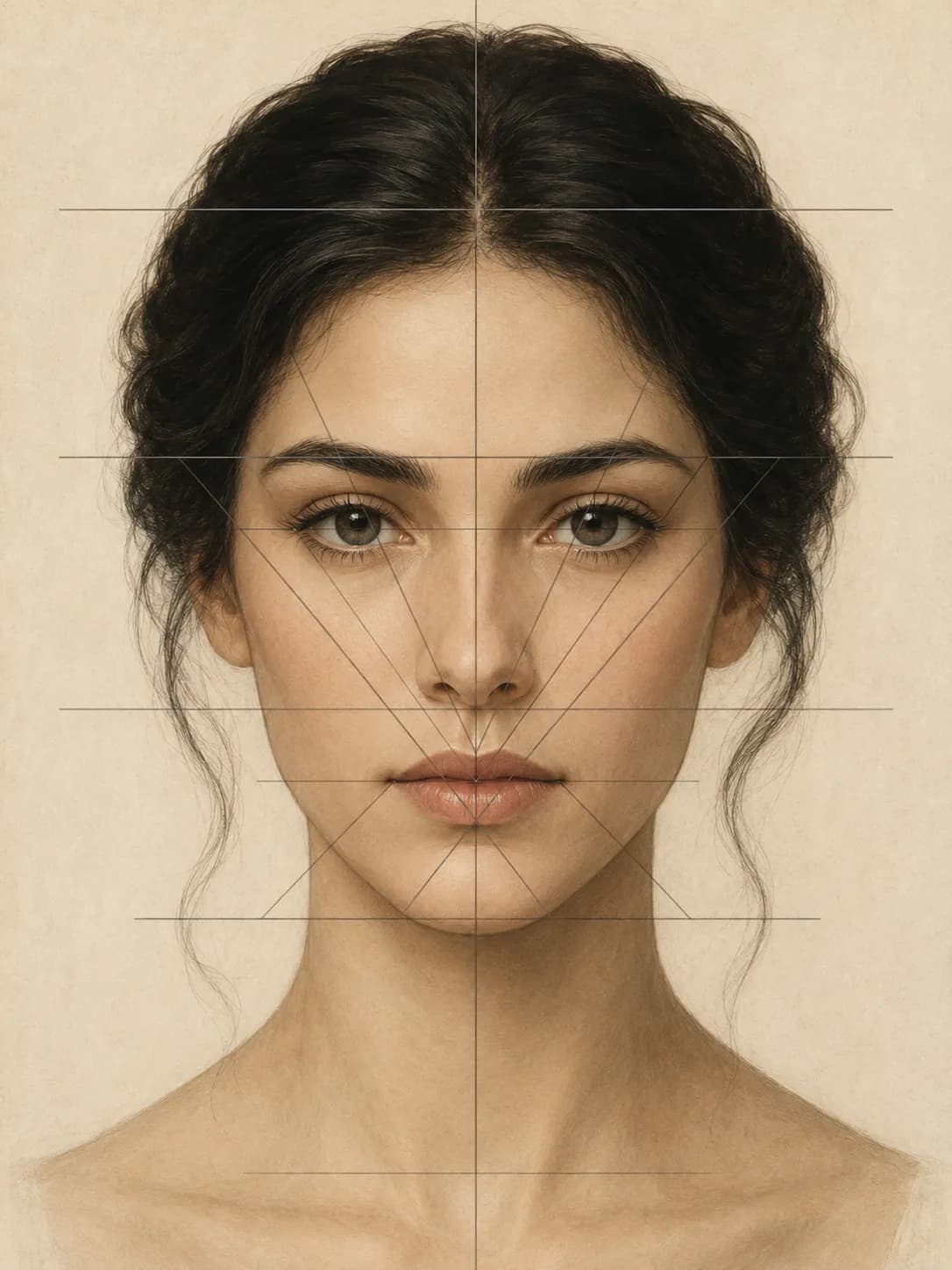
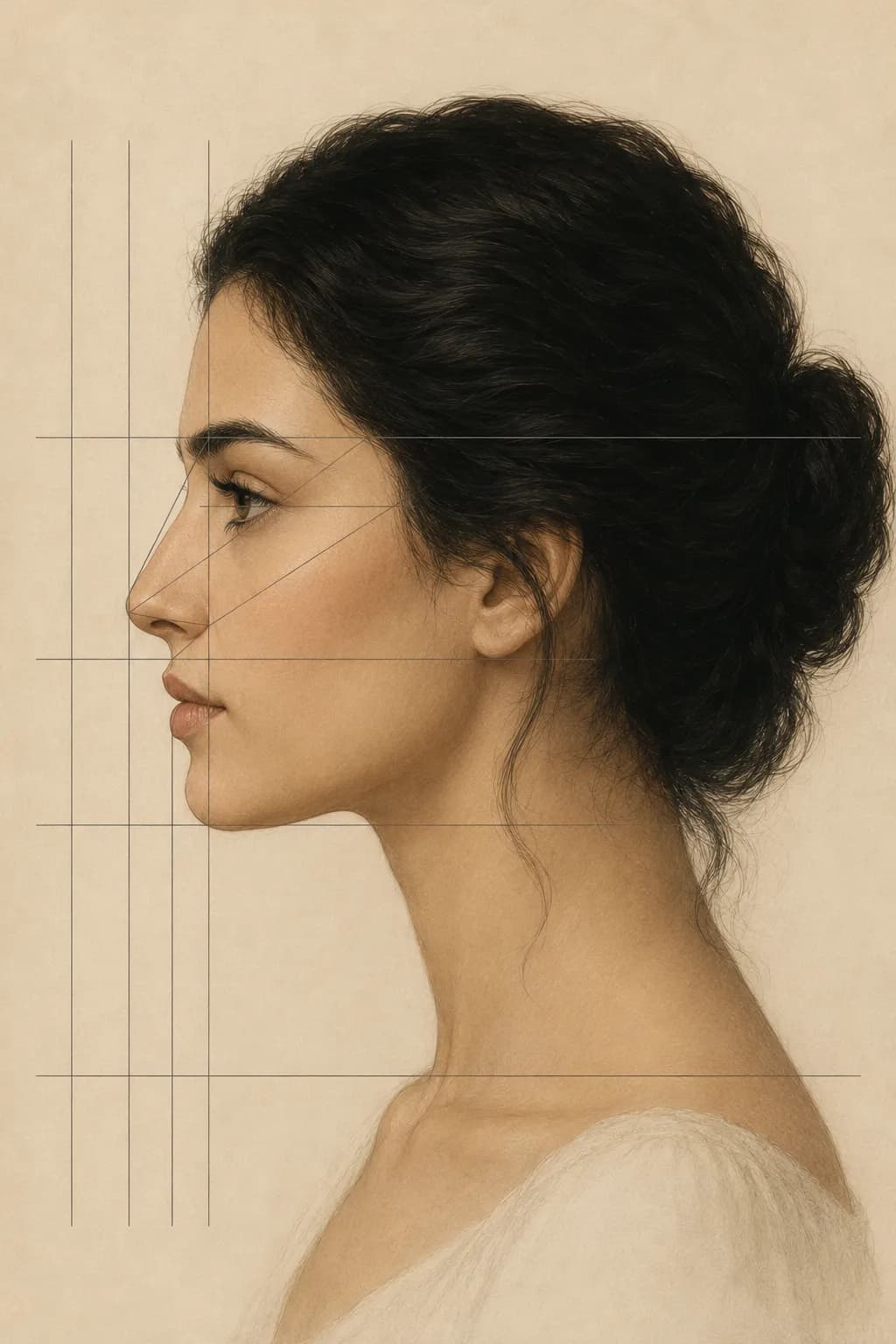
Loading calculator…
How It Works
From photo to phi ratio report in seconds — all processed locally on your device.
Upload or take a photo
Use the golden ratio face calculator upload photo option or take a photo with your device camera directly in the browser. A clear, front-facing shot in even lighting gives the most accurate phi ratio calculation. No account needed.
AI maps 478 facial landmarks
The same MediaPipe Face Landmarker used across this site plots 478 precise landmark points on your face — all computation stays on your device.
Five phi ratios are computed
Face length to width, mouth to nose width, eye span to nose width, lips-to-chin to nose-to-lips, and pupil span to mouth width — each compared to φ = 1.618.
Your proportion report is ready
A per-ratio breakdown shows the measured value, deviation from 1.618, and a proximity score. A canvas overlay marks each measurement pair on your photo.
What Is the Golden Ratio Face?
How φ = 1.618 came to define classical facial beauty — and what modern science actually says about it
Ancient Greece
~300 BCE
Euclid formalised the golden section in Elements as the "extreme and mean ratio"
Renaissance
1509 CE
Luca Pacioli's De Divina Proportione, illustrated by Leonardo da Vinci, applied φ to the human form
Modern claim
1999
Dentist Stephen Marquardt popularised the "golden ratio face mask" as a universal beauty template
Research today
2000s – present
Peer-reviewed studies find symmetry and averageness — not phi proximity — predict attractiveness
The Historical Claim
The golden ratio (φ = 1.6180339…) appears when a line is divided such that the ratio of the whole to the larger part equals the ratio of the larger part to the smaller. Applied to faces, the theory holds that a golden ratio face — one whose key proportions cluster near 1.618 — is perceived as more harmonious. The idea was formalised in Pacioli's 1509 De Divina Proportione and later popularised by Stephen Marquardt's phi mask in the 1990s.
What Researchers Find
Modern peer-reviewed research is largely sceptical. Studies including Pallett et al. (2010, Vision Research) find that symmetry and feature averageness — not phi-ratio proximity — are the strongest geometric predictors of attractiveness ratings. Some studies report weak correlations; most find none. Scientific consensus treats phi-based facial analysis as a historical aesthetic framework, not a validated beauty standard.
The Golden Section — a Line Divided by φ
Key Terms — All Refer to the Same Core Concept
Golden ratio face
Face whose key ratios ≈ φ = 1.618
Golden face ratio
Same concept, reversed word order
Face phi ratio
Any facial proportion compared to φ
Divine proportion face
Renaissance name for the same concept
Face beauty ratio
Common framing in cosmetics / aesthetics
Golden proportion face
Proportions analysed via the golden section
Perfect ratio face
Aspirational ideal — all 5 ratios ≈ φ
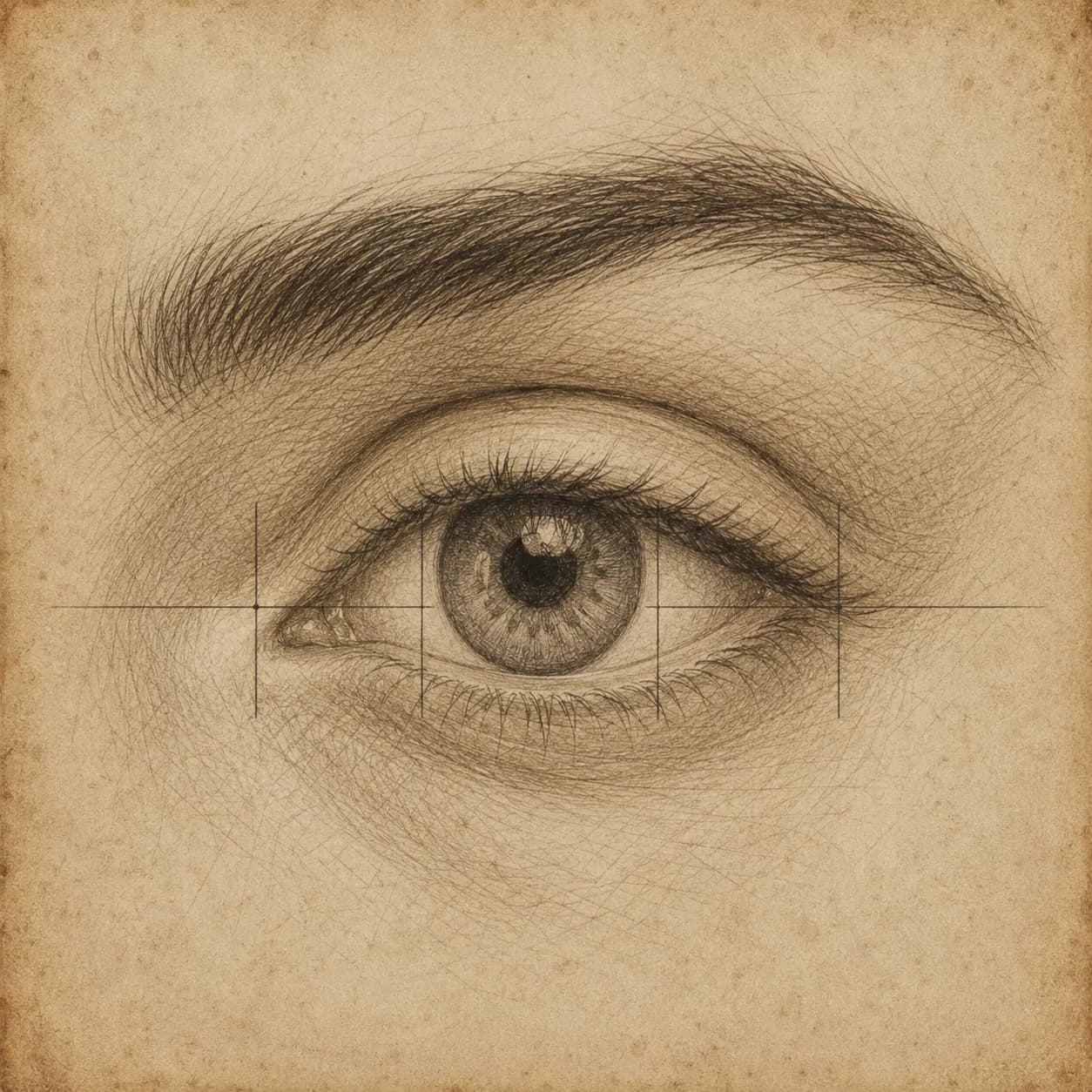
Renaissance Reference
Classical proportion studies
Proportion grids on the human face were formalised by Leonardo da Vinci and Albrecht Dürer. These sketches apply the same geometric framework this tool measures.
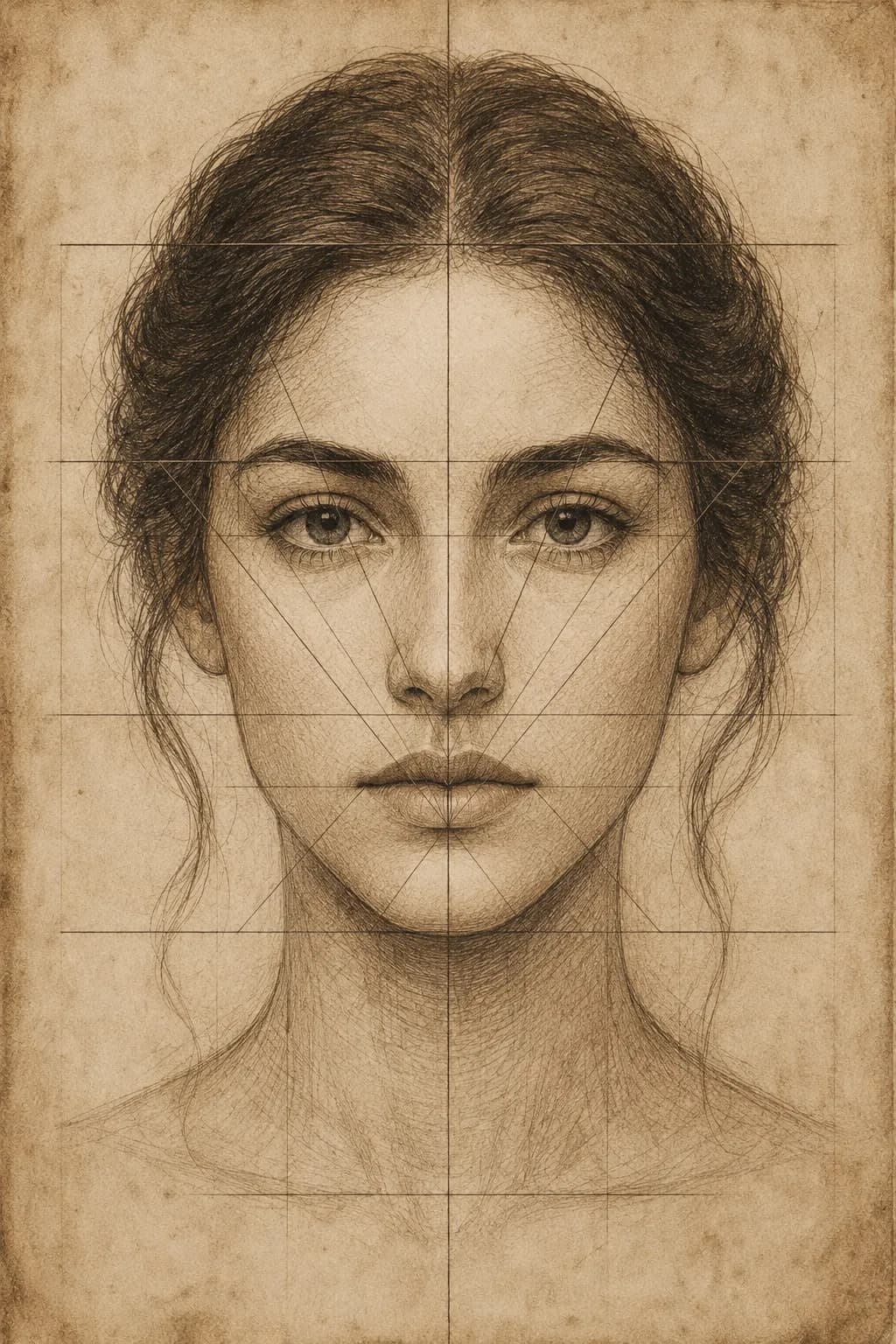
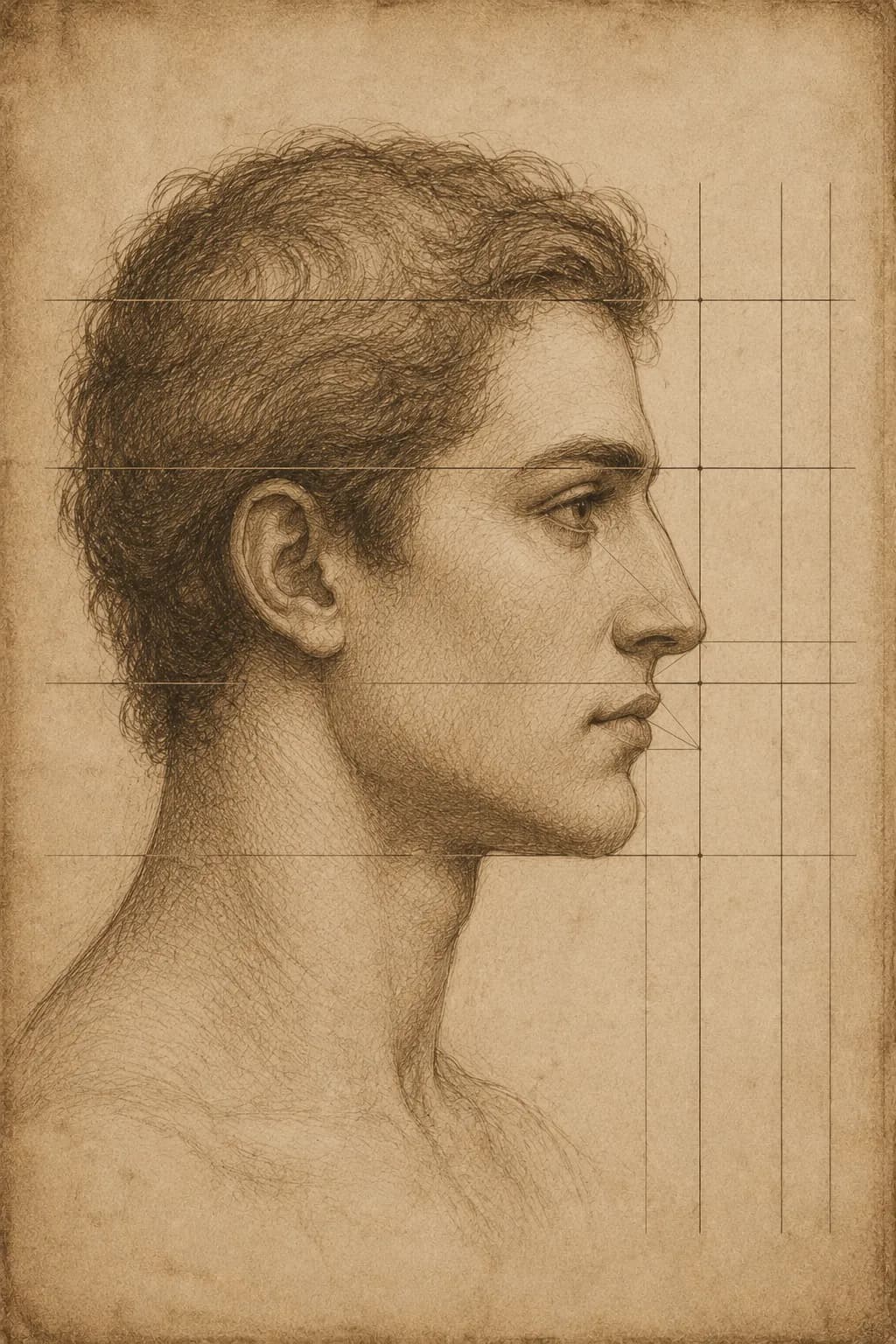
Golden section facial measurements explained
Each ratio compares two facial distances. A value of 1.618 is the classical phi target; the score reflects how close the measured value comes to that target.
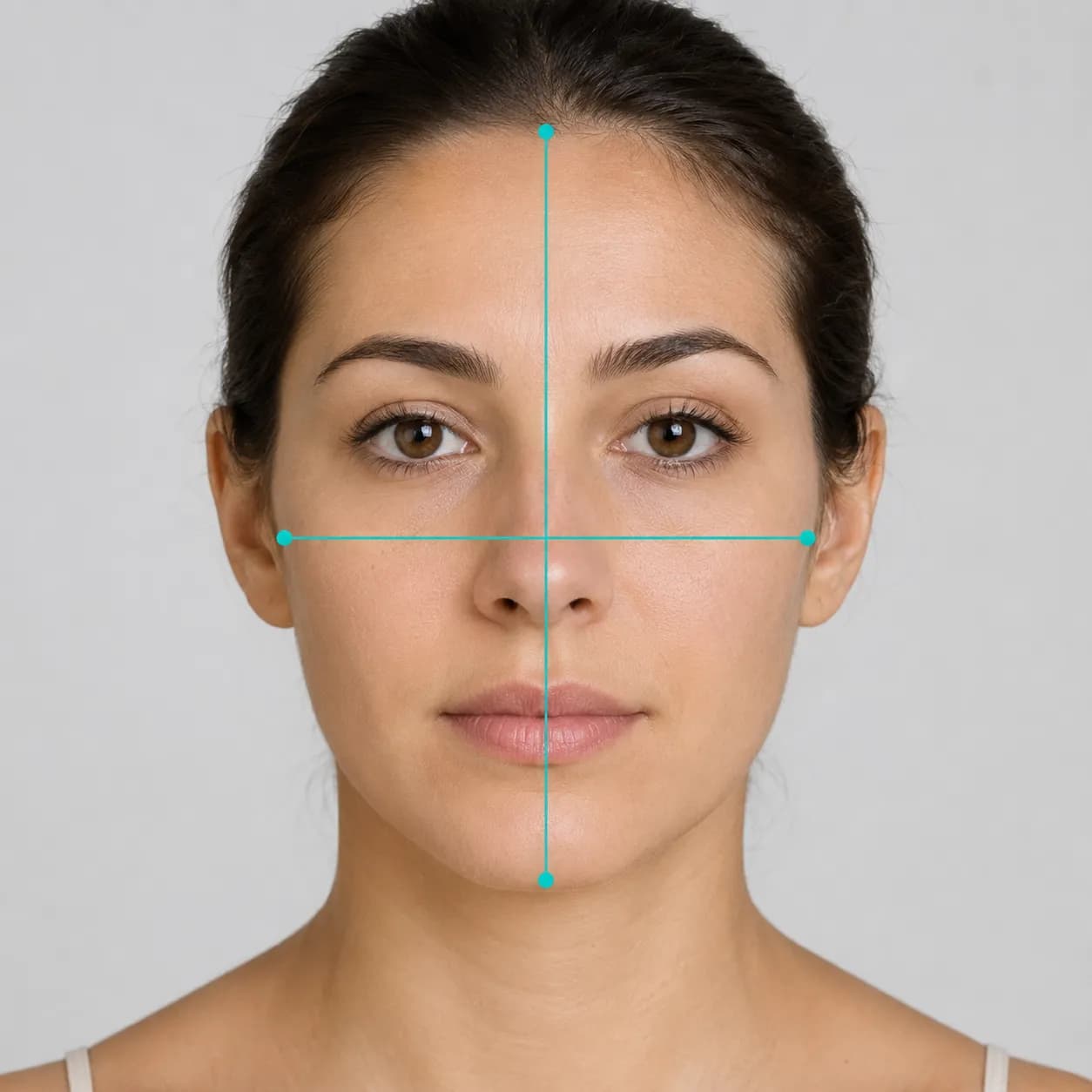
Face length ÷ face width
Forehead top to chin vs cheekbone span
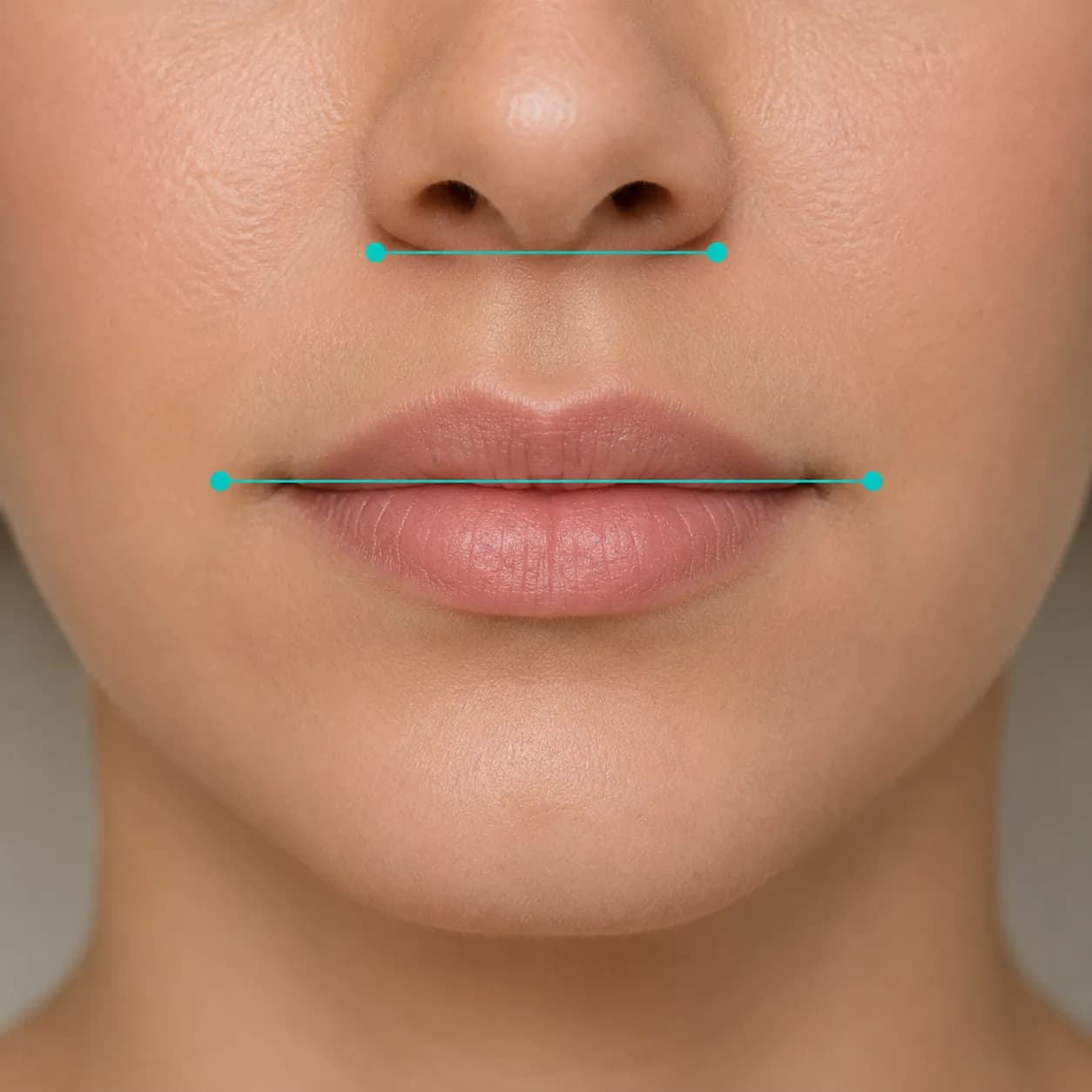
Mouth width ÷ nose width
Mouth corner span vs nostril base width
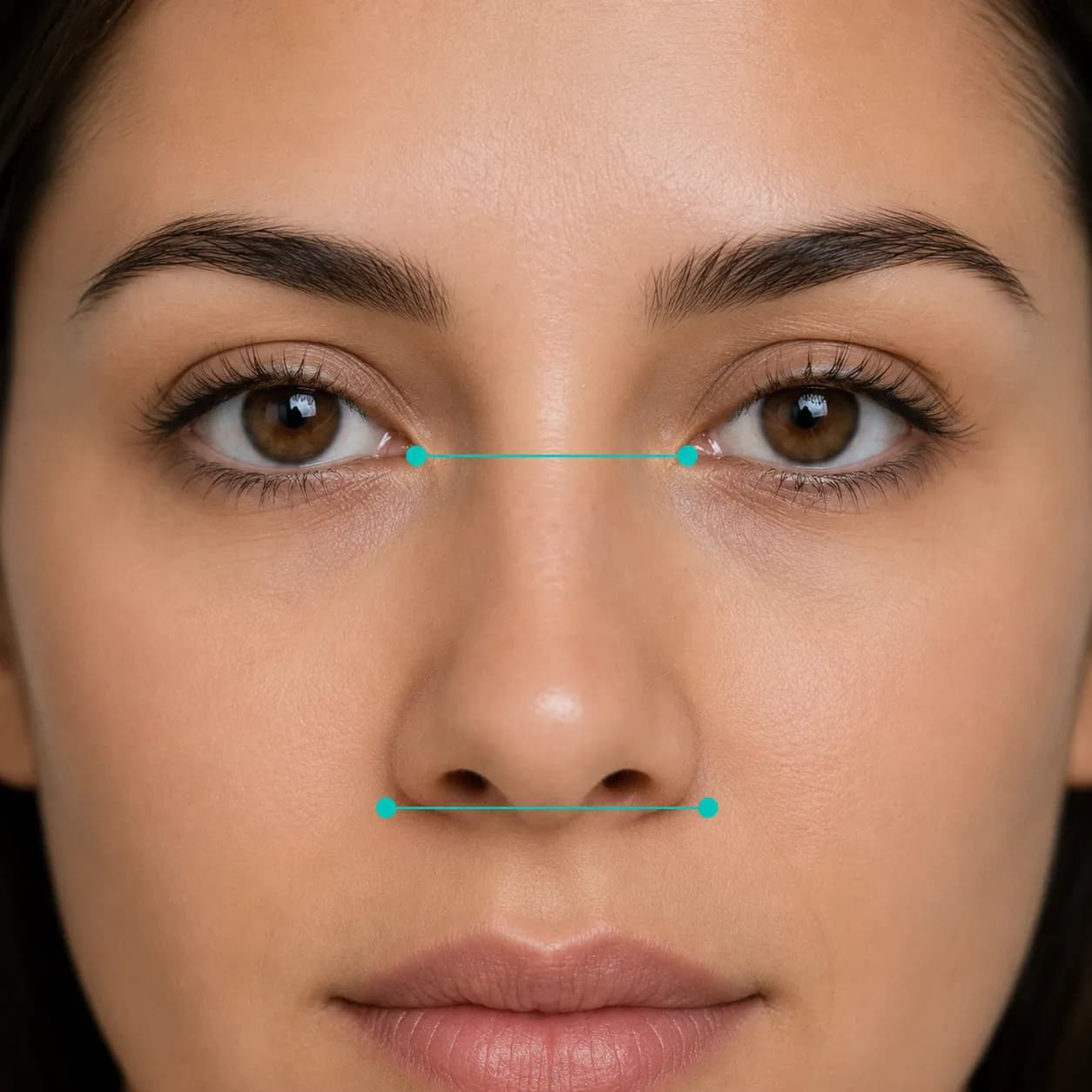
Eye span ÷ nose width
Inner eye corner span vs nostril width
Lips-to-chin ÷ nose-to-lips
Lower lip to chin distance vs nose-to-lip distance
Pupil span ÷ mouth width
Eye-centre span vs mouth corner width
The Golden Ratio
Formally: (1 + √5) / 2. Also called the divine proportion, golden section, or phi. A ratio of the whole to its larger part equalling the larger part to the smaller.
Understanding your results
Each ratio receives a score from 0–100 based on proximity to φ = 1.618. A higher overall score indicates a more proportioned face by the classical golden section standard — this is a proportion guide, not a face rating. Here is what each band means.
The ratio is within roughly 6% of 1.618. This is uncommon — most real faces land in the 60–79 range across most measurements.
The ratio sits within roughly 13% of φ. This is the most common band for healthy adult faces on most of the five measurements.
The ratio is 13–22% away from φ. A lower score here is entirely normal — the golden ratio rarely applies uniformly to all five proportions at once.
The ratio is more than 22% away from φ. This is common for certain measurements — and may also reflect photo angle or expression. Lower scores here carry no negative meaning.
How to Calculate Your Golden Ratio Face
The AI 5-measurement method — how this free face ratio calculator computes your face beauty ratio and phi proximity score
AI Technology
This golden ratio face calculator online uses Google MediaPipe Face Landmarker — a WebAssembly machine-learning model that locates 478 precise facial landmarks from a single photo entirely within your browser tab. No image data leaves your device. From those landmarks, five face proportions are extracted and compared to φ = 1.618 — the divine proportion — giving you a complete divine proportion face analysis in seconds.
The 5 Face Proportion Measurements
Face length ÷ face width
Forehead top to chin vs cheekbone span
LM 10→152 ÷ LM 234→454Mouth width ÷ nose width
Mouth corner span vs nostril base width
LM 61→291 ÷ LM 129→358Eye span ÷ nose width
Inner eye corner span vs nostril width
LM 33→263 ÷ LM 129→358Lips-to-chin ÷ nose-to-lips
Lower lip to chin vs nose-tip to philtrum
LM 17→152 ÷ LM 1→0 (y)Pupil span ÷ mouth width
Interpupillary distance vs mouth corner width
Eye centroids ÷ LM 61→291Face Beauty Ratio Formula — Scoring Method
Score = max(0, round(100 × (1 − |ratio − 1.618| / (0.30 × 1.618))))
100
ratio = φ exactly
≈ 80
±6% from φ
0
±30% from φ
Photo Tips for Accurate Results
- Front-facing — eyes level with camera
- Even, natural lighting, no harsh shadows
- Neutral expression, mouth relaxed closed
- No glasses; hair away from face
- Full face in frame, nothing cropped
Face Beauty Ratio vs Face Rater
This tool — objective geometric ratio vs φ = 1.618. Measures your golden ratio face proportions. No attractiveness verdict, no evaluator bias.
Face rater — subjective attractiveness score based on evaluator opinion or AI trained on culturally biased data. Not what this is.
Facial Thirds: How Renaissance Artists Measured the Face
The neoclassical proportion canon codified by Leonardo da Vinci and Albrecht Dürer — and how it differs from the golden ratio
Leonardo da Vinci
Anatomical Notebooks, c. 1490–1519
Documented facial zone divisions in his anatomical studies, including the Vitruvian Man and portrait proportion notes, applying horizontal thirds to idealised faces.
Albrecht Dürer
Four Books on Human Proportion, 1528
Codified the neoclassical facial thirds as an artistic standard, describing idealized proportions derived from classical Greco-Roman sculpture — not empirically validated averages.
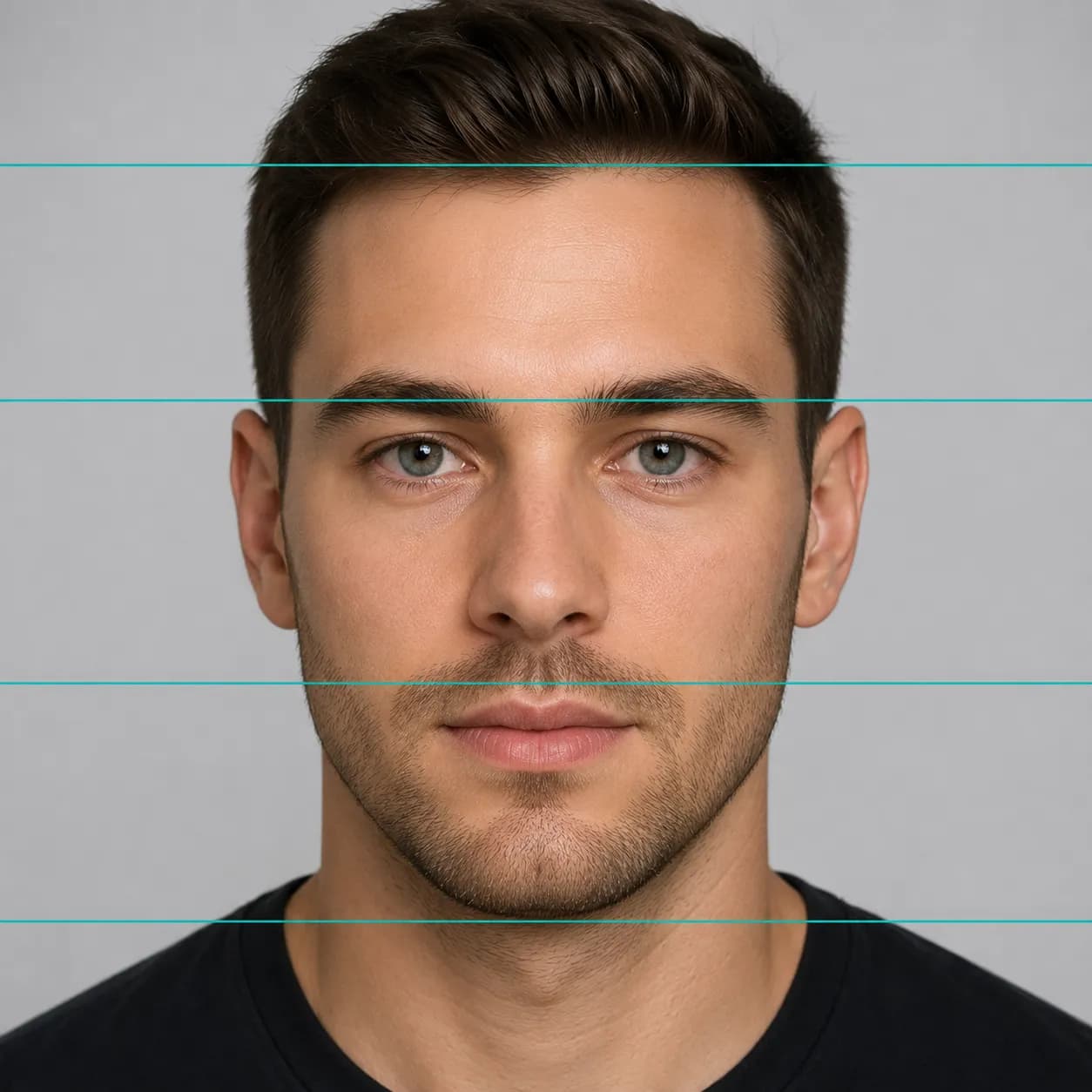
Upper third
Hairline → Brows
From the front hairline down to the top of the eyebrows. Forehead height defines this zone.
Middle third
Brows → Nose base
From the brow ridge to the base of the nose (subnasale). The eye region occupies the centre.
Lower third
Nose base → Chin
From the base of the nose to the chin tip (menton). Lips and jaw define this zone.
Three Classical Proportion Frameworks Compared
| Framework | What it measures | Ideal target | Historical origin |
|---|---|---|---|
| Golden Ratio Face | Width-to-height proportion ratios | Each ratio ≈ φ = 1.618 | Ancient Greece · Renaissance 1509 |
| Facial Thirds | Vertical zone equality | 3 equal horizontal zones | Renaissance · da Vinci, Dürer 1528 |
| Face Symmetry | Left–right mirror balance | Deviation from mirror axis = 0 | Modern aesthetics research |
Frequently Asked Questions
Everything you need to know about the golden ratio face and how this calculator works.
What is the golden ratio face?
The "golden ratio face" is a classical aesthetic concept suggesting that faces perceived as harmonious tend to have key proportion ratios close to φ = 1.618 (the golden ratio). It originates from Renaissance art theory and the work of mathematician Luca Pacioli, who applied the ratio to human anatomy. This calculator measures five such ratios from your photo and compares each to 1.618. It is an educational guide to classical proportion — not a measure of attractiveness, health, or worth.
What is the difference between the golden ratio and the divine proportion?
They are the same number. The golden ratio (φ = 1.618…) has been called the "divine proportion," the "golden section," the "golden mean," and phi (φ) throughout history. Renaissance scholars like Leonardo da Vinci and Luca Pacioli used the term "divine proportion" in art and architecture. In modern mathematics and science it is called the golden ratio or phi. All these terms refer to the mathematical constant (1 + √5) / 2 ≈ 1.6180339…
What does a "good" face beauty ratio mean, and does this tool measure it?
The term "face beauty ratio" typically refers to how closely facial proportions match the golden ratio (φ = 1.618). This calculator measures that precisely. However, beauty is not determined by a single number — countless studies show that attractiveness is influenced by symmetry, skin texture, expression, movement, familiarity, cultural norms, and personal taste. Scoring below φ on any ratio does not indicate lower beauty, and scoring at φ does not guarantee it. This tool presents classical proportion metrics as a historical curiosity and educational reference, not as a beauty verdict.
How accurate is this golden ratio face calculator?
Accuracy depends on photo quality. A clear, front-facing photo in even lighting with a neutral expression and your full face in frame will yield the most reliable measurements. Tilted heads, side lighting, strong expressions, glasses, or heavy contouring can shift landmark positions and alter ratio values. The tool reports raw computed ratios alongside scores — you can evaluate the numbers directly rather than relying solely on the summary score.
Is the golden ratio an objective measure of beauty?
No. The golden ratio is a mathematical constant with genuine properties in geometry and nature, but its role as an "objective beauty standard" is not supported by modern science. Multiple peer-reviewed studies have found that faces rated as attractive by observers do not consistently have facial proportions closer to 1.618 than faces rated as average. The concept gained cultural traction through Renaissance art and 20th-century popular science, but researchers today treat it as one of many historical aesthetic frameworks — not an empirical standard. This calculator presents the golden ratio as a classical proportion guide, not a measure of beauty or worth.
What is facial harmony, and how does the golden ratio relate to it?
Facial harmony refers to the overall sense of balance and proportional consistency across facial features — how well the eyes, nose, lips, and chin relate to each other in size and spacing. The golden ratio (φ = 1.618) is one classical framework for measuring this: it proposes that faces perceived as harmonious tend to have key proportion ratios near φ. This calculator measures five such ratios and reports how close each comes to 1.618, giving you a classical phi-based assessment of your facial harmony. Modern aesthetic science also considers symmetry, feature averageness, skin quality, and expression — all of which contribute to the perception of a harmonious face independently of the golden ratio.
What is a golden ratio face test?
A golden ratio face test is a tool that measures specific facial proportion ratios and compares them to φ = 1.618. This calculator is one such test: it plots 478 landmarks on your photo, computes five classical phi ratio pairs (face length ÷ face width, mouth width ÷ nose width, eye span ÷ nose width, lips-to-chin ÷ nose-to-lips, and pupil span ÷ mouth width), and scores each against the golden ratio. Results are shown as individual ratio values, deviation from φ, and a per-ratio proximity score. Because photo conditions affect landmark detection accuracy, the test is most reliable with a clear, front-facing photo taken in even lighting with a neutral expression.
What is a face harmony test, and is it the same as this calculator?
A face harmony test evaluates how balanced and proportionally consistent your facial features are as a whole — a broader concept than pure left-right symmetry. This golden ratio face calculator functions as a face harmony test: it measures five classical phi-ratio pairs (face length ÷ face width, mouth width ÷ nose width, eye span ÷ nose width, lips-to-chin ÷ nose-to-lips, and pupil span ÷ mouth width) and scores how closely each aligns with φ = 1.618, giving you a proportion-based facial harmony score. It differs from our Face Symmetry Test, which measures left–right mirror balance specifically rather than overall proportion harmony — the two are complementary, not interchangeable.
What is the facial thirds method and how does it differ from the golden ratio?
The facial thirds method is a neoclassical proportion canon that divides the face into three roughly equal horizontal zones: upper (hairline to brows), middle (brows to nose base), and lower (nose base to chin). Equal zones indicate classical vertical balance. It differs from the golden ratio, which measures specific width-to-height ratios vs φ = 1.618. Both are historical frameworks from Renaissance art — neither is a validated scientific beauty standard.
How do I calculate the golden ratio of my face?
To calculate the golden ratio of your face, you need five pairs of facial measurements: (1) face length ÷ face width, (2) mouth width ÷ nose width, (3) eye span ÷ nose width, (4) lips-to-chin ÷ nose-to-lips, and (5) pupil span ÷ mouth width. Each result is compared to φ = 1.618 — the closer the ratio, the higher the phi proximity score. You can calculate these manually with a ruler on a printed photo, or use this free golden ratio face calculator online to upload a photo and get all five ratios computed automatically in seconds from 478 facial landmarks.
What is a face phi ratio and how is it different from a face beauty ratio?
A face phi ratio (or phi ratio face) is any facial proportion measurement compared against φ = 1.618. Examples include face length ÷ face width or mouth width ÷ nose width. A face beauty ratio is a broader, more marketing-oriented term that often refers to the same phi-based measurements — it became common in cosmetics and aesthetic surgery to describe how close facial proportions come to the golden number face ideal. Both terms describe the same underlying geometry: how specific facial distances relate to the 1:1.618 golden section. This calculator reports both the raw measured ratios and a proximity score for each of the five classical pairs.
What is a golden proportion face or golden number face?
A "golden proportion face" describes a face whose key facial measurement ratios cluster near φ = 1.618 (the golden proportion, also called the golden number or divine proportion). A "golden number face" specifically refers to φ = 1.6180339… as the target value. Both terms describe the same classical aesthetic ideal derived from Renaissance art theory. In practice, no face has all five phi ratios simultaneously equal to 1.618 — most faces land in the 60–79 proximity score range across the five measurements. A golden proportion face is an aspirational classical standard, not a binary pass/fail.
What is a face beauty ratio?
A face beauty ratio (also written as "beauty face ratio" or "beautiful face ratio") is a measurement of how closely specific facial proportions match a classical ideal — most commonly φ = 1.618, the golden ratio. The concept gained traction in cosmetics and aesthetic surgery as a way to quantify facial balance before and after procedures. This free face beauty ratio calculator computes five classical proportion pairs — face length ÷ face width, mouth width ÷ nose width, eye span ÷ nose width, lips-to-chin ÷ nose-to-lips, and pupil span ÷ mouth width — and scores each against the golden ratio. The result is a face beauty analysis based on golden ratio geometry. It is important to note that modern research does not support the golden ratio as an objective or universal beauty standard; face beauty ratio scores are an educational and historical reference, not a verdict on attractiveness or worth.
How to calculate beauty ratio of face?
To calculate the beauty ratio of your face using the golden ratio method, you need five measurement pairs: (1) face length ÷ face width, (2) mouth width ÷ nose width, (3) eye span ÷ nose width, (4) lips-to-chin ÷ nose-to-lips, and (5) pupil span ÷ mouth width. Each result is compared to φ = 1.618 — the closer the measured value, the higher the phi proximity score. Manually, this requires a ruler on a printed photo or a precise digital annotation tool. This face beauty ratio calculator automates all five steps from a single uploaded photo using MediaPipe's 478-point facial landmark model — making it the fastest way to calculate face beauty ratio online without rulers or manual effort. For accurate results, use a clear front-facing photo in even lighting with a neutral expression.
What is a perfect ratio face?
A "perfect ratio face" refers to a face in which all (or most) key facial proportion ratios are simultaneously close to φ = 1.618. In classical proportion theory, a perfect ratio face would have a face length-to-width ratio near 1.618, mouth-to-nose-width near 1.618, eye span-to-nose width near 1.618, and so on across all five measured pairs. In practice, no photographed face achieves a perfect score across all five ratios simultaneously — most real faces score high on some ratios and moderate on others. The concept of a perfect ratio face originates from Renaissance aesthetic theory and was popularised by Stephen Marquardt's golden ratio face mask in the late 20th century. Contemporary aesthetic science does not treat perfect phi proportions as an objective beauty standard; symmetry and feature averageness are stronger empirical predictors of attractiveness than golden ratio proximity.
Am I pretty? Can a face beauty ratio calculator answer that?
A face beauty ratio calculator — including this one — does not answer whether you are pretty. It measures specific facial proportions against the classical golden ratio (φ = 1.618) and reports how close those face proportions come to a historical mathematical ideal. "Am I pretty?" is a subjective question that depends on symmetry, skin quality, expression, personal style, cultural context, and individual perception — none of which a phi ratio calculator measures. Research consistently shows that golden ratio proximity is a weak predictor of attractiveness ratings compared to symmetry and feature averageness. This tool gives you a classical proportion analysis as an educational reference; it does not produce a beauty verdict, attractiveness score, or answer to "am I pretty." If you're curious about facial symmetry specifically, our Face Symmetry Test measures left–right balance across paired landmarks.
What are face proportions, and why do they matter?
Face proportions are the measurable relationships between different facial features — for example, how wide your mouth is relative to your nose, or how long your face is relative to its width. Aestheticians, portrait artists, and plastic surgeons have studied face proportions for centuries as a way to describe balance, harmony, and classical beauty ideals. This golden ratio face calculator measures five specific face proportions and compares each to φ = 1.618, the divine proportion. The resulting scores tell you how closely your face proportions align with the classical golden section standard. It is important to note that face proportions alone do not determine attractiveness — symmetry, feature averageness, skin texture, and expression all play significant roles independent of any proportion ratio.
What is a face beauty ratio test or golden ratio face test?
A face beauty ratio test (also called a golden ratio face test) is a tool that measures specific facial proportions from a photo and scores them against φ = 1.618. This calculator is one such test: it runs an AI-powered golden ratio face test by plotting 478 landmarks on your uploaded photo and computing five phi ratio pairs — face length ÷ face width, mouth width ÷ nose width, eye span ÷ nose width, lips-to-chin ÷ nose-to-lips, and pupil span ÷ mouth width. Each pair is scored by proximity to the golden ratio, and an overall proportion score is produced. The test runs entirely in your browser — no photo is sent to any server. For best results, use a clear front-facing photo with even lighting and a neutral expression.
What is the face beauty ratio formula?
The face beauty ratio formula is built on the golden ratio: φ = (1 + √5) / 2 ≈ 1.6180339. To apply it, you measure a pair of facial distances (e.g. face length and face width), divide the larger by the smaller, and compare the result to 1.618. The proximity score used by this calculator is: Score = max(0, round(100 × (1 − |measured ratio − 1.618| / (0.30 × 1.618)))). A measured ratio of exactly 1.618 gives a score of 100; a deviation of 30% or more from φ gives a score of 0. The same face beauty ratio formula is applied to all five measurement pairs. Because the formula compares a geometric ratio to a mathematical constant, the result is objective — but whether that ratio correlates with perceived attractiveness is a separate, empirical question that modern research does not consistently support.
How does this compare to a face rater tool?
A face rater is a tool that assigns a subjective attractiveness score — typically by having human evaluators rate photos or by training an AI on attractiveness ratings. This golden ratio face calculator is fundamentally different: it is a proportion measurement tool, not a face rater. It computes objective geometric ratios (face length ÷ face width, mouth width ÷ nose width, etc.) and reports how close each comes to φ = 1.618. No subjective attractiveness score is produced. The distinction matters because face raters reflect cultural and evaluator biases; a golden ratio proportion analysis reflects only the geometry of your face proportions against a classical mathematical standard. Both have educational interest; neither should be treated as a definitive verdict on attractiveness.
Is there a golden ratio face app, or do I need to download something?
No download needed. This golden ratio face calculator runs entirely as a web app in your browser — on desktop or mobile — and works exactly like a native golden ratio face app without an install, account, or app-store listing. Open this page, upload or take a photo, and the same MediaPipe landmark model and phi ratio calculations run locally on your device.
Does the golden ratio face test work the same for men, women, and girls?
Yes. The five phi ratio measurements — face length ÷ face width, mouth width ÷ nose width, eye span ÷ nose width, lips-to-chin ÷ nose-to-lips, and pupil span ÷ mouth width — are purely geometric and are computed identically regardless of gender, age, or ethnicity. Whether you are running a golden ratio face test for a girl, a guy, or anyone else, the same 478-landmark detection and scoring formula applies to every uploaded photo.
Related Tools
Face Symmetry Test
Measures left–right balance — distinct from golden ratio proportions
Face Shape Detector
Identify your oval, round, square, heart, or diamond face shape
Eye Shape Detector
Find your eye shape — almond, round, hooded, and more
Lip Shape Analyzer
Discover your lip shape and golden proportion
AI Age Detector
Curious what age you look? Guess from a photo with AI
Best Sunglasses for Your Face Shape
Frame shapes that flatter your specific face shape
Best Earring Styles for Your Face Shape
Earring lengths and shapes that flatter your face shape
Best Glasses Frames for Your Face Shape
Eyeglasses frame shapes that flatter your specific face shape
Age Calculator
Want a precise calculated estimate instead? Try our calculator
Facial Thirds Analyzer
Learn how the neoclassical facial thirds canon works
Attractiveness Test
Get your AI facial proportion score
Nose Shape Detector
Find your nose shape from 12 types
Face Analyzer
Run every face analysis in one place