Gonial Angle Calculator
Upload a photo for an instant gonial angle test — powered by AI. Our free gonial angle calculator measures the exact jaw angle at each jaw corner and tells you whether it reads as acute (defined), average, or obtuse (soft). Educational and geometric — not a beauty verdict.
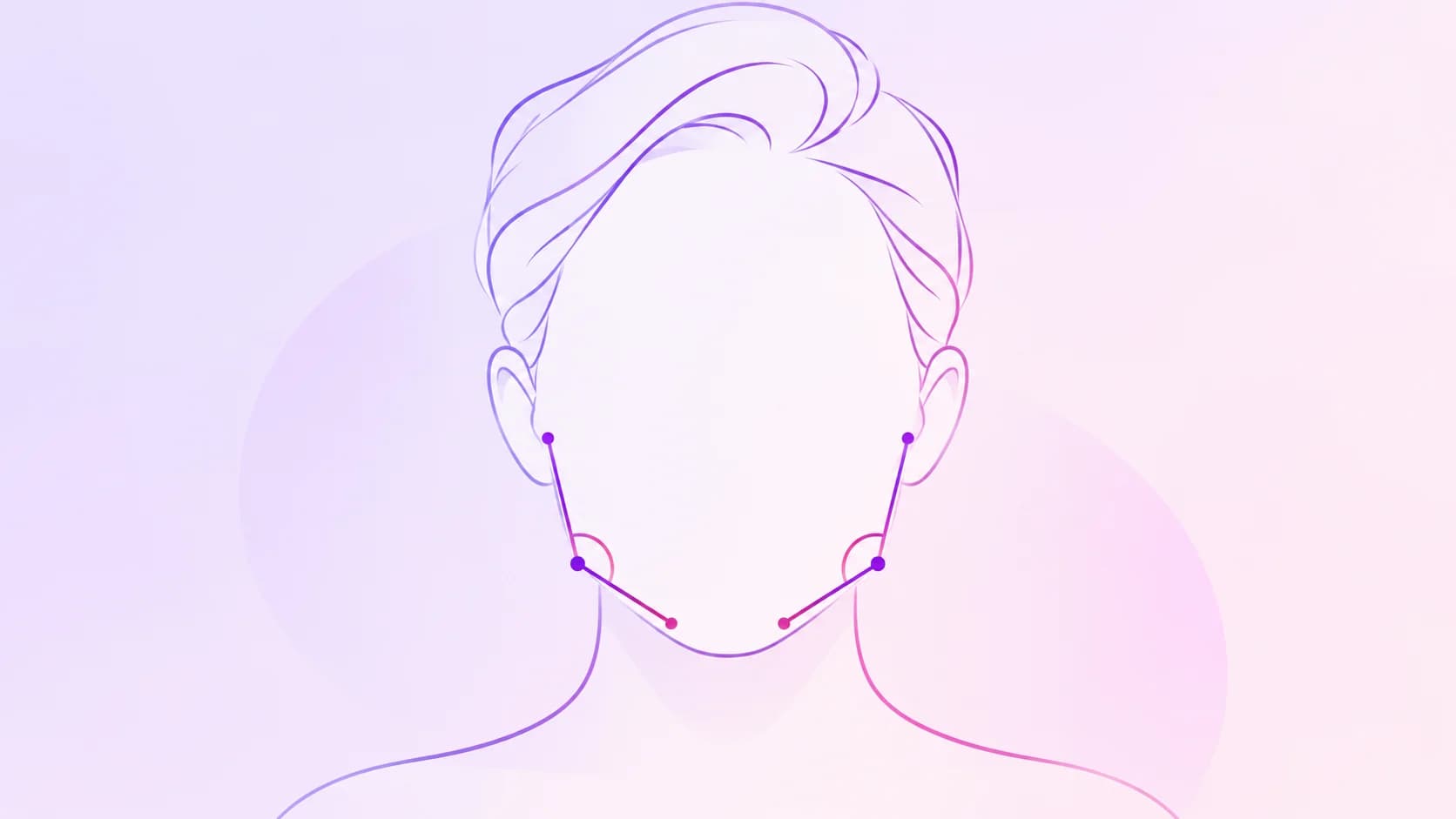
Gonial Angle — Definition
The gonial angle (or mandibular angle) is the angle formed at the gonion — the corner of the lower jaw — between the ramus (running up toward the ear) and the body (running toward the chin). A smaller angle reads as a sharper, more defined jaw corner; a larger angle reads as a softer, more rounded one. This free calculator measures your approximate angle from a photo. It is a geometric descriptor sourced from craniofacial and orthodontic literature — not a measure of beauty, health, or worth.
Loading calculator…
How It Works
From photo to gonial angle in seconds — all processed locally on your device.
Upload or take a photo
Use the upload option or take a photo with your device camera directly in the browser. A clear, front-facing shot with your full jawline visible gives the most accurate gonial angle reading. No account needed.
AI maps 478 facial landmarks
The same MediaPipe Face Landmarker used across this site plots 478 precise landmark points on your face — all computation stays on your device.
The gonion corner is located
The jaw corner (gonion) on each side is pinpointed, along with the cheekbone point and a lower-jaw point near the chin, and the angle between those two edges is calculated.
Your angle report is ready
A per-side breakdown shows each angle in degrees, the average angle, and a category — acute (defined), average, or obtuse (soft) — with a canvas overlay marking the measurement lines.
What Is the Gonial Angle?
A standard cephalometric measurement — where it comes from, how it's measured, and what it actually means
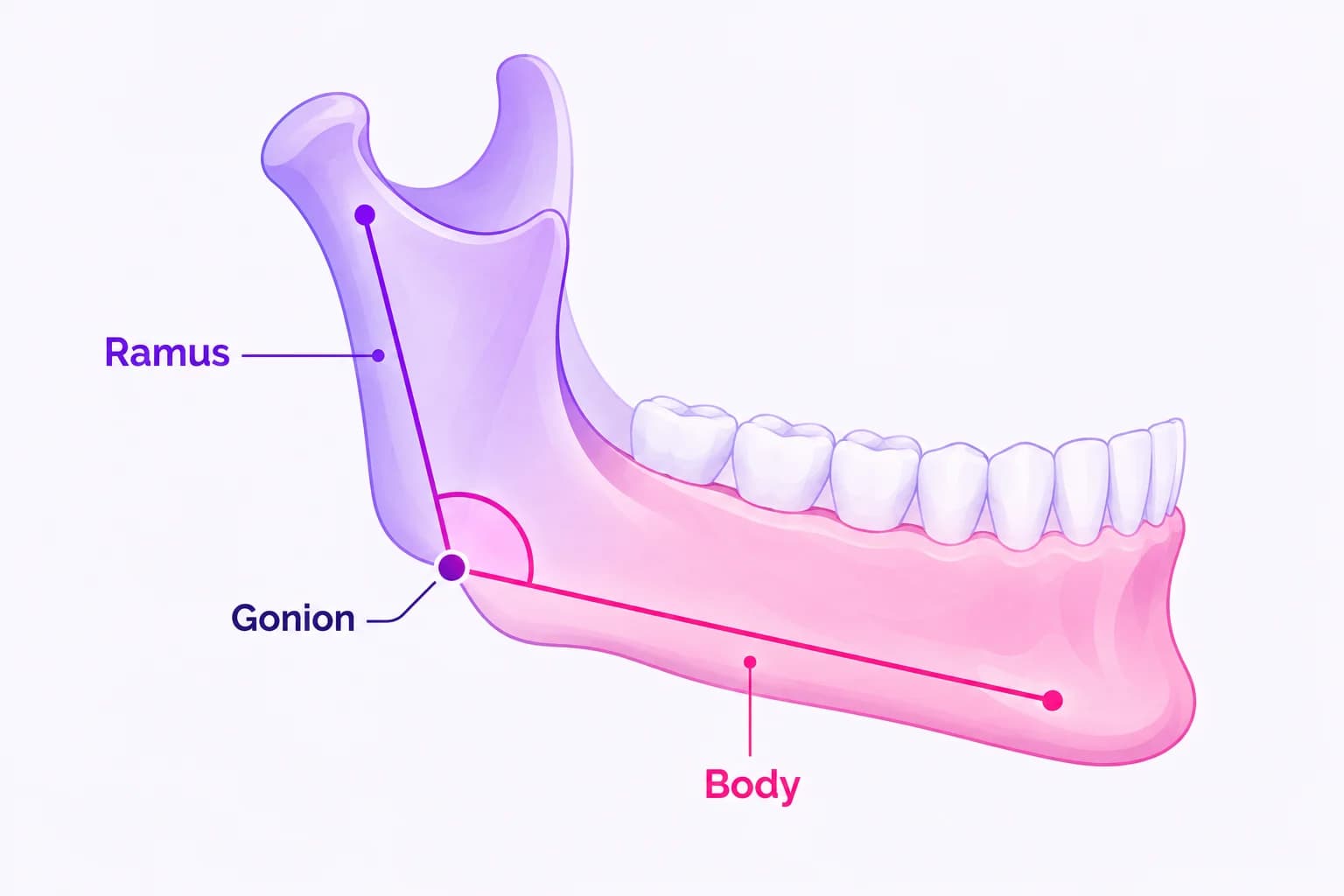
The Anatomy
The gonion is the lowest, most posterior point at the corner of the mandible (lower jaw), where the ramus (the near-vertical segment running up toward the jaw joint and ear) meets the body (the near-horizontal segment running forward toward the chin). The gonial angle quantifies this corner as a single angle, and orthodontists and maxillofacial specialists use it as one of several standard cephalometric landmarks when assessing jaw growth and facial profile.
The Popular Framing
Outside clinical contexts, gonial angle is discussed as part of broader jawline-aesthetics conversations — a sharper, more acute angle is popularly linked to a "square" or "defined" jaw, while a wider, more obtuse angle is linked to a softer, rounder jawline. This popular framing treats a smaller angle as more desirable in some contexts, but that is a cultural and cosmetic preference — it is not a scientific or medical standard of attractiveness.
How the AI Locates Your Gonial Angle
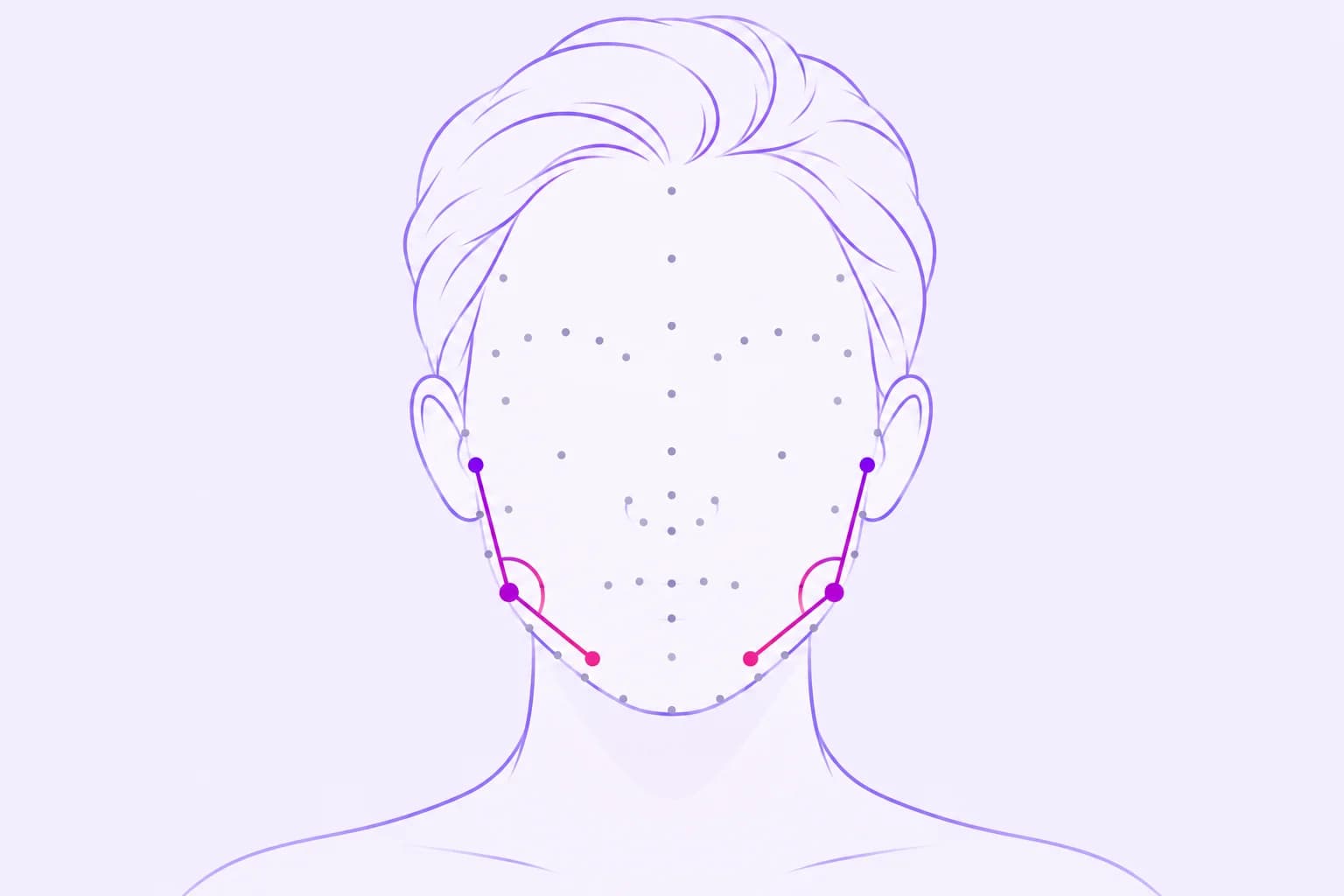
Highlighted points = cheekbone → gonion → near-chin on each side · gray dots = the other 478-point landmarks
Key Terms
Gonion
Corner point of the lower jaw
Ramus
Near-vertical mandible segment toward the ear
Mandibular body
Near-horizontal segment toward the chin
Gonial angle
Angle at the gonion between ramus and body
Mandibular angle
Same concept, alternate name
Cephalometrics
Measuring facial bone structure from X-rays
Acute vs. obtuse
Both terms describe the same underlying measurement — a sharper or wider gonial angle — from opposite directions.
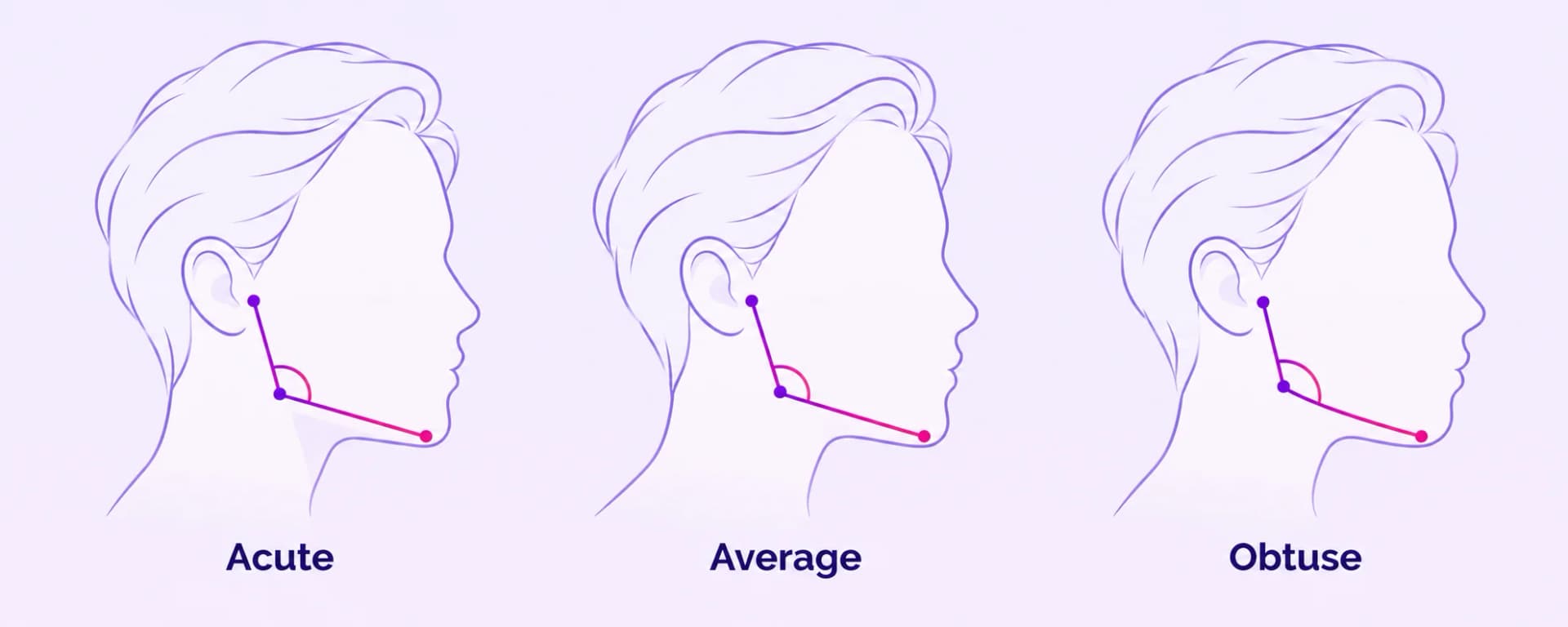
Acute (Defined)
Jaw corner angle below 125°. Popularly linked to a squared-off, chiseled jawline appearance.
Average
Jaw corner angle between 125° and 140°. The range most commonly reported in cephalometric studies.
Obtuse (Soft)
Jaw corner angle above 140°. Popularly linked to a softer, more rounded jawline appearance.
Gonial Angle at a Glance
| Category | Angle range | Popular framing | Jaw corner shape |
|---|---|---|---|
| Acute | Less than 125° | Square / defined jaw | Sharper corner |
| Average | 125° to 140° | — | Typical corner |
| Obtuse | Greater than 140° | Soft / rounded jaw | Wider corner |
Frequently Asked Questions
Everything you need to know about the gonial angle and how this calculator works.
What is the gonial angle?
The gonial angle (also called the mandibular angle) is the angle formed at the gonion — the corner point of the lower jaw — between the ramus (the near-vertical part of the mandible running up toward the ear) and the body (the near-horizontal part running toward the chin). It is a standard measurement in craniofacial and orthodontic cephalometric analysis, and it is also widely discussed outside clinical settings as a geometric descriptor of jaw shape.
How do you measure the gonial angle?
Clinically, the gonial angle is measured on a lateral cephalometric X-ray by drawing a line along the mandibular ramus and a second line along the mandibular body, then measuring the angle between them at the gonion. This calculator approximates that same angle from a 2D photo instead of an X-ray: it detects 478 facial landmarks with MediaPipe, locates the jaw corner on each side along with a cheekbone point and a near-chin point, and computes the angle between those two directions in degrees.
What is a normal gonial angle?
Cephalometric literature typically reports adult gonial angles in a broad range of roughly 110° to 140°, with many studies citing an average somewhere in the low-to-mid 120s. This calculator labels average angles below 125° as "Acute," 125°–140° as "Average," and above 140° as "Obtuse." These are clearly labeled modeling thresholds for this calculator, not a single universal medical cutoff — different studies and populations report somewhat different reference ranges.
What does an acute (smaller) gonial angle mean?
A smaller gonial angle means the jaw corner is sharper — the ramus and body of the mandible meet at a tighter angle. Visually, this tends to read as a more defined, squared-off jawline. It is a geometric trait linked to individual bone structure, not an indicator of health or attractiveness.
What does an obtuse (larger) gonial angle mean?
A larger gonial angle means the jaw corner is wider — the ramus and body of the mandible meet at a more open angle. Visually, this tends to read as a softer, more rounded jawline. Gonial angle can also widen somewhat with age or tooth loss, as orthodontic and dental literature has long documented, though day-to-day variation is mostly just individual bone structure.
Does gonial angle differ between men and women?
Some cephalometric studies report that, on average, male gonial angles trend slightly smaller (sharper) than female gonial angles across certain populations, which lines up with the common association between a more acute jaw angle and a traditionally "masculine" jawline. However, individual variation within any gender is large, and this calculator measures the same geometry identically regardless of who is being measured — there is no separate scoring rule by gender.
Can the gonial angle change with jaw exercises, fillers, or surgery?
The gonial angle is primarily determined by the underlying bone structure of the mandible, which does not change through jaw exercises or chewing gum, despite some marketing claims. Dermal filler along the jawline can visually soften or sharpen the perceived angle without changing the bone itself, and orthognathic (jaw) surgery can genuinely reshape the bone and alter the measured angle — but that is a significant surgical procedure that should only be discussed with a qualified maxillofacial or craniofacial surgeon, not pursued based on this calculator.
How accurate is this gonial angle calculator?
Accuracy depends heavily on photo quality, and on the fact that this tool measures a 2D photo rather than the lateral X-ray used in clinical cephalometry — it is an approximation, not a diagnostic-grade measurement. A clear, front-facing photo with even lighting, a neutral expression, and your full jawline visible gives the most reliable reading. A tilted head, facial hair obscuring the jawline, or an extreme camera angle can shift the detected landmark positions and change the reported degrees. The tool reports the raw measured angle for each side so you can judge the numbers directly rather than relying only on the category label.
Is this a substitute for a cephalometric X-ray or medical consultation?
No. This calculator is an educational, geometry-based tool intended for curiosity and self-exploration — it is not a diagnostic or medical device and does not provide medical advice. A true gonial angle measurement in orthodontics and maxillofacial medicine is taken from a lateral cephalometric X-ray. If you have a clinical question about your jaw structure, bite, or growth, consult an orthodontist or maxillofacial surgeon.
Why do my left and right gonial angle show different values?
Mild left-right facial asymmetry is present in nearly every face, and the gonial angle is no exception — most people have a slightly different angle on each side. This calculator flags a difference greater than 6° as noteworthy, but small differences are normal and not a cause for concern.
Does gonial angle affect attractiveness?
Gonial angle is one of many geometric traits some observers associate with jawline definition, but research on facial attractiveness consistently points to symmetry, feature averageness, skin quality, and expression as far stronger predictors of perceived attractiveness than any single angle measurement. Gonial angle is a descriptive geometric trait, not a determinant of beauty, health, or worth.
What landmarks does this tool use to calculate the gonial angle?
The calculator uses MediaPipe's 478-point face mesh to locate the jaw corner (gonion) on each side, a cheekbone point standing in for the ramus direction, and a lower-jaw point near the chin standing in for the body direction, then computes the angle between those two edges at the gonion. This is the same underlying jaw-corner geometry already used elsewhere on this site for jawline shape classification — expressed here as a precise angle in degrees instead of a shape category alone.
Related Tools
Jawline Shape Detector
Find your full jawline type — square, round, V-shaped, and more
Face Symmetry Test
Measures left–right balance — distinct from gonial angle
Canthal Tilt Calculator
Measure the angle of your eye corners instead of your jaw
Face Rating Test
See jaw definition folded into a full 5-signal geometry breakdown
Golden Ratio Face Calculator
Measure five classical facial phi proportions
Square Jawline Guide
Traits and styling tips for a more acute gonial angle