Rate My Face
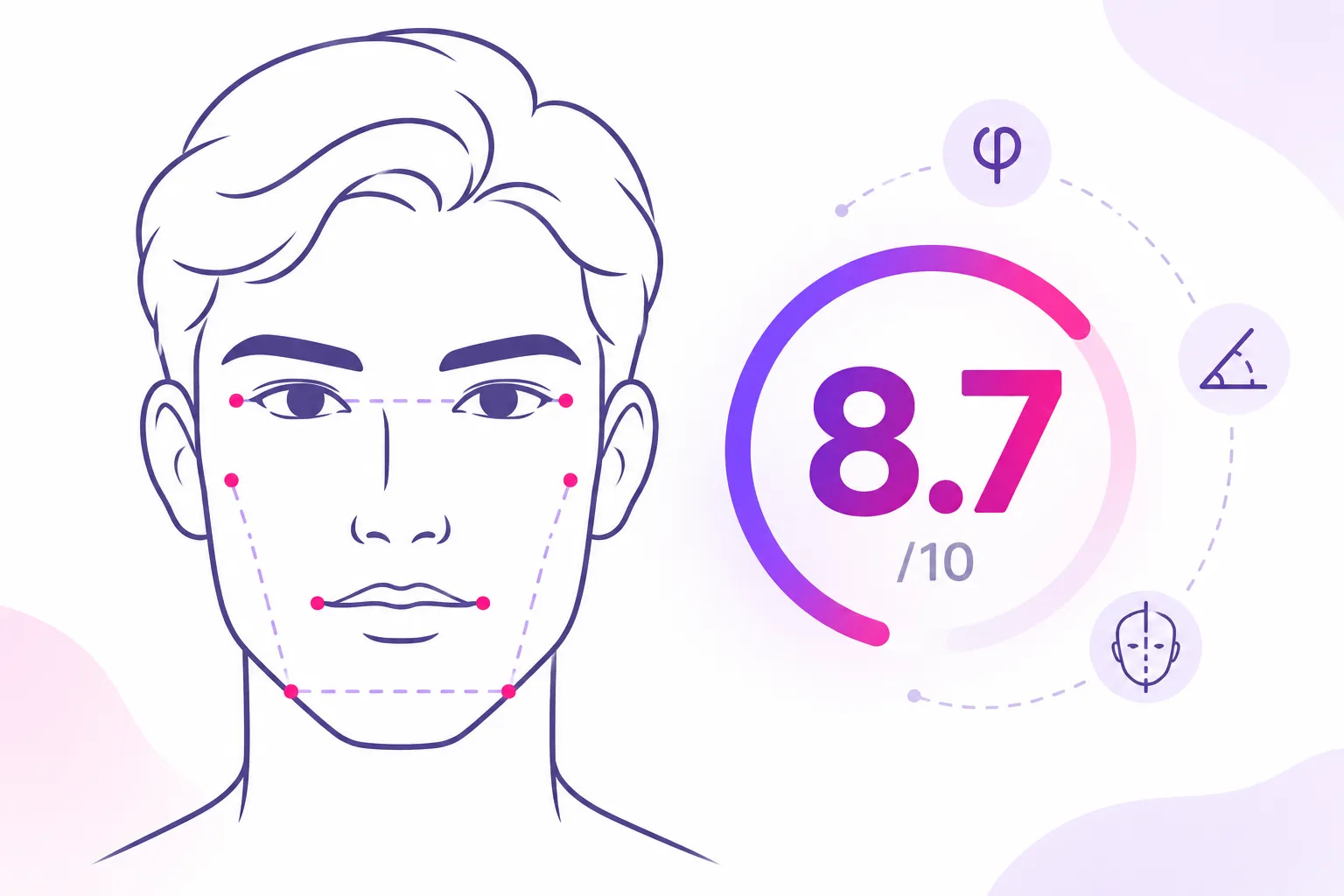
Upload a photo and get one score out of 10 in seconds. Our free AI blends five facial geometry signals — symmetry, golden-ratio proximity, canthal tilt, jaw definition, and eye harmony — into a single rating, with the full breakdown behind it. No sign-up, fully private.
How the Face Rating Works
Four steps from photo to a single rating — all processed locally on your device.
Upload or take a photo
Upload a clear, front-facing photo in natural light, or use your device camera directly in the browser.
AI maps 478 facial landmarks
MediaPipe Face Landmarker runs entirely in your browser and locates 478 precise points across your face — nothing is uploaded.
Five signals are measured and blended
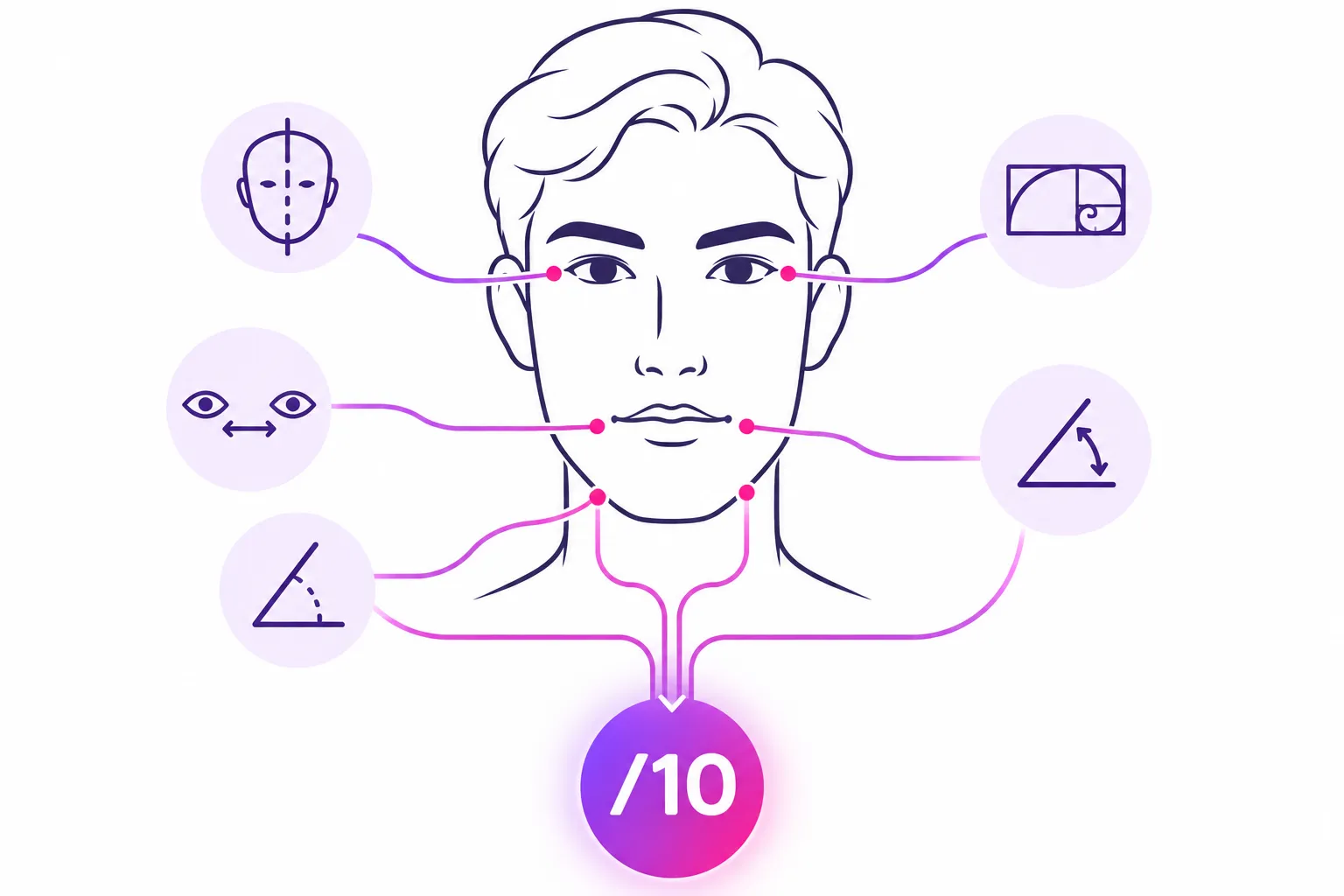
Symmetry, golden-ratio proximity, canthal tilt, jaw definition, and eye harmony are each scored, then averaged into one number.
Your rating out of 10 appears
A single score, a verdict tier, and the five-signal breakdown behind it — so you see the "why", not just the number.
Reading Your Rating
Your 0-10 score falls into one of six verdict tiers, based on how your five signals average out.
| Score Range | Verdict |
|---|---|
| 8.5 – 10 | Exceptional |
| 7.0 – 8.4 | Striking |
| 5.5 – 6.9 | Above Average |
| 4.0 – 5.4 | Average |
| 2.5 – 3.9 | Below Average |
| 0 – 2.4 | Needs a Better Photo |
How to Photograph Yourself
A good photo makes a real difference to your score.
Face the camera directly
Look straight ahead — chin level, not tilted up or down. Head rotation skews symmetry and canthal tilt.
Relaxed, neutral expression
Keep your mouth gently closed and your face relaxed. Big smiles distort proportions.
Even, natural lighting
Soft daylight from in front is ideal. Shadows on one side can skew the symmetry signal.
High-resolution photo
A clear, sharp photo gives the AI more precise landmark positions to work from.
Single face in frame
The analyzer works best with one person clearly visible, with no other faces in frame.
Hair away from your face
Hair covering your brows, eyes, or jawline can obscure landmarks used for several signals.
Remember: this is a geometric estimate against modeled reference ranges, affected by angle, lighting, and expression — not a verdict on attractiveness, health, or worth. Treat it as entertainment.
Want the five signals shown separately?
Try the Face Rating Test — same signals, no combined number
Also try the Attractiveness Test
A different 0-100 score based on eye spacing, nose breadth, mouth width & facial thirds
Rate My Face vs. Our Other Rating Tools
All three tools run the same on-device MediaPipe landmark model — they differ in which signals they measure and whether those signals get combined into one number.
| Tool | Output | Signals Used | Best For |
|---|---|---|---|
| Rate My Face | One score, 0-10 | Symmetry, golden ratio, canthal tilt, jaw definition, eye harmony — averaged | A quick, shareable single answer |
| Face Rating Test | Five scores, 0-100 each | Same five signals — shown separately, never combined | Seeing the full signal-by-signal detail |
| Attractiveness Test | One score, 0-100 | Eye spacing, nose breadth, mouth width, face ratio, facial thirds | A proportion-based score with a different method |
How We Built This Rating
Face landmark positions come from Google's open-source MediaPipe Face Landmarker, the same 478-point model used across every analysis tool on this site, including our Face Rating Test, Attractiveness Test, and Golden Ratio Face test. This page averages the same five signals used in the Face Rating Test — bilateral symmetry, golden-ratio proximity, canthal tilt, jaw definition, and eye harmony — into one number, because that single-score framing is what most people searching "rate my face" actually want. The Face Rating Test keeps the same five signals separate on purpose, for anyone who wants the detail instead of one number.
The reference "ideal" ranges for each signal (golden ratio ≈ 1.618, canthal tilt +2° to +8°, etc.) are drawn from widely cited aesthetic and cosmetic-surgery literature, not a single scientific consensus — because no such consensus on facial attractiveness exists. We show the full five-signal breakdown underneath every rating, so the single number is never a black box.
Think your score is miscalibrated, or have feedback on the rating? You can submit it here — we read every report.
References
- Farkas, L.G. (1994). Anthropometry of the Head and Face (2nd ed.). Raven Press — facial proportion and symmetry reference measurements used as a modeling baseline.
- Naini, F.B. & Gill, D.S. (2008). "Facial Aesthetics: 1. Concepts and Canons." Dental Update, 35(2) — discussion of the golden ratio and canthal tilt in facial aesthetic assessment.
Known limitations: this score depends on photo quality — angle, expression, lighting, and resolution all shift the detected landmark positions, and therefore every signal feeding the final number. Averaging five measurements into one score also hides which signal drove the result, which is exactly why we show the full breakdown underneath — check it before drawing any conclusion from the headline number. This tool is for entertainment and informational purposes only; it is not a scientific or medical assessment of attractiveness.
Written by Naeem Ullah, Facial Feature Analyst · Last updated November 2026
Frequently Asked Questions
Everything you need to know about rating your face and how it works.
How does "Rate My Face" give me a single score?
It measures five independent facial-geometry signals from your photo — symmetry, golden-ratio proximity, canthal tilt, jaw definition, and eye harmony — and averages them into one number out of 10. Each signal is shown separately underneath the score, so you can see exactly what it's built from.
How is this different from the Face Rating Test?
The Face Rating Test (/face-rating-test) deliberately shows the same five signals separately, each on its own modeled percentile, without combining them. Rate My Face uses the same underlying signals but condenses them into a single out-of-10 score for a quick, shareable answer — pick whichever framing you prefer.
How is this different from the Attractiveness Test?
The Attractiveness Test (/attractiveness-test) is a separate 0-100 score built from a different set of ratios — eye spacing, nose breadth, mouth width, face ratio, and facial thirds. Rate My Face uses symmetry, golden ratio, canthal tilt, jaw definition, and eye harmony instead, so the two scores often differ.
Is a face rating out of 10 scientifically accurate?
No. This is an illustrative, entertainment-focused tool. It uses real landmark detection and real geometric measurements, but the "ideal" reference ranges (golden ratio, canthal tilt, etc.) come from popular aesthetic literature, not a scientific consensus on attractiveness — which doesn't exist.
Is my photo stored or shared?
No. All processing happens entirely in your browser using Google's MediaPipe Face Landmarker. Your photo never leaves your device and is not uploaded to any server.
Why did I get a low score?
Photo angle, lighting, expression, and resolution all shift the detected landmark positions — and therefore the score. A turned head, a big smile, or heavy shadow on one side can lower your rating even if a different photo of the same face would score higher. Try a front-facing, neutral-expression photo in even light.
Can I rate my face for free?
Yes — this tool is completely free, with no sign-up, no photo uploads to a server, and no limit on how many times you can try it.
Does this work for all face shapes and ethnicities?
Landmark detection itself works across face shapes and ethnicities. The "ideal" reference ranges used for scoring originate mostly from Western aesthetic traditions, though, and may not reflect the full diversity of features and beauty standards worldwide — keep that in mind when reading your score.
Who built this tool and is it reviewed?
Rate My Face was built and is maintained by Naeem Ullah, who has spent over four years researching how facial landmark geometry translates into practical, measurable signals. The scoring methodology — which signals to use, how to weight them, and how to present the result honestly — is documented in full in the Methodology section above, and every page on this site is reviewed before publishing.
What facial-landmark technology powers the score?
Google’s open-source MediaPipe Face Landmarker, the same 478-point computer-vision model used across every analysis tool on this site. It runs locally in your browser via WebAssembly — no server-side face recognition or image upload is involved.