Written by Naeem Ullah·Facial Feature Analyst, faceshapedetector.app·Reviewed September 2026
Almond eyes are an elongated oval shape, widest at the center and gently tapered at both corners, with the iris touching both the upper and lower lid and the outer corner sitting slightly higher than the inner. The name comes from the nut: when open, the eye forms a shape wider at the middle and narrowing to a soft point at each end. Almond is the single most common eye shape worldwide, and because of that it became the reference point for professional makeup artistry — when a tutorial says "wing the liner along the lash line" with no modification notes, it is assuming almond eyes. That makes almond the most tutorial-compatible shape of all ten: virtually no technique needs to be adapted to work on it, which is also why it is frequently framed as the aspirational "ideal" in beauty media even though it is, statistically, simply the baseline.
What Are an Almond Eyes?
The iris touches both the upper and lower lid with no sclera visible, and the outer corner sits slightly higher than the inner — an elongated, tapered oval that nearly every mainstream makeup technique is built around.
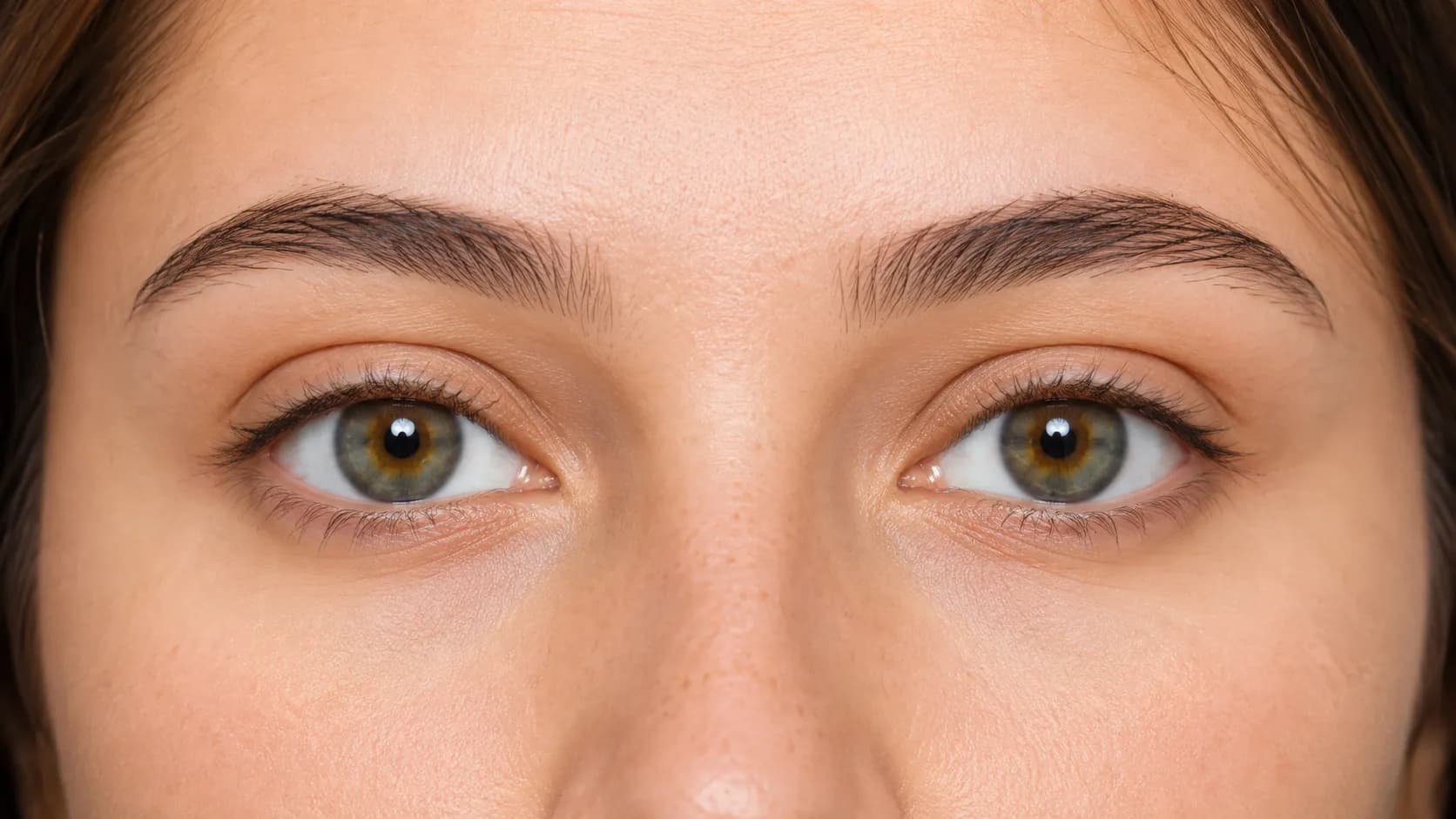
Sclera visibility
None — iris touches both lids
Corner tilt
Slight upward lift, outer corner
Most confused with
Round Eyes
Best liner move
Classic wing, natural angle
Key Characteristics of Almond Eyes
- 1Iris touches both the upper and lower lid — no sclera (white) visible above or below
- 2Outer corner sits slightly higher than the inner corner, a gentle (not dramatic) upward tilt
- 3Elongated oval outline, wider at the center and tapered at both corners
- 4Width-to-height ratio typically between 1.5:1 and 2:1
Not sure which eye shape you have?
What Causes Almond Eyes?
Almond eyes are largely defined by the relationship between the iris and the two eyelid margins: when the iris makes full contact with both the upper and lower lid at rest, no sclera shows above or below it, which is the primary anatomical marker separating almond from round. The outer corner, or lateral canthus, sits at a comparatively higher attachment point on the orbital rim than it does for a purely neutral or downturned eye, producing the gentle upward tilt that gives the shape its tapered, elongated silhouette — though the lift is subtler than a true upturned eye, where the tendon attachment is noticeably higher still. Because almond is the statistically most common configuration of iris coverage and corner height across populations, it became the default reference point in professional makeup artistry: tutorials describe technique in almond-eye terms first and then note adjustments for other shapes. Almond is a lid-outline classification only, fully independent of crease visibility, orbital depth, and eye spacing — it can combine with any modifier, including hooded, deep-set, close-set, or wide-set, and frequently shifts toward hooded later in life as skin elasticity around the upper lid decreases.
How to Tell If You Have Almond Eyes
- 1Look straight ahead into a well-lit mirror with a neutral, relaxed gaze — not squinting or raising your brows.
- 2Check whether any white (sclera) is visible above or below your iris; if none shows, continue — if some shows, your eyes lean round.
- 3Mentally trace your eye's outline: a wider-at-center oval that tapers to a gentle point at both corners confirms almond rather than a circular outline.
- 4Visualize a horizontal line from your inner corner outward — an outer corner that sits at or just slightly above that line (not dramatically above) confirms almond rather than upturned.
- 5Confirm with a straight-on, evenly lit photo rather than a mirror alone, since head angle and lighting can exaggerate or hide the outer-corner tilt.
Analyst's Pro Tip
If your eyes look oval in a mirror and no sclera is visible below the iris, you almost certainly have almond eyes — and the fastest makeup upgrade is doing less, not more: skip elongating techniques built for round or downturned eyes and instead extend your existing lash-line angle by only a few millimeters, since the anatomy is already doing most of the work.
Almond Eyes vs Round Eyes — What's the Difference?
Almond eyes have the iris touching both the upper and lower lid with no sclera visible, plus a slight upward tilt at the outer corner, while round eyes show sclera above or below the iris and have corners at roughly equal height — the fastest test is simply whether any white shows around the iris when looking straight ahead.
Not sure which applies to you? Use our free AI eye shape detector for an instant result. You can also read the Round Eyes guide directly.
Makeup and Glasses for Almond Eyes
Classic winged liner follows the natural corner tilt with almost no adjustment, tight-lining the upper waterline adds depth without changing the shape, and a standard crease-to-lid gradient or cut-crease both photograph cleanly. Apply mascara evenly across all upper lashes — there is no priority zone the way there is on round or downturned eyes.
Almond eyes suit the widest range of frames of any shape: cat-eye frames echo the natural corner tilt, teardrop aviators mirror the elongated outline, rectangular frames provide flattering contrast, and even round or oval frames work well when sized slightly smaller than the socket. The only frames to avoid are very deep or oversized styles that dwarf the eye.
Common Mistakes to Avoid
Lining the entire lower waterline with heavy, dark pencil
It reduces the visible iris area that already makes almond eyes read as open and balanced, producing a smaller, more closed-off look instead of the smoky definition most people intend.
Treating the shape as needing active "correction"
Almond is already the shape most mainstream techniques are built around, so applying heavy elongating or lifting fixes designed for round or downturned eyes tends to overcomplicate a look that already works as applied.
Keeping an identical makeup routine as hooding develops with age
As the upper lid loses elasticity and begins covering the crease, shadow placed at the original crease line gradually disappears from view — the routine needs to shift toward tight-lining and a slightly higher crease placement to stay visible.
Choosing extremely deep or oversized glasses frames
Frames that sit well below the brow line can dwarf the eye's natural proportions; almond eyes have enough structure to anchor most sizes, but very deep styles are one of the few frame choices that work against the shape rather than with it.
Public Figures Often Cited as Having Almond Eyes
Beyoncé, Rihanna, Megan Fox are commonly cited in beauty and style coverage as examples of this eye shape. As with any public-facing trait assessment, these are popular reference points rather than clinical classifications.
Almond Eyes — Frequently Asked Questions
Are almond eyes common?
Yes — almond is the most common eye shape globally and the baseline shape in professional makeup artistry. Most liner, shadow, and lash techniques are written with almond eyes in mind and note modifications for other shapes. If you have almond eyes, almost every mainstream tutorial applies to you without adjustment.
What is the difference between almond eyes and round eyes?
Almond eyes are wider than tall with the iris touching both the upper and lower lid — no white (sclera) is visible above or below when looking straight ahead, and the outer corner sits fractionally higher than the inner. Round eyes show sclera above or below the iris and have corners at a more even height. The fastest test: if you can see white above or below your iris, your eyes lean round; if the iris contacts both lids, they lean almond.
Can I have almond eyes that are also hooded or deep-set?
Yes. These are independent attributes. Almond describes the lid outline; hooded describes whether excess skin from the brow bone covers the crease when the eye is open; deep-set describes how far the eye recedes into the orbital socket. All three can apply simultaneously — almond-hooded is particularly common as people age and lid elasticity decreases.
Do almond eyes change with age?
Yes. As the upper eyelid loses elasticity, skin may droop and cover the crease — gradually shifting almond eyes toward hooded. The outer corner can also lose its subtle upward tilt over time. Tight-lining the upper waterline, an upswept wing, brow-bone highlighter, and curling lashes before mascara all help maintain the original lift.
Are almond eyes rare or are they attractive because they are common?
Almond eyes are not rare — they are, by most population estimates, the most common eye shape globally. They are widely cited as attractive in part because of proportional balance, but largely because the dominant makeup technique libraries were built around this one shape, which frames it as the ideal rather than one option among several equally compelling shapes.
What eyeliner suits almond eyes best?
Virtually every liner style. Classic winged liner follows the natural corner tilt effortlessly; tight-lining adds depth; a double-wing creates a graphic look; smudged lower pencil adds smoky intensity. The shape is forgiving enough that techniques which would distort other eye shapes read as intentional rather than unflattering on almond eyes.
Related Eye Shapes
- →Round Eyes — A wide, open appearance with visible sclera
- →Hooded Eyes — A crease hidden by overhanging brow-bone skin
- →Upturned Eyes — A natural cat-eye lift — sometimes called "feline" eyes
Find Out If You Have an
Almond Eyes
Upload a photo to our free AI eye shape detector and get an instant result.
Detect My Eye Shape — FreeNo sign-up · 100% private · Works on all devices