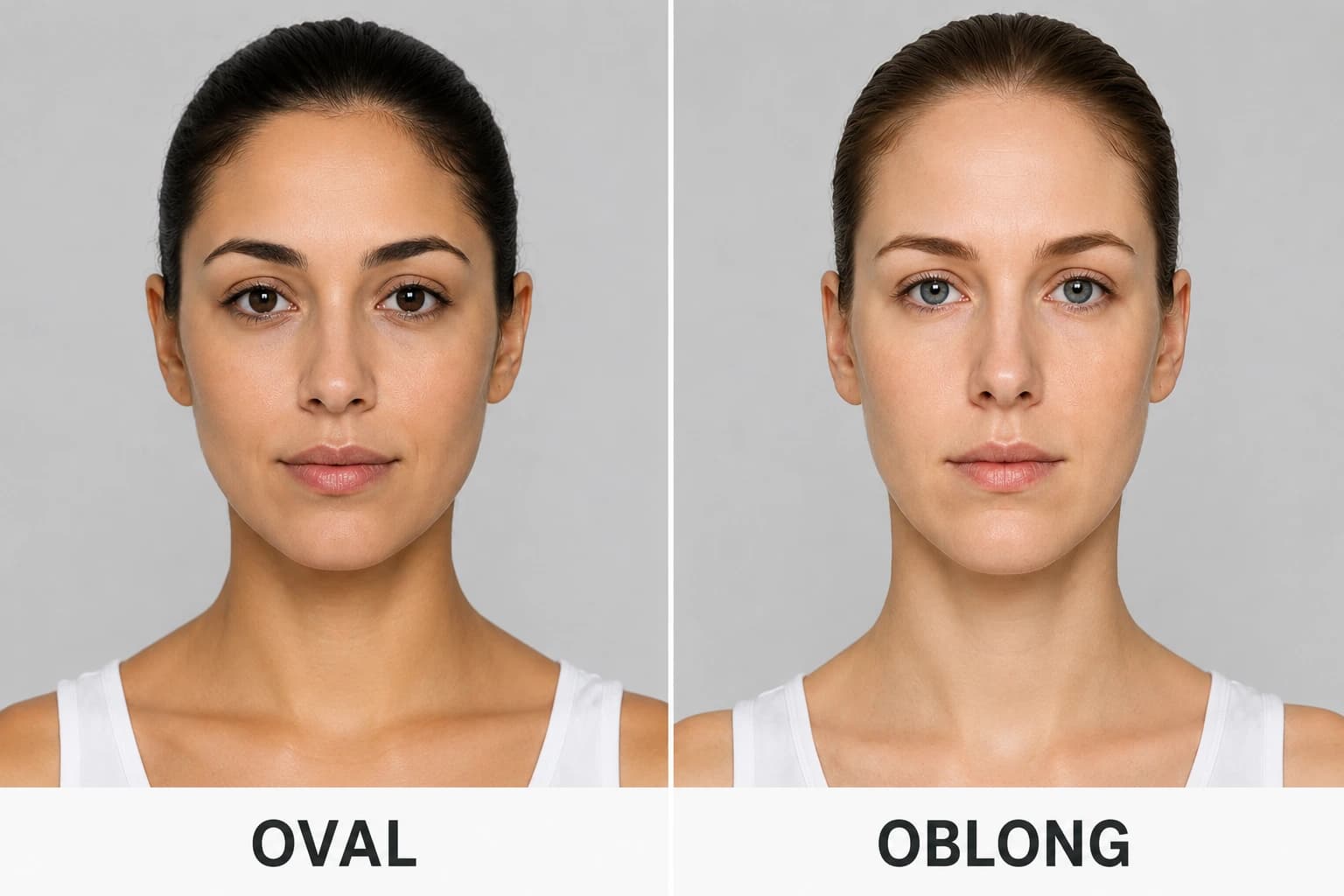
The Fast Answer
Look at your cheek line. An oval face has a soft inward curve at the cheeks and a moderate length-to-width ratio, around 1.5 times longer than wide. An oblong face has straighter, nearly parallel sides and a more dramatic ratio — 1.75 times longer than wide or more. If your sides curve in gently, you're likely oval. If they run almost straight down, you're likely oblong. Still not sure? The free AI face shape detector measures your exact ratio and cheek curvature from a photo in seconds.
Why Oval and Oblong Get Confused
Oval and oblong are the two most commonly confused face shapes — and for good reason. Both share the same fundamental trait: the face is longer than it is wide, with the cheekbones close to the widest point. That overlap is exactly where the similarity ends, but it's enough to make self-assessment in a mirror genuinely difficult, especially without a reference point for what "longer than wide" actually looks like in practice.
Part of the confusion is historical. Older style guides often grouped both shapes under a single "long face" category, or used oblong and oval interchangeably as informal synonyms. Modern face shape classification treats them as distinct because the styling implications are genuinely different: oval faces need very little correction, while oblong faces benefit specifically from horizontal volume and width-adding elements that would look out of place on a true oval face. Applying oval-style guidance to an oblong face — or vice versa — is a common source of styling advice that "technically follows the rules" but still doesn't look quite right.
This guide focuses purely on telling the two apart, based on the same facial landmark measurements — forehead width, cheekbone width, jawline width, and face length — used throughout the rest of this site. For hairstyle, glasses, and makeup recommendations once you know your shape, see the full oval face shape guide or the full oblong face shape guide.
Oval vs Oblong: Side by Side
| Criterion | Oval | Oblong |
|---|---|---|
| Length-to-width ratio | ~1.5:1 — noticeably but not dramatically longer than wide | ~1.75:1 or more — significantly longer than wide |
| Cheek line | Gentle inward curve at the cheeks | Straight, nearly parallel sides with little curve |
| Widest point | Cheekbones, slightly wider than jaw and forehead | Forehead, cheeks, and jaw are all close in width |
| Chin | Gently rounded, tapers smoothly | Often somewhat squared or flat |
| Overall impression | A softened egg shape | An elongated, almost rectangular silhouette |
Real-World Examples
Seeing both shapes side by side on recognisable faces makes the difference easier to spot than any measurement alone.
Oval examples
Beyoncé, George Clooney, Jessica Alba, and Ryan Gosling all have oval faces — notice the soft curve at the cheeks and the balanced, egg-like outline rather than a sharply elongated one.
Oblong examples
Liv Tyler, Adam Driver, Sarah Jessica Parker, and Meryl Streep all have oblong faces — the sides run noticeably straighter and the overall face reads as more elongated, even at a glance.
Common Self-Assessment Mistakes
Assuming "longer than wide" automatically means oblong
Most faces are at least somewhat longer than they are wide — oval faces are too. The mistake is stopping at that one observation instead of also checking the cheek line and the actual ratio.
Judging from a photo angled up or down
Camera angle distorts perceived face length far more than most people expect. A phone held slightly below eye level can make an oval face look noticeably more elongated than it is. Use a straight-on photo or mirror at eye level.
Letting hairstyle influence the assessment
Volume at the crown, a centre part, or long straight hair with no layers can all make a face read as more elongated than its underlying bone structure actually is. Pull hair back completely before comparing proportions.
Which One Am I? A 3-Step Self-Check
No tape measure needed for the first pass — just a mirror and good light.
Check the cheek line
Pull your hair back and look straight on. Does the outline curve gently inward at the cheeks, or does it run in an almost straight line from cheekbone to jaw?
Estimate the ratio
Compare hairline-to-chin length against cheekbone width. Roughly 1.5 times longer than wide points to oval. Closer to 1.75 times or more points to oblong.
Look at the chin
A gently rounded, tapering chin leans oval. A flatter or slightly squared chin leans oblong.
If you identified oval
Get the full breakdown of characteristics, hairstyles, glasses, and makeup for your shape.
Read the oval face shape guide →If you identified oblong
Get the full breakdown of characteristics, hairstyles, glasses, and makeup for your shape.
Read the oblong face shape guide →Skip the Guesswork
Upload a photo and the AI measures your exact length-to-width ratio and cheek curvature — free, no sign-up required.
Frequently Asked Questions
- Is oblong the same as oval face shape?
- No. They share one trait — both are longer than they are wide — but oval has a soft inward curve at the cheeks and a moderate length-to-width ratio (around 1.5:1), while oblong has straighter, more parallel sides and a more dramatic ratio (roughly 1.75:1 or greater). They are frequently confused but are two distinct classifications.
- Can a face be both oval and oblong?
- A face can sit near the border between the two, since both shapes share the same general proportions and there is no hard cutoff between a 1.5:1 and 1.75:1 ratio. In that case, treat the shape with the milder ratio and softer cheek curve as your practical baseline, and read both style guides — most of the styling advice for borderline oval-oblong faces overlaps anyway.
- Does the AI face shape detector ever confuse oval and oblong?
- Oval and oblong are the pair the detector is most likely to sit close together on, simply because the underlying measurements are similar by nature — both are defined by a longer-than-wide face with the cheekbones near the widest point. The detector uses your precise length-to-width ratio and cheek-line curvature rather than a visual guess, which is considerably more consistent than self-assessment in a mirror, but borderline faces can still land close to the cutoff between the two.
- Which is more common, oval or oblong?
- Oval is far more common — it accounts for roughly 46% of results across AI face shape scans, making it the single most frequent classification. Oblong is comparatively uncommon. This gap is part of why so many people with an oblong face assume they must be oval instead: oval is the statistically likely guess, even when it is not the accurate one.
- Can a hairstyle make an oval face look oblong, or an oblong face look oval?
- Yes, temporarily and visually — though not structurally. Volume at the crown, a centre part, or long straight hair with no layers can make an oval face read as more elongated than its underlying proportions actually are. Conversely, side-swept bangs or width-adding layers can soften how elongated an oblong face appears. For an accurate self-assessment, always pull hair back completely before comparing proportions.
- Does camera angle change whether a face looks oval or oblong?
- Yes, significantly. A phone or camera angled slightly upward or downward distorts perceived face length more than most people expect, and can make an oval face look noticeably more elongated — or an oblong face look more balanced — than it actually is. For the most reliable read, use a straight-on photo taken at eye level, or use the AI face shape detector, which corrects for landmark positions rather than relying on visual impression alone.
