Half-Up Half-Down
Hairstyles by Face Shape
Where to Set the Crown, 5 Styles to Try, and How to Stop the Slipping

Half-up half-down works on almost any length and any hair type, which is exactly why it's easy to get slightly wrong — the same style can flatter one face and add unwanted length or width to another, depending on where the crown section sits and how much volume builds up there. This guide covers how to section and secure it properly, five variations worth knowing, and which ones to reach for based on your face shape.
This guide is for everyday wear. If you're specifically after bridal or occasion styling, our wedding hairstyles by face shape guide covers half-up bridal updos in more depth, and if you want a fuller list of styles beyond half-up, see our ponytail height and position guide for a related, closely-adjacent option.
How to Section and Secure It
Where the crown section starts and ends matters more than any other decision in this style — it's what determines whether the finished look adds height, width, or neither.
- 1Part from the top of one ear, across the crown, to the top of the other ear — this is the widest section that still reads as 'half-up' rather than a full ponytail — going narrower risks a thin, stringy-looking top section
- 2Backcomb the roots of that section lightly before gathering it — a flat crown section is the single biggest cause of a half-up style looking deflated within an hour, especially on fine or freshly washed hair
- 3Decide the height of the secure point based on your face shape, not habit — a high point near the crown adds visible length to the face, while a lower point nearer the back of the head adds almost none — this is the main lever for tailoring the style
- 4Secure with a small elastic first, then cover it with a clip or pin — an elastic underneath holds the section through movement; a clip alone tends to slip once hair reaches medium weight or below
- 5Cross two bobby pins in an X directly under the elastic or clip — crossed pins grip in two directions at once, which is what actually prevents the slow slide backward that plain parallel pins don't stop
5 Half-Up Half-Down Styles
The core technique above stays the same across all of these — what changes is how the crown section is finished (braided, twisted, clipped) and where it's secured.
| Style | Best For | Note |
|---|---|---|
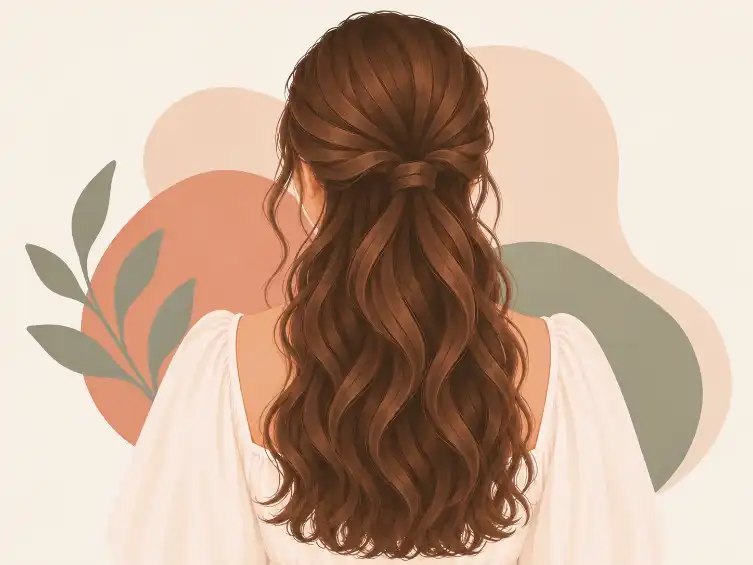
| Classic half-up | All shapes, everyday wear | Straight crown section pulled into a low ponytail — the baseline version, no braiding or twisting |
| Bubble half-up | Oblong, diamond | The down section is segmented into small bubble sections, adding fullness without extra height at the crown |
| Clipped half-up | Round, square | A claw clip holds the crown section flat, giving more control over volume than an elastic alone |
| Twisted half-up | All shapes | Two twisted sections meet at the back instead of a single clip point, for a more textured finish |
| Braided crown half-up | Oval, heart, diamond | A braid across the crown adds texture and structure without adding extra volume |
Classic half-up
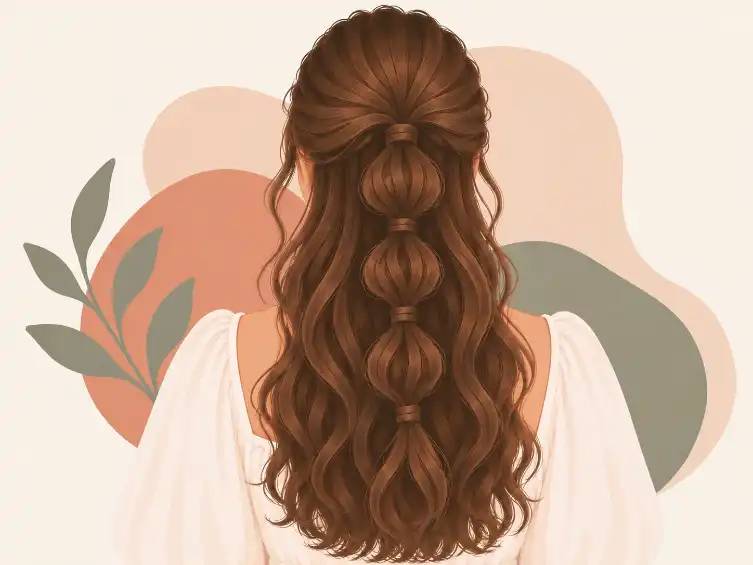
Bubble half-up
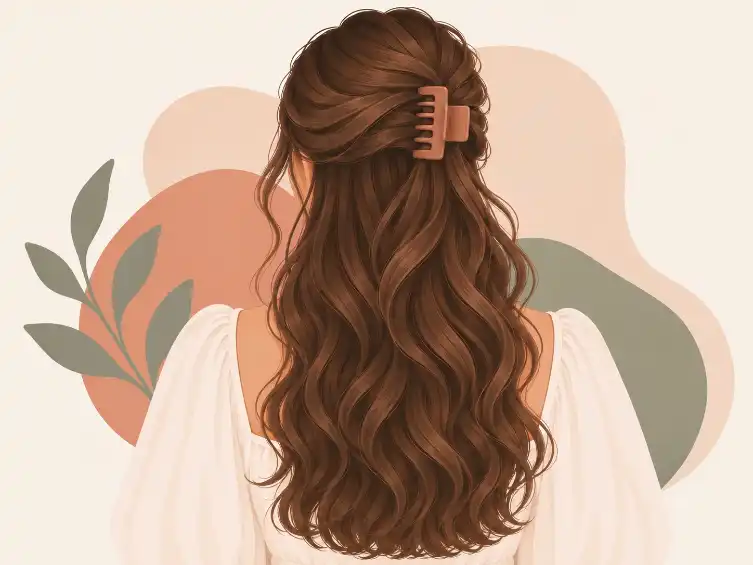
Clipped half-up
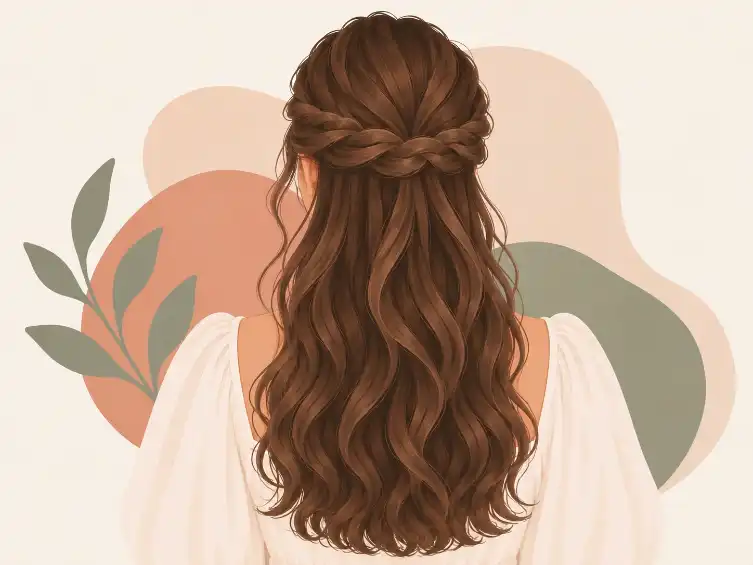
Twisted half-up
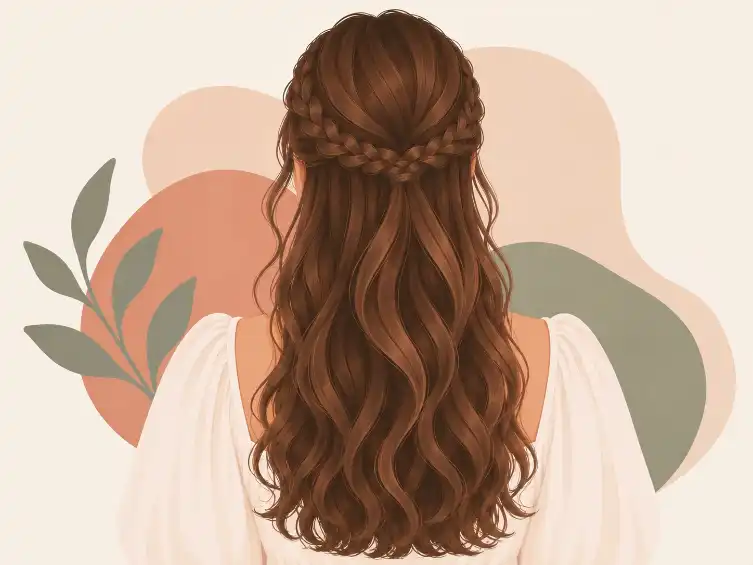
Braided crown half-up
Which Half-Up Style Suits Your Face Shape
The style itself works on every face shape — what should change is the crown height and where any added volume sits.
- Round — a higher crown section with volume adds visual length; avoid a low, flat half-up, which widens the face.
- Oval — closest to a neutral base; nearly any crown height works, so this is the easiest shape to experiment on.
- Square — a double half-up or one with face-framing pieces left out softens a strong jawline better than a single high section.
- Heart — keep crown volume moderate and let face-framing pieces or curls add width lower down, near the jaw, to balance a wider forehead.
- Diamond — a low half-up secured at the nape keeps the narrowest point (the forehead and chin) from looking exaggerated by extra height.
- Oblong — skip height altogether; a low half-up or a bump styled forward rather than up avoids stretching an already long face.
- Triangle — a bump or bouffant at the crown adds width up top to balance a heavier jawline.
Not Sure of Your Face Shape?
The breakdown above only helps once you know which shape you're working with. Our free AI face shape detector gives you a result from a single photo, or see the full hairstyles for every face shape guide for styles beyond half-up.
Adjusting for Hair Type
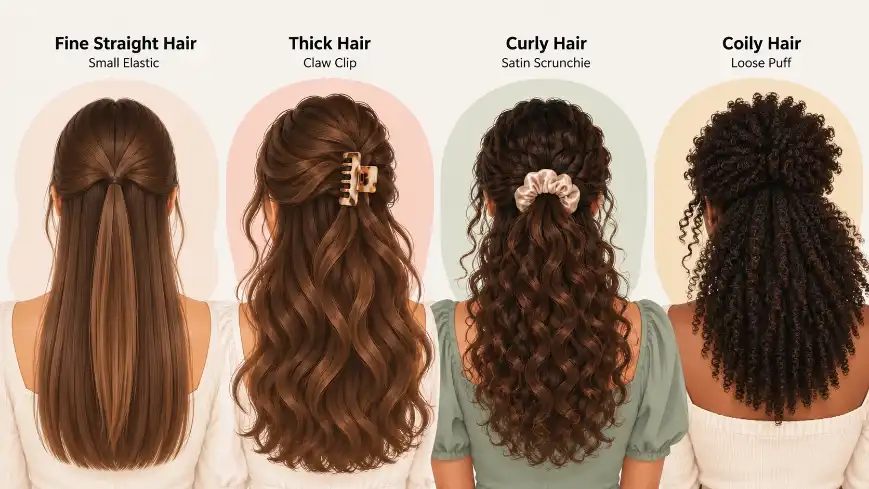
Fine or thin hair benefits most from backcombing the crown section before securing it — without that step, the top section tends to lie flat and disappear rather than reading as a deliberate style. Curly and coily hair generally needs a wider crown section than straight hair, since curls take up more visual space and a narrow section can look sparse once curls settle. Thick, heavy hair holds the style well with minimal product but benefits from a slightly stronger hold elastic underneath, since the weight of the down section pulls harder on the secure point.
Fixing the Most Common Problem: Slipping
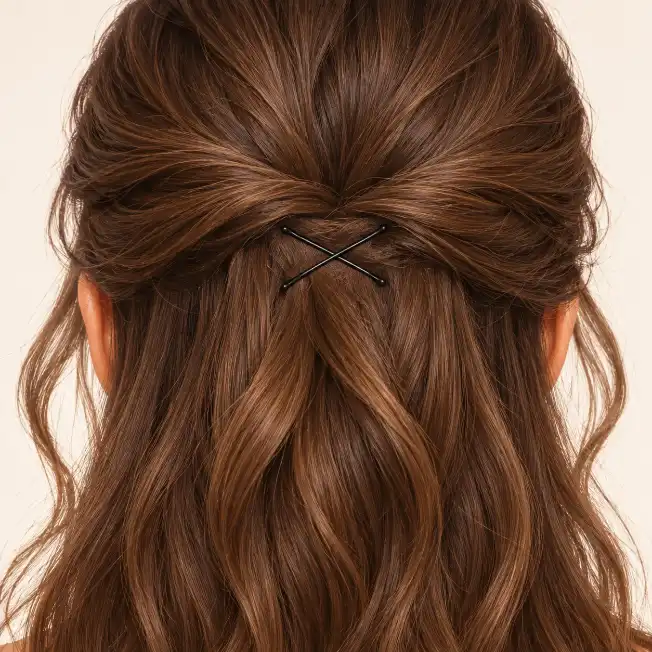
Slipping is almost always a sectioning problem, not a product problem. A crown section that's too narrow, or clipped too close to the very top of the head without an elastic underneath, has nothing to grip against once hair starts moving. Widening the section to include hair from just above both ears, backcombing the roots for texture, and layering an elastic under the visible clip fixes most cases without needing extra product.
On very fine or freshly washed hair — which has less natural grip — a light texturizing spray applied to the crown section before sectioning gives pins something to hold onto, and makes the difference between a style that lasts all day and one that needs redoing by midafternoon.
How We Approached This Guide
The sectioning and securing technique in this guide reflects standard, widely-used styling practice in our own words. Where this guide connects to face shape — crown height and volume placement — we use the same landmark-based face-shape classification logic that powers the rest of this site, for consistency with our other styling guides.
Frequently Asked Questions
What face shape does a half up half down hairstyle suit?
How do you keep a half up half down hairstyle from slipping?
Can you do a half up half down hairstyle with short hair?
Does half up half down work for thin hair?
What is the difference between half up and half up half down?
Further Reading

Naeem Ullah
Founder, Face Shape Detector • AI & Facial Proportion Researcher
Founder of faceshapedetector.app · 4+ years in facial proportion research · 200,000+ monthly readers
Naeem Ullah is the founder of Face Shape Detector and has spent over four years researching how facial landmark geometry translates into practical styling decisions. His work draws on training principles from professional hairstyling, optician certification programs, and academic literature on facial symmetry and proportion. He built the face detection system at the core of this tool and personally writes and reviews every styling guide published on this site. His guides are read by over 200,000 users monthly across 140+ countries.