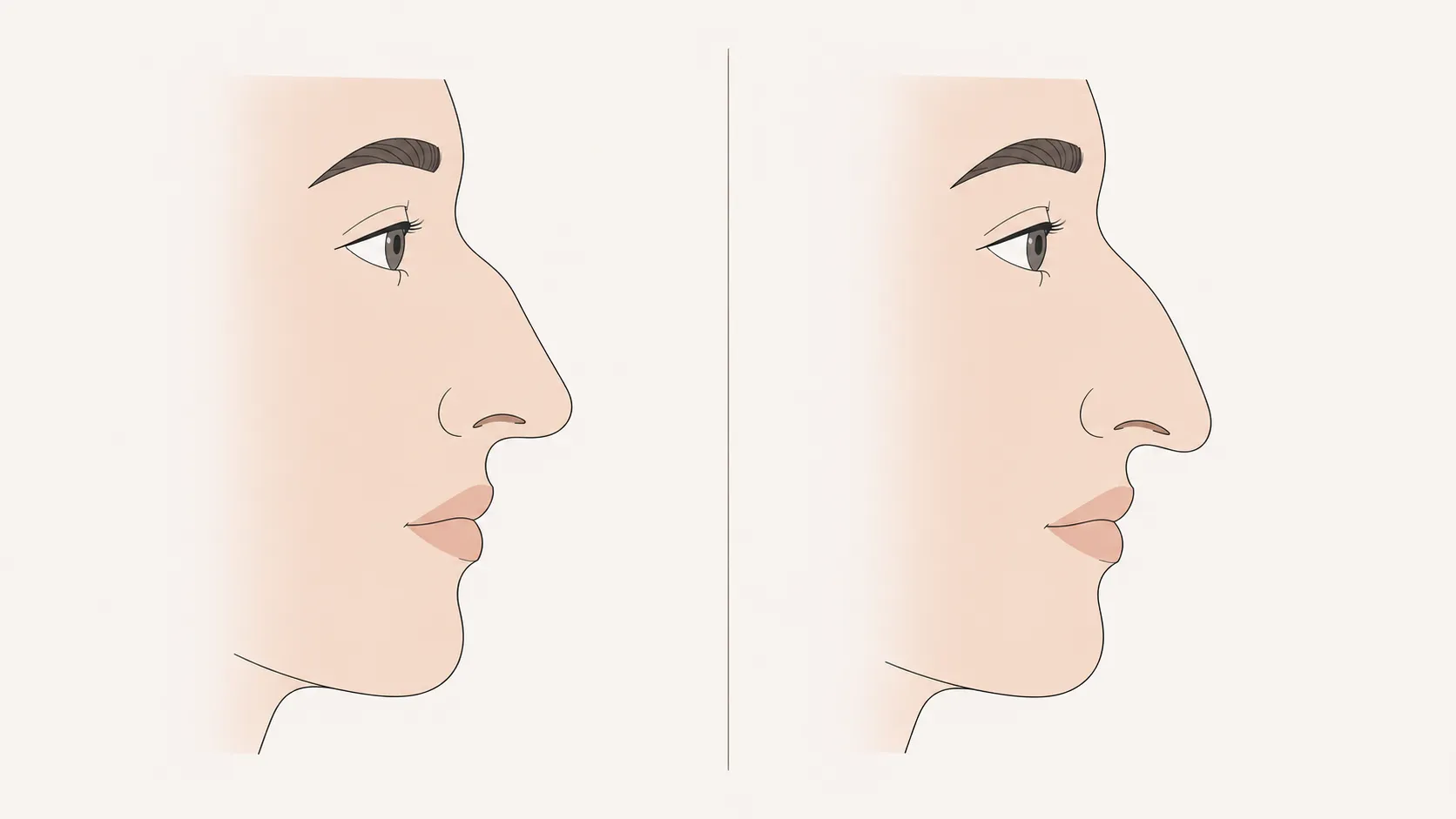
Roman and aquiline noses are the two most frequently confused nose types, and for good reason — both feature a convex bridge with a visible hump. The distinction that actually separates them isn't the hump at all; it's what happens at the tip. Get this one detail right and the rest of the classification follows.
The Short Answer
A Roman nose has a defined bridge hump with a tip that stays level or projects forward. An aquiline nose has that same hump, but the curve continues down through the lower bridge toward the tip, producing an eagle-beak silhouette. If the curve goes further still — enough to droop past the nostril line — that's a hooked nose, not aquiline.
Side-by-Side Comparison
| Trait | Roman Nose | Aquiline Nose |
|---|---|---|
| Bridge shape | Visible convex hump, usually upper-to-middle third | Convex bridge that continues curving downward through the lower third |
| Tip position | Level, or projects forward | Curves downward, but nostrils stay visible from the front |
| Overall silhouette | Strong, prominent — often longer profile | Eagle-beak profile — the defining curve is more pronounced |
| Most-confused with | Aquiline, hawk | Roman, hooked |
| Distinguishing test | Trace brow-to-tip line — stays level past the hump | Trace brow-to-tip line — keeps curving down past the hump |
How to Tell Them Apart in a Photo
Look at your profile from the side and mentally trace the bridge line from the brow down to the very tip of the nose:
- Roman: the line rises into a bump, then flattens out or points forward for the rest of the way to the tip.
- Aquiline: the line keeps curving downward all the way to the tip, without flattening out.
- Don't judge by the hump alone — both types have one. The hump tells you it's not a Greek nose, not which of the two curved types it is.
Which One Does Our AI Detector Report — and Why?
Our nose shape detector can't see your bridge profile from a single frontal photo, so it asks you directly: is your bridge straight, humped, curved downward, or scooped upward? From there:
- 1If you answer “has a bump or hump”, the detector classifies you as Roman by default.
- 2If you answer “curves downward”, it checks your tip-droop measurement: moderate droop is classified as aquiline; a stronger droop where the tip visibly curls toward the nostrils is classified as hooked instead.
- 3If either answer is paired with an unusually wide, flared frontal measurement, the detector reports hawk instead — the most dramatic variant of the curved-bridge family.
Not sure which one describes you?
Frequently Asked Questions
Is a Roman nose the same as an aquiline nose?
No, though they’re closely related. Both have a convex bridge hump, but a Roman nose’s tip sits level or projects forward, while an aquiline nose’s bridge continues curving down toward the tip, creating a more pronounced eagle-beak silhouette.
What is the easiest way to tell them apart?
Look at the tip, not just the bridge. Trace the profile line from the bump down to the very end of the nose: if it stays roughly level or points forward, that’s Roman. If it keeps curving downward toward or past the nostril line, that’s aquiline.
Where does each name come from?
Both names come from classical reference points: "Roman" from Roman portrait busts and coinage showing a prominent bridge hump with a level tip, and "aquiline" from the Latin aquilinus ("eagle-like"), describing the downward-curving, beak-like profile.
How does the AI nose shape detector tell them apart?
The detector combines your frontal measurements with a direct question about your bridge profile. If you report a "hump" bridge with a tip that doesn’t curl down significantly, it classifies as Roman. If you report a "downward curve" bridge, it checks how far the tip droops — moderate droop reads as aquiline, while a stronger droop that starts to hide the nostrils reads as hooked instead.
Is one more common than the other?
Both are broadly documented curved-bridge profiles that occur across many populations. Neither is inherently rarer — they represent a continuum of bridge and tip curvature rather than two isolated categories.
Read the Full Guides
- →Roman Nose — full guide
- →Aquiline Nose — full guide
- →Hooked Nose — the more extreme curved variant
- →Hawk Nose — the wider, more dramatic variant
Find Out Which One You Have
Upload a photo to our free AI nose shape detector and get an instant result across all 12 nose types — including Roman, aquiline, and 10 more.
Detect My Nose Shape — FreeNo sign-up · 100% private · Works on all devices