7 Best AI Attractiveness
Test Apps in 2026
Tested Hands-On for Privacy, Accuracy & Transparency
Full Disclosure
I built FaceShapeDetector's attractiveness test, which appears at #1 on this list. To keep the comparison fair, I tested every tool with the same photos, applied the same criteria to all of them — including my own — and I list my tool's weaknesses alongside its strengths below. Judge the evidence, not the ranking.
Type "how attractive am I" into Google and you'll find dozens of AI face raters promising an instant beauty score. Most work the same way: upload a selfie, a server processes it, you get a number. The differences that matter are the ones most reviews skip — what happens to your photo after upload, whether the score is explainable or a black box, and whether the tool is honest about what "attractiveness" even means to an algorithm.
I've spent two years building browser-based face-analysis tools, so I know what's happening under the hood. Here's how the popular options compare — tested hands-on.
How I Tested Every Tool
- ✓Same photos, every tool — The same set of photos — a well-lit frontal shot, a slightly tilted angle, and a lower-quality webcam shot — run through all seven tools, so no tool got an easier input than another.
- ✓Consistency check — The same photo run twice through each tool to see whether the score stayed stable or drifted between runs.
- ✓Privacy audit — Browser DevTools' Network tab open during every test to see whether an image request actually left the device, plus a read of each tool's privacy policy for retention claims.
- ✓Transparency check — Does the tool explain why you got the score — sub-scores, measurements — or just hand you a number?
- ✓Cost and friction — Sign-up walls, watermarks, upsells, and app-install requirements, noted for each tool.
How the 7 Tools Compare
| Tool | Photo Leaves Device? | Score Explanation | Free Tier | Sign-Up |
|---|---|---|---|---|
| FaceShapeDetector | No — client-side | Full 5-ratio breakdown + weights | 100% free | No |
| Fotor | Yes (server) | Multi-dimension scores | Limited | Some features require an account |
| Facewow | Yes (deleted on page exit) | Feature report | Yes | No |
| PinkMirror | Yes (server) | Geometric breakdown | Partial | No |
| Vidnoz | Yes (server) | Single % score | Yes | Required for downloads |
| AttractivenessTest.com | Yes (server) | Score + tips | Yes | No (app upsell) |
| Umax | Yes (server) | Feature ratings | No — paid | Yes |
All 7 Tools, Ranked
FaceShapeDetector Attractiveness Test
Best for: Privacy and Transparent Scoring
Full disclosure again: this is my tool, so judge what follows on the specifics, not on my say-so.
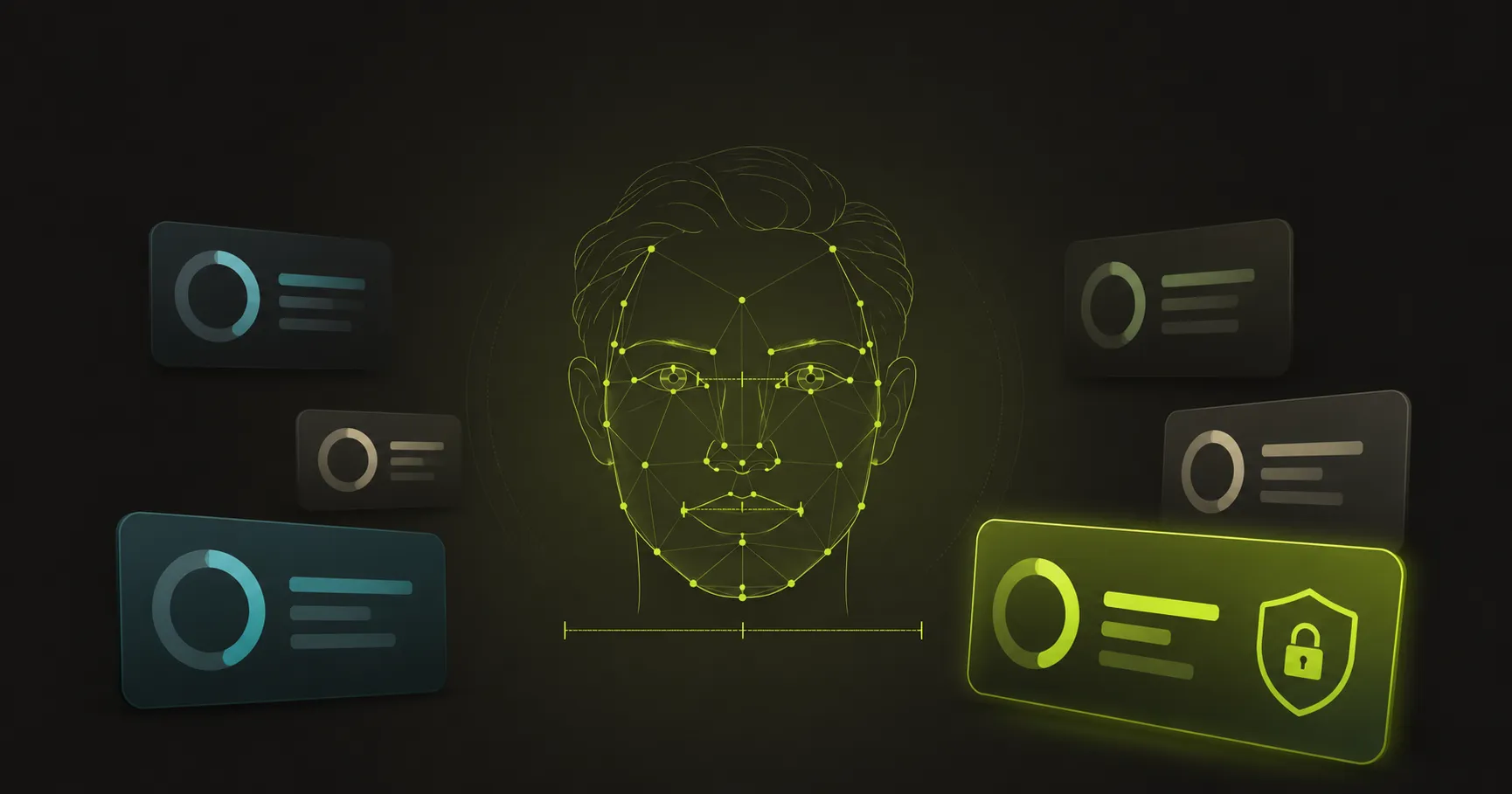
It maps 478 facial landmarks using Google's MediaPipe framework, running entirely in your browser. Your photo is never uploaded, never stored, never touches a server — you can verify this yourself in the DevTools Network tab. Every other tool on this list uploads your photo to a server and asks you to trust a deletion policy.
The score isn't a black box either. It's five published, weighted proportion ratios — eye spacing (25%), mouth width (25%), nose breadth (20%), face height-to-width ratio (15%), and facial-thirds balance (15%) — each measured against reference ranges used in facial analysis research. You get the overall 0–100 score plus a full per-metric breakdown, with defined bands: 85+ Exceptional Proportions, 70–84 Balanced Proportions, 55–69 Near-Balanced, and below 55 Outside Typical Ranges.
One thing I deliberately do differently: I don't claim the number measures beauty. Research shows proportion and symmetry correlate only modestly with perceived attractiveness, so the tool reports geometry, honestly labeled as geometry. If you want a tool that tells you you're a 9, this isn't it. If you want to know which specific features are driving your proportions, it's the most detailed free option on this list.
Strengths
- ✓100% client-side — your photo never leaves your device, verifiable in DevTools
- ✓Full 5-ratio breakdown with weights, not just a single number
- ✓Completely free, no sign-up, no watermark
Weaknesses
- ✕Web-only — no native iOS/Android app (works fine in any mobile browser)
- ✕No skin-quality or "vibe" analysis — proportions only
- ✕No photo editing or retouching attached — it measures, it doesn't beautify
Fotor AI Attractiveness Test
Best for: Multi-Dimension Scoring
Fotor lets you pick which dimensions to score — face shape, symmetry, skin quality, cuteness, masculinity/femininity — and returns a rating for each. It's one of the more thorough server-side options, and Fotor is upfront that scores reflect algorithm patterns rather than "real beauty."
Strengths
- ✓Scores multiple dimensions instead of one composite number
- ✓Established brand with a long track record
- ✓Results are downloadable
Weaknesses
- ✕Photo is uploaded and processed server-side
- ✕Sits inside a full photo-editor funnel with retouching upsells
- ✕Some features require an account
Facewow
Best for: "Vibe" Analysis for Dating & Profile Photos
Facewow scores structural features — shape, symmetry, skin, contour — alongside perception-style ratings like confidence, trustworthiness, and approachability, aimed squarely at picking a dating or LinkedIn photo. Photos are deleted when you leave the page, according to its policy.
Strengths
- ✓Useful for A/B testing between profile photo options
- ✓No sign-up required
- ✓Detailed report beyond a single score
Weaknesses
- ✕"Vibe" scores (confidence, trustworthiness) are unverifiable black-box outputs
- ✕Photo still leaves your device during processing, even if deleted afterward
PinkMirror
Best for: Geometric Breakdown (Server-Side)
One of the older players in this space, PinkMirror is measurement-first — it analyzes geometric proportions and feature distances and shows which features drove the score. Philosophically it's the closest to FaceShapeDetector on this list, but processing happens on its servers and funnels into a paid retouching product.
Strengths
- ✓Feature-level score explanation, not just a number
- ✓Long track record in the category
Weaknesses
- ✕Photo processed server-side
- ✕Heavy retouching upsell built into the flow
- ✕Dated interface
Vidnoz AI Attractiveness Test
Best for: Quick Casual Scoring
Vidnoz gives you a simple 1–100% score instantly, completely free, and positions itself squarely as entertainment rather than analysis.
Strengths
- ✓Fast — score in seconds
- ✓Free
- ✓Zero learning curve
Weaknesses
- ✕Single opaque score with no breakdown
- ✕Photo uploaded server-side
- ✕Part of a large AI tool suite with aggressive cross-promotion
- ✕Sign-up required to download your result
AttractivenessTest.com
Best for: Improvement Tips
Rates your photo 1–10 with personalized tips, plus companion tools like an age estimator and celebrity lookalike finder, and iOS/Android apps if you want the mobile version. It leans into a "baseline, then re-test" use case — get a score, change something, check again.
Strengths
- ✓Actionable improvement suggestions, not just a score
- ✓Native mobile apps available
- ✓No sign-up required on the web version
Weaknesses
- ✕Photo uploaded server-side
- ✕App install pushed fairly hard
- ✕The improvement-tracking framing can encourage over-fixation on scores that carry real measurement noise between photos
Umax
Best for: Mobile-Native Experience (Paid)
The best-known mobile "looksmaxxing" app: it rates individual features and generates a structured improvement plan. It's the most polished option if you specifically want a native app rather than a browser tool.
Strengths
- ✓Native iOS/Android app
- ✓Structured, ongoing improvement plans rather than a one-off score
Weaknesses
- ✕Paid subscription required
- ✕Account required
- ✕Photo processed server-side
- ✕Same over-fixation caveat as AttractivenessTest.com, amplified by rating-driven app design
What These Tests Actually Measure (And What They Can't)
Every tool on this list — mine included — measures some combination of symmetry, proportion, and feature spacing, because that's what computer vision can quantify. Research (Langlois & Roggman, 1990, on averageness; Rhodes, 2006, on symmetry) shows these traits correlate with perceived attractiveness on average, modestly. They don't capture expression, grooming, style, charisma, or cultural context.
Two implications follow. First, score variance between photos of the same person is measurement noise, not a change in your face — lighting, lens distance, and head tilt all shift landmark positions. A selfie taken at arm's length enlarges your nose relative to a photo taken from two meters away. Never compare scores across photos taken under different conditions.
Second, no tool can tell you how attractive you are. It can tell you how proportioned a specific photo of you is.
"No tool can tell you how attractive you are. It can only tell you how proportioned a specific photo of you is."
The Question Nobody Asks Before Uploading Their Face
Your face is biometric data. There's one question worth asking before you use any face-analysis tool: does the photo leave my device?
Client-side tools process the image entirely in your browser — there's nothing to delete because nothing was ever sent. Server-side tools, which is every other option in this comparison, upload your photo. Most promise deletion after processing, a claim you can't independently verify. Some fold uploads into broad product ecosystems with longer, vaguer data-retention terms.
Check It Yourself
Open DevTools (F12) → the Network tab, then run the test on any site. Watch whether an image request actually leaves your machine. If it does, the tool is server-side, whatever its marketing copy says.
Frequently Asked Questions
Are AI attractiveness tests accurate?
Which attractiveness test is the most private?
Why do I get different scores from different tools?
Can I improve my score?
Explore Our Other Free Tools
Same client-side approach as the attractiveness test above, applied to other parts of the face.
Face Shape Detector
Identify your oval, round, square, heart, or diamond shape
Face Symmetry Test
Measure left-right facial balance
Golden Ratio Face Calculator
Measure your phi proportion ratios
AI Age Detector
Guess your age from a photo
Celebrity Look-Alike Finder
Find your celebrity doppelganger
Eye Shape Detector
Identify your eye shape type
Nose Shape Detector
Find your nose shape from 12 types
Further Reading
This comparison is for informational and entertainment purposes. Attractiveness scores from any tool — including ours — are not assessments of health, worth, or objective beauty.

Naeem Ullah
Founder, Face Shape Detector • AI & Facial Proportion Researcher
Founder of faceshapedetector.app · 4+ years in facial proportion research · 200,000+ monthly readers
Naeem Ullah is the founder of Face Shape Detector and has spent over four years researching how facial landmark geometry translates into practical styling decisions. His work draws on training principles from professional hairstyling, optician certification programs, and academic literature on facial symmetry and proportion. He built the face detection system at the core of this tool and personally writes and reviews every styling guide published on this site. His guides are read by over 200,000 users monthly across 140+ countries.