Identify Your Face Shape
& Find Your Best Hairstyle
Two Reliable Identification Methods, Plus Hairstyles for Men & Women Across All 7 Shapes
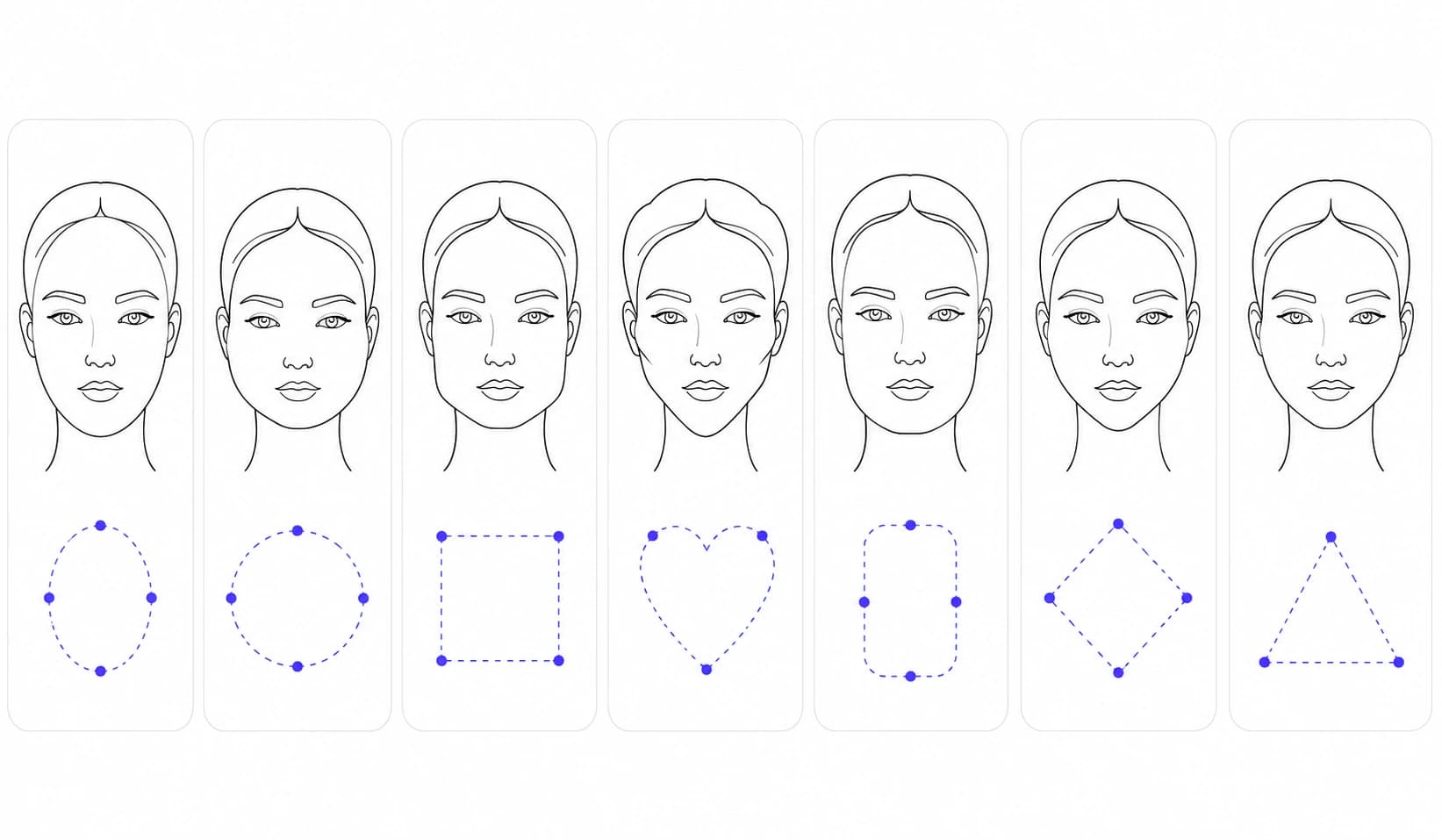
Your facial shape is the geometric relationship between four measurements — forehead width, cheekbone width, jawline width, and face length — and it's the single factor stylists, barbers, and opticians assess before recommending anything. Get the shape wrong and even a well-executed haircut or frame choice can work against your proportions instead of with them.
This guide covers how to identify your shape using two methods and what hairstyles are best suited to each of the 7 categories — for both men and women. For glasses-frame guidance and common identification mistakes, see Face Shapes Explained. Use the free AI face shape detector on this site to confirm your shape before working through the recommendations below.
Why Face Shape Actually Matters for Styling
When a hairstylist or barber sits you down for the first time, your hair type, texture, and lifestyle all matter — but your facial shape is what they assess first. That's because shape determines proportion, and proportion determines which styles will look balanced versus which will accentuate the wrong zones. A haircut that adds height at the crown is excellent for a round facial shape and potentially counterproductive for an oblong one. The same cut, two different results — the only variable is the underlying geometry.
Technically, your facial shape is defined by the relationship between four measurements: forehead width, cheekbone width, jawline width, and face length. These aren't subjective impressions — they're ratios. The ratio of length to width, the relative width of each horizontal zone, and the degree of taper from cheekbones to jaw are what determine which of the seven shape categories your face falls into. Knowing these ratios is more useful than knowing the category label alone, because the ratios tell you exactly what your styling decisions need to account for.
The practical applications are well-established. Hairstyles interact with facial shape through visual proportion — adding height elongates, adding side width broadens, and adding fringe shortens the apparent face length. Glasses frames either complement facial geometry by providing contrast or clash with it by mirroring the dominant characteristic. Understanding your facial shape removes the guesswork from both decisions and lets you evaluate recommendations with the same logic a professional uses, rather than just following rules by rote.
Most classification systems use 5 to 7 shapes. This guide uses 7 because the additional detail captures meaningful styling distinctions that 5-shape systems lose. Diamond and triangle facial shapes have genuinely different styling needs from heart and square respectively — grouping them produces advice that's accurate for one and counterproductive for the other. Seven categories is the minimum granularity that produces useful, shape-specific style decisions.
Full definitions and proportions for all 7 facial shapes now live on the Complete Guide to All Face Shapes — this page stays focused on measurement and the hairstyle guidance below.
Mixing up an adjacent pair (oval/oblong, round/square, heart/diamond)? See the commonly confused shape pairs table on Face Shapes Explained for the exact distinguishing test for each pair.
How to Find Your Facial Shape: Two Methods That Actually Work
Most people try to identify their facial shape by looking in the mirror and going with their gut. The problem is that our self-perception of our own faces is demonstrably poor — research in face perception consistently shows people rate their own faces as more oval than they actually measure. Eyeballing your face in a mirror is unreliable for the same reason that estimating your own height without a tape is unreliable: your perception is calibrated to what you're used to seeing, not to objective ratios. Most people measure wrong for a second reason too — they include hair volume in the forehead width, which produces an inflated reading that can push a heart shape toward oval. Measurement with hair pulled fully back fixes both problems.
Method 1: Manual Measurement
Use a flexible tape measure or a piece of string held against a ruler. Stand in front of a mirror with your hair pulled completely back. Take these four measurements in order:
- 1.Forehead width. Measure across the widest point of your forehead — roughly halfway between your hairline and your eyebrows. Common mistake: most people measure too close to the hairline, which gives a narrower reading than the actual widest point and often misidentifies a heart shape as oval.
- 2.Cheekbone width. Place the tape from the outer corner of one eye to the outer corner of the other, passing over the top of the cheekbones. The outer eye corner is the reference point because it aligns with the cheekbone's widest anatomical position at the surface — measuring from the temples includes too much soft tissue.
- 3.Jawline width. Measure from the tip of your chin to the angle of your jaw just below your ear — that bony corner where the jaw turns upward. Double that number to get the full jaw width. This trips most people up because they measure along the jaw edge rather than taking the straight-line distance, which significantly understates the true jaw width.
- 4.Face length. Measure from your hairline at the center of your forehead straight down to the tip of your chin. This is where hair volume causes errors — if hair rests against your forehead, measure from the actual hairline skin, not from where the hair falls. The difference can add a centimeter or more to the reading.
Reading Your Measurements
- →Cheekbones widest, forehead slightly narrower, jaw narrower still, length ~1.5× width → Oval
- →Width ≈ length (1:1 to 1.1:1), soft jaw curves, no dominant angles → Round
- →Forehead, cheekbones, and jaw roughly equal, strong flat jaw, length close to width → Square
- →Forehead clearly wider than jaw, jaw narrow and pointed, tapers progressively → Heart
- →All three widths roughly equal, face length significantly exceeds width (1.6:1+) → Oblong
- →Cheekbones clearly the widest zone, forehead and jaw both noticeably narrower → Diamond
- →Jawline clearly the widest zone, forehead noticeably narrower, face widens toward jaw → Triangle
Method 2: AI Facial Shape Detection
Our AI facial shape detector uses landmark detection to map 68 facial points — including jaw corners, cheekbone positions, brow landmarks, and chin tip. From these points it calculates the same four measurements as manual measurement, then derives the length-to-width ratio and the relative widths of each horizontal zone to classify your facial shape against the seven shape profiles. Where manual tape measurement struggles — natural facial asymmetry, jaw angle, forehead curvature — the AI accounts for automatically. It also identifies when a face sits between two shapes, which is common: most people don't fall perfectly into one category, and that's normal, not a problem.
Camera Angle Changes Everything
A photo taken from slightly above your face makes it look shorter; from slightly below, longer. Camera angle shifts apparent face length by up to 15% — enough to move a borderline oval into oblong territory, or a borderline round into oval. For an accurate AI result, the photo conditions matter as much as the algorithm:
- →Front-facing photo only — not a three-quarter turn, not a selfie angle
- →Camera held at exact eye level, not tilted upward toward the ceiling
- →Chin level — neither lifted nor lowered
- →Even, natural light; overhead lighting creates chin shadows that shift landmark positions
- →Hair fully pulled back so the hairline and jawline are visible to the detection system
Best Hairstyles for Every Facial Shape (Men and Women)
Hairstyle recommendations for facial shape operate on one of two logics: complement the shape's existing strengths, or compensate for its proportional challenges. Oval faces get the first logic — the proportions are already balanced, so almost anything works. Every other shape gets the second logic — the hair's job is to adjust what the face's natural geometry cannot. A skilled stylist knows which logic applies, and more importantly, which specific mechanism to use: height for length illusion, side volume for breadth, fringe for shortening apparent face length, tight sides for narrowing. The following recommendations are organized around those mechanisms, not arbitrary rules.
Oval Facial Shape — Hairstyles
The styling goal is to maintain the existing proportional balance. Almost any style works, so the focus narrows to avoiding the two things that would disrupt it.
What Works
- ✓Any length, most cuts — the balanced proportions support everything from a buzz cut to long layers without creating imbalance — choose based on texture and maintenance preference
- ✓Blunt cuts at any length (women) — the geometric precision of a blunt cut reads as intentional rather than severe on an oval face, where it has the proportion to carry the weight
- ✓Side part with natural volume — lets the face's natural symmetry do the work rather than fighting it; a classic approach that holds up across decades and styling contexts
- ✓Short textured cuts (men) — textured crops, fades, and most men's cuts fall within the oval's large compatible zone — there is genuine freedom here that other shapes don't have
What to Avoid
- ✕Very long, flat hair with no layers — the only real risk for oval faces is over-elongating; heavy, volume-free length pulls the face toward oblong proportions
- ✕Extreme volume at the cheeks only — dramatic side-only width on an oval pushes it toward round; some side volume is fine, but width-at-the-cheeks styling serves no proportional purpose here
Round Facial Shape — Hairstyles
The goal is to create the illusion of length and introduce angularity where the face naturally has none. Men typically achieve this through fade height and crown volume; women through long layers and face-framing pieces — the mechanism is identical, the toolkit differs.
What Works
- ✓Height at the crown (men) — volume above the head creates vertical emphasis that pulls the eye upward and makes the face read as longer than it is wide
- ✓Long layers with face-framing (women) — length that falls past the chin elongates the face; face-framing pieces at the cheeks create a leaner visual profile than blunt all-one-length cuts
- ✓Side-swept styles — asymmetry disrupts the circular impression; a sweep in either direction introduces diagonal lines that read as angular on a face that naturally has none
- ✓Tight sides or fades (men) — removing side volume is the single most effective change for a round face — every unit of width added at the cheeks works directly against the goal
What to Avoid
- ✕Full, puffed-out sides — adds width to a face that is already as wide as it is long; makes the round proportion more pronounced, not less
- ✕Chin-length blunt bobs (women) — the horizontal line at the jaw adds width at the cheekbone zone and shortens apparent face length simultaneously — a double problem
- ✕Center parts with no height (men) — bisects the face evenly and adds no vertical emphasis, leaving the width-to-height imbalance completely unaddressed
Square Facial Shape — Hairstyles
The goal is to soften the strong jaw angles and create the illusion of added length. Square face styling diverges more by gender than most other shapes — women typically use length and softness below the jaw; men use height and texture above it.
What Works
- ✓Soft waves or curls (women) — organic curves at jaw level soften the angular jaw by contrast; flowing movement reduces the sharp horizontal impression without hiding the jaw's structural strength
- ✓Long layers below the jaw (women) — length past the chin draws the eye downward and outward, creating the perception of added length and de-emphasizing the jaw width
- ✓Textured crop with fringe (men) — the fringe adds visual softness at the forehead and breaks the sharp horizontal lines of the jaw by drawing attention upward
- ✓Quiff or height at the crown (men) — vertical emphasis at the top counterbalances the jaw width and makes the face read as proportionally longer
What to Avoid
- ✕Jaw-length blunt bobs (women) — terminates at the exact width point of the face and frames the jaw square-on; one of the most amplifying choices for this shape
- ✕Very short buzz cuts with no fade (men) — removes all visual softness and leaves the jaw angles completely exposed and unbalanced
- ✕Center parts with no movement — flat symmetrical division without softening movement leaves the angular jaw as the dominant feature of the face
Heart Facial Shape — Hairstyles
The goal is to add visual weight at the narrow jaw and chin while reducing the visual dominance of the wide forehead. This is one of the easier shapes to style once the principle is understood.
What Works
- ✓Side-swept bangs or fringe — breaks the horizontal line of the wide forehead and adds asymmetry that visually narrows the top zone — more effective than straight-across fringe
- ✓Shoulder-length hair with volume at the ends (women) — flaring out at jaw level adds width exactly where the face needs it; keeps visual weight at the bottom without the heavy forehead emphasis of very short styles
- ✓Side part with weight to one side (men) — reduces the apparent symmetrical width of the forehead by drawing attention to one side rather than framing the full span
- ✓Chin strap or light jaw beard (men) — adds definition and visual mass at the narrow jaw without adding bulk at the cheeks, directly addressing the lower imbalance
What to Avoid
- ✕Blunt straight-across bangs — emphasizes the wide forehead by framing it cleanly; widens rather than narrows the already-dominant top zone
- ✕Very short close-cropped styles (women) — exposes the full forehead width without any balancing width at the jaw; amplifies the top-heavy proportion
- ✕Full beard with side volume (men) — adds width at the upper jaw where the face is already on the narrow side, without specifically addressing the chin imbalance
Oblong Facial Shape — Hairstyles
The goal is to interrupt the vertical length and add horizontal visual weight — the opposite of what most elongating styles do. The most common mistake oblong-faced people make is choosing tall hairstyles that worsen the already-long proportion. Oblong and diamond are the shapes where hairstyle recommendations diverge most by gender.
What Works
- ✓Bangs or fringe (women) — cuts the perceived face length by covering part of the forehead; a horizontal line at brow level is one of the most effective tools available for an oblong facial shape
- ✓Waves and curls with side width (women) — volume at the sides adds horizontal mass and disrupts the straight-sided profile that makes oblong faces read as very long
- ✓Mid-length or low fade with textured sides (men) — retaining volume at the sides adds perceived width; a high skin fade removes this side volume and worsens the elongation
- ✓Side part swept sideways, not upward (men) — horizontal movement at the crown creates width impression; redirecting a side part upward just adds height to a face that already has too much
What to Avoid
- ✕High quiff or tall pompadour (men) — adds crown height to a face that is already long; the most common and most impactful mistake for oblong-faced men
- ✕Very long straight hair with no layers (women) — length without width adds vertical without horizontal; makes the face read as even longer rather than balanced
- ✕Slicked-back tight styles — removes all side volume and leaves the oblong proportions fully exposed with no visual interruption to the length
Diamond Facial Shape — Hairstyles
The goal is to add width at the forehead and chin to balance the dominant cheekbones from both ends. Most common mistake: styles that further emphasize the cheekbones, which need no additional attention.
What Works
- ✓Side-swept fringe or brow-length bangs — adds a horizontal visual line at the forehead and widens the narrow upper face; brow-length specifically fills in the narrow forehead zone
- ✓Chin-length or longer with volume at the ends (women) — width at chin level balances the narrow lower face against the prominent cheekbones — the ends flaring slightly out is ideal
- ✓Side part with forward fringe (men) — fringe that sits forward widens the narrow forehead by occupying the visual space above the brows that would otherwise read as bare
- ✓Chin beard or goatee (men) — adds width and mass at the narrow chin, directly balancing the cheekbone prominence from below
What to Avoid
- ✕Pulled-back or slicked-back styles — exposes the narrow forehead completely and creates a harsh contrast with the wide cheekbones that makes the diamond proportion more extreme
- ✕Center part with no volume — splits the forehead cleanly down the middle, emphasizing its narrowness rather than adding any visual width
- ✕Clean-shaved chin (men) — leaves the narrow chin exposed; the face reads as most imbalanced when cheekbones are prominent and the chin has no mass to counterbalance them
Read the full diamond face shape guide for glasses, makeup, and celebrity examples.
Triangle Facial Shape — Hairstyles
The goal is to add visual width at the forehead and temples while reducing emphasis at the wide jawline — essentially inverting the face's natural proportions through deliberate style choices.
What Works
- ✓Volume and width at the crown and temples — broadening the upper half of the head draws the eye upward and rebalances the face's inverted proportion from the bottom
- ✓Chin-length or shorter with top volume (women) — terminates the hair before reaching the jaw and keeps volume concentrated in the upper zone where the face needs width
- ✓Pompadour or textured top with volume (men) — height and breadth at the crown directly counterbalances the wide jaw below; the effect works in proportion to how much upper volume is added
- ✓Side volume at temples with light jaw sides — volume concentrated at the top and tapering toward the jaw directly addresses the triangle's fundamental proportion problem
What to Avoid
- ✕High fade with tight sides (men) — removes all width from the upper head, making the jaw appear even wider by stark contrast
- ✕Long hair terminating at jaw level — the hair's end point at the jaw adds width at exactly the wrong zone, reinforcing the already-dominant bottom-heavy impression
- ✕Wide, full beard with side volume (men) — adds lateral mass at the jaw where there is already too much visual weight; the most counterproductive choice for a triangle facial shape
“The hair's job isn't to make you look like a different person — it's to use proportion and contrast so your face's existing geometry reads as more balanced.”
Looking for glasses and common-mistake advice too?
Frequently Asked Questions About Facial Shape
What is the most attractive facial shape?
Can two people have the same facial shape but look completely different?
How do I know if I have an oval or oblong facial shape?
Does facial shape affect which beard styles suit men?
How accurate is AI facial shape detection compared to manual measurement?
Further Reading

Naeem Ullah
Founder, Face Shape Detector • AI & Facial Proportion Researcher
Founder of faceshapedetector.app · 4+ years in facial proportion research · 200,000+ monthly readers
Naeem Ullah is the founder of Face Shape Detector and has spent over four years researching how facial landmark geometry translates into practical styling decisions. His work draws on training principles from professional hairstyling, optician certification programs, and academic literature on facial symmetry and proportion. He built the face detection system at the core of this tool and personally writes and reviews every styling guide published on this site. His guides are read by over 200,000 users monthly across 140+ countries.