Face Shapes
for Men
Hairstyles, Beard Styles & Glasses for Every Male Face Shape
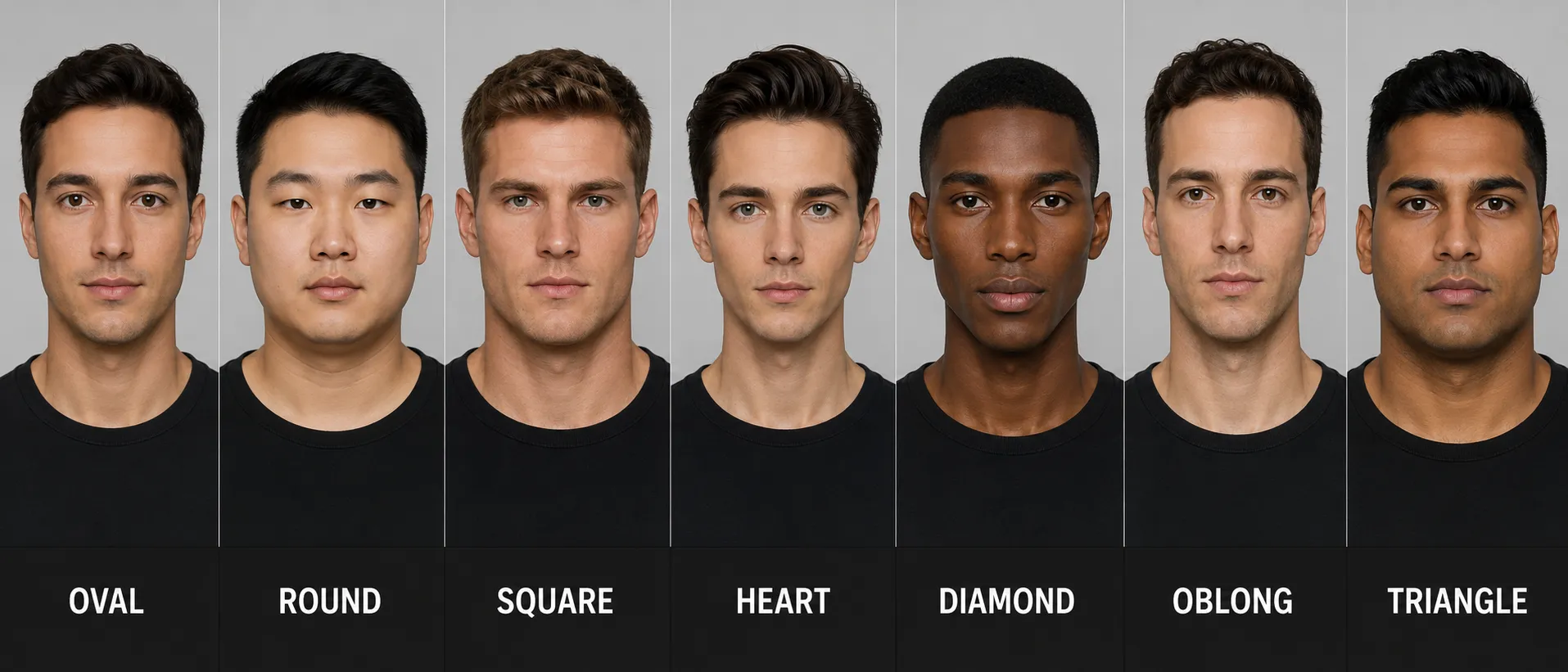
Men's faces fall into six main shapes — oval, square, round, oblong, diamond, and triangle — and knowing yours is the fastest way to pick haircuts, beards, and glasses that actually fit your bone structure.
Walk into any barbershop and the first thing a skilled barber does is study your face shape. Not your hair type, not your lifestyle — your face shape. Because the same haircut that looks exceptional on one man looks entirely wrong on another, and the difference almost always comes down to how the cut interacts with the underlying bone structure.
This guide covers how to identify your face shape accurately — including how to measure it yourself — and then provides specific, actionable recommendations for haircuts, beard styles, and eyewear for all six male face shapes: oval, square, round, oblong, diamond, and triangle. Not sure which one you have? Use our free AI face shape detector above to find your face shapes for men result in under 30 seconds.
How to Identify Your Face Shape
There are two reliable methods: manual measurement and AI analysis. Manual measurement is slower but useful for understanding your proportions in detail. AI analysis is faster and accounts for asymmetry and soft tissue that tape measurements miss.
Manual Measurement Method
Use a flexible tape measure or a piece of string against a ruler. Take four measurements while standing in front of a mirror with hair pulled back:
- 1.Forehead width. Measure across the widest point of your forehead, roughly halfway between your hairline and your eyebrows.
- 2.Cheekbone width. Measure from the outer corner of one eye straight across to the other, passing over the top of the cheekbones.
- 3.Jawline width. Measure from the tip of your chin to the angle of your jaw just below the ear. Double that number to get the full jaw width.
- 4.Face length. Measure from your hairline at the center of the forehead down to the tip of your chin.
Reading Your Measurements
- →Cheekbones widest, forehead slightly narrower, jaw narrower still, length ~1.5× width → Oval
- →Forehead, cheekbones, and jaw roughly equal, face as wide as it is long → Square
- →Width and length nearly equal, soft jaw curves, minimal angles → Round
- →All three widths roughly equal, face length significantly exceeds width → Oblong
- →Cheekbones clearly the widest, forehead and jaw noticeably narrower → Diamond
- →Jaw is the widest zone, forehead noticeably narrower → Triangle
The 6 Male Face Shapes at a Glance
Face Shape Comparison — Key Proportions
| Shape | Key Characteristic | Widest Zone | Jaw Type |
|---|---|---|---|
| Oval | Length ~1.5× width, gentle taper | Cheekbones | Softly tapered |
| Square | Width ≈ length, strong angles | Even across all three | Broad, flat, angular |
| Round | Width ≈ length, soft curves | Even, minimal angles | Soft, rounded |
| Oblong | Length >> width, straight sides | Even across all three | Rounded or squared |
| Diamond | Wide cheekbones, narrow forehead & jaw | Cheekbones (prominently) | Narrow, pointed chin |
| Triangle | Jaw widest, forehead narrowest | Jawline | Wide and strong |
"The same haircut that looks exceptional on one man looks entirely wrong on another — the difference almost always comes down to face shape."
Hair, Beard & Glasses: All 6 Shapes
Oval Face Shape
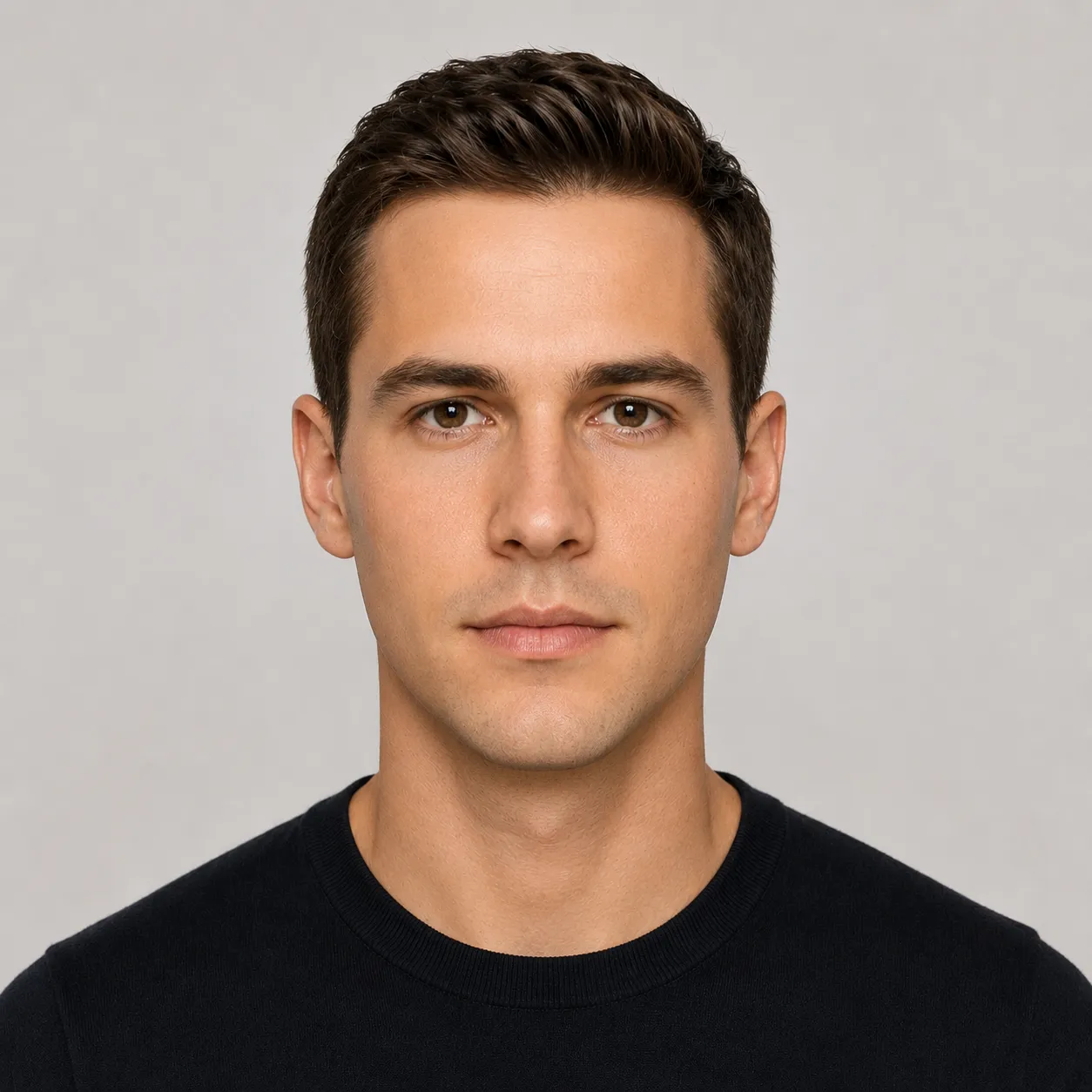
Oval is the most versatile male face shape. The gentle taper from forehead to jaw and the defined cheekbones mean that very few styles are off-limits. The styling goal is simply to maintain balance — avoid anything that dramatically elongates the face or adds excessive width at any single zone.
What Works
- ✓Almost any hairstyle — the balanced proportions support everything from a buzz cut to a pompadour to medium-length textured styles without creating imbalance
- ✓Side part with natural volume — lets the face's natural symmetry do the work without fighting it; a classic look that holds up across decades
- ✓Most beard styles — short boxed beard, full beard, stubble, and goatees all work well — the face can support virtually all of them without visual imbalance
- ✓Rectangular or aviator frames — add a subtle angular counterpoint to the face's softer curves; both enhance without dominating
What to Avoid
- ✕Very long straight hair with no layers — the only risk for oval faces is over-elongating; flat, volume-free length moves the face toward oblong territory
- ✕Extremely wide styles at the cheeks — excessive side width can push an oval toward round; some width is fine, but dramatic cheek puffing isn't needed
Square Face Shape
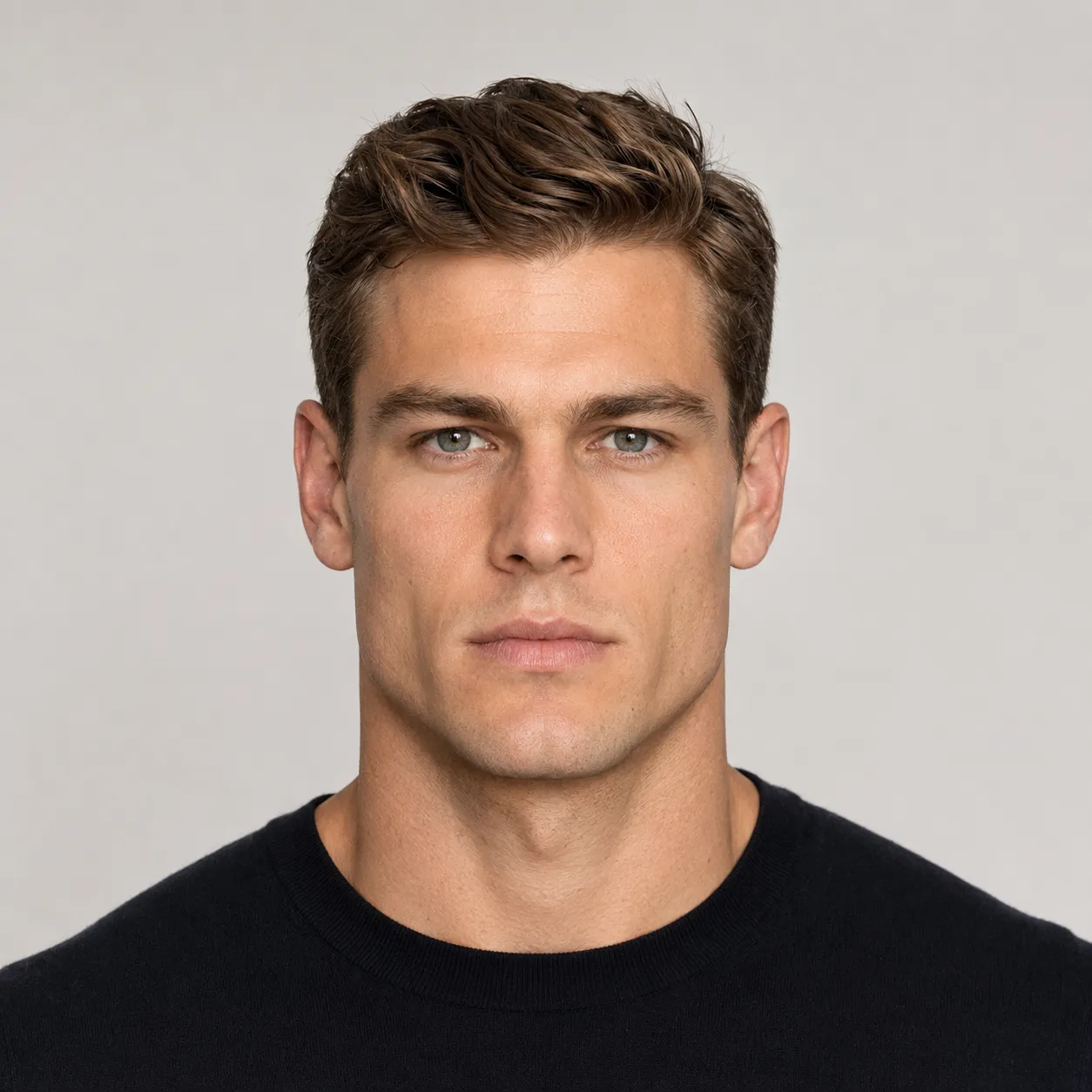
Square faces have a strong, wide jaw roughly equal in width to the forehead. The face reads as angular and powerful. The styling goal is to soften the jaw's hard corners and add some perceived length — without making the face look top-heavy.
What Works
- ✓Textured crop with fringe — the fringe adds softness at the forehead and breaks the sharp horizontal lines of the jaw by drawing attention upward
- ✓Quiff or pompadour — height at the crown creates the illusion of a longer face, counterbalancing the strong jaw width
- ✓Stubble or short beard — softens the jaw angles without adding bulk; keeps the face looking defined rather than blocky
- ✓Round or oval glasses frames — circular shapes counterbalance the jaw's angles and add visual softness at exactly the right zone
What to Avoid
- ✕Boxy, hard-edged full beards — stacking a rectangular beard on an already-angular jaw creates a very heavy, squared-off appearance that dominates the face
- ✕Very short buzz cuts with no fade — removes all visual softness and leaves the jaw angles completely exposed and unbalanced
- ✕Square eyewear frames — mirrors the jaw shape and doubles the angular impression rather than balancing it
Round Face Shape
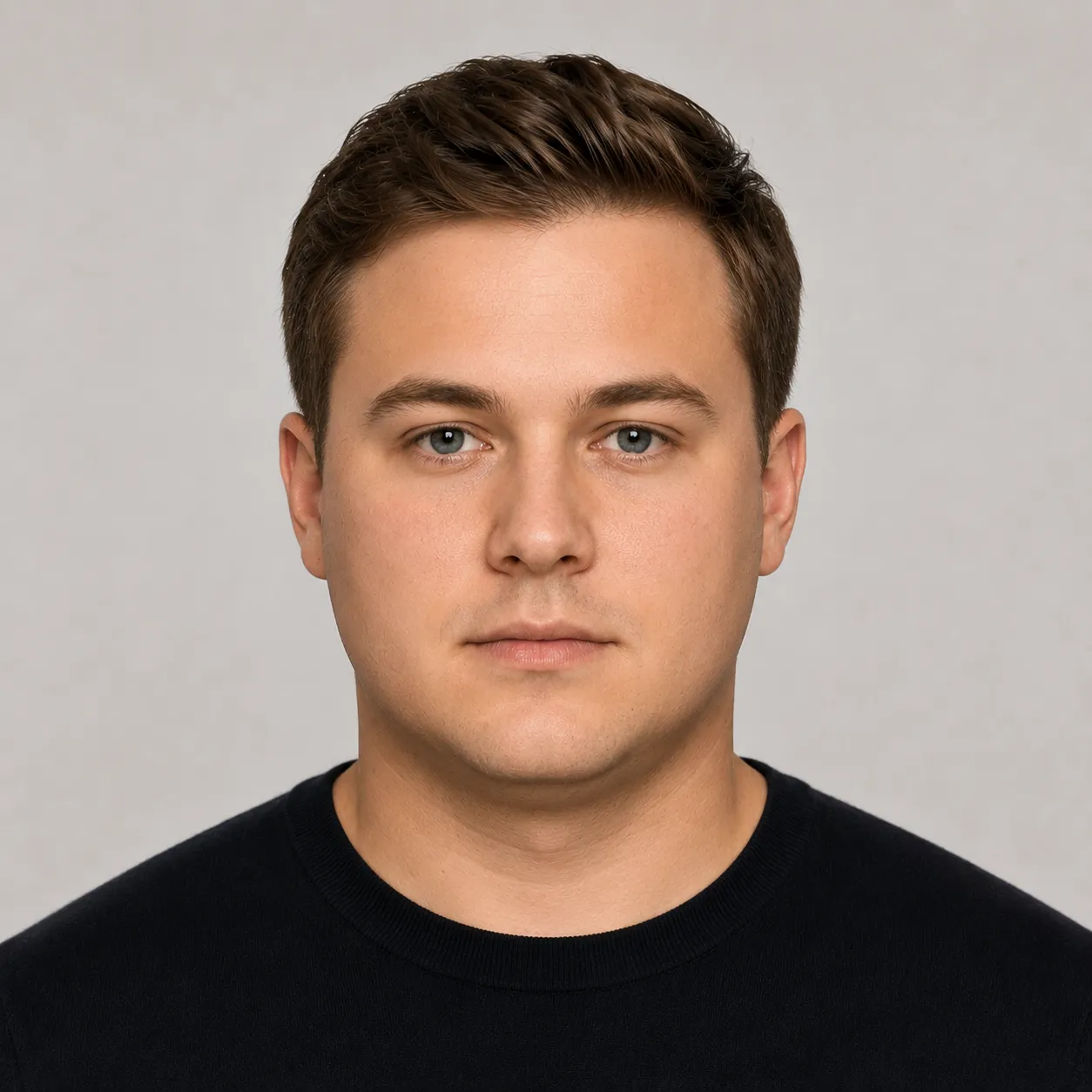
Round faces have width and length that are nearly equal, with soft curves and no sharp angles. The styling goal is to create the illusion of length and angularity — adding vertical emphasis and avoiding anything that makes the face appear wider or rounder.
What Works
- ✓High fade with volume on top — height at the crown elongates the face; the fade keeps the sides tight, preventing additional width at the cheeks
- ✓Hard side part — a defined part with one side swept over adds asymmetry and the illusion of angularity to a face that naturally has little
- ✓Angular beard with defined chin line — a goatee or extended goatee adds visual structure at the chin where the face lacks definition naturally
- ✓Rectangle or square frames — angular frame shapes introduce lines and corners that counterbalance the face's soft curvature
What to Avoid
- ✕Full, puffed-out sides on the hair — adds width to a face that's already as wide as it is long; makes the round shape more pronounced
- ✕Round glasses frames — circular frames on a round face amplifies the shape — one of the most commonly cited mismatches in men's style
- ✕Center-parted styles with no height — bisects the face evenly and adds no vertical emphasis, leaving the width-to-height imbalance unaddressed
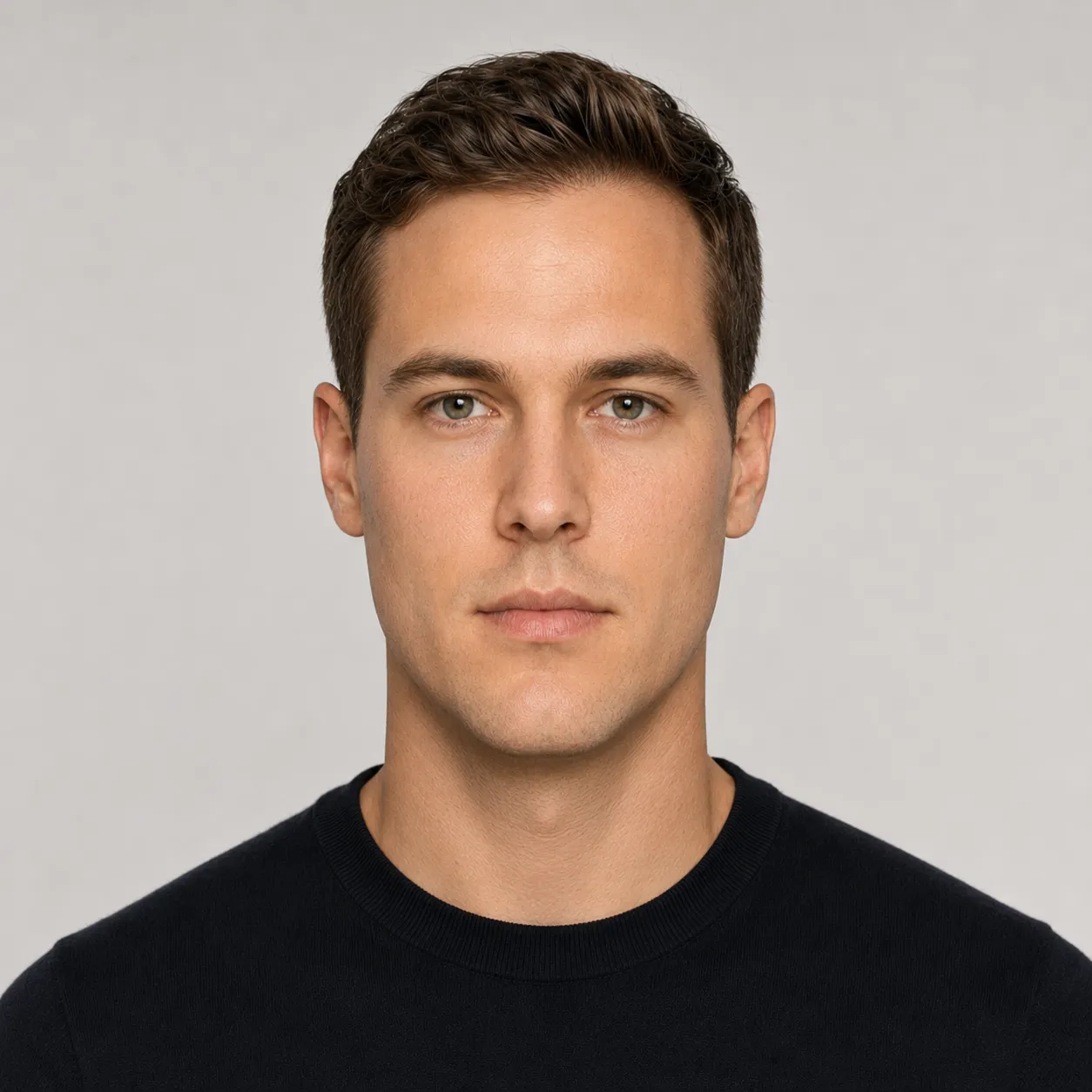
Oblong Face Shape
Oblong faces are longer than wide with relatively straight sides and minimal cheekbone prominence. The styling goal: interrupt the vertical length and add horizontal width. The most common mistake oblong-faced men make is choosing tall hairstyles that worsen the already-long proportion.
What Works
- ✓Medium fade with textured sides — a mid or low fade retains some hair volume at the sides, adding perceived width; a high skin fade removes too much
- ✓Side part swept sideways, not upward — horizontal movement at the crown creates width impression; redirecting a side part upward just adds height
- ✓Textured fringe swept forward — acts like bangs — covers part of the forehead and reduces the vertical space the eye travels across
- ✓Wide rectangular glasses frames — horizontal emphasis is exactly what oblong faces need; frames that extend to the cheekbones add perceived mid-face width
- ✓Short boxed beard with fuller sides — adds width and mass at the jaw, improving the width-to-length ratio from the bottom
What to Avoid
- ✕High quiff or tall pompadour — adds crown height to a face that's already long; the most common and most damaging mistake for oblong-faced men
- ✕Goatee with clean-shaved cheeks — concentrates beard mass at the chin, creating a downward focal point and adding length at exactly the wrong zone
- ✕Very narrow, tall glasses frames — emphasizes the vertical at the mid-face — the opposite of what an oblong face needs from eyewear
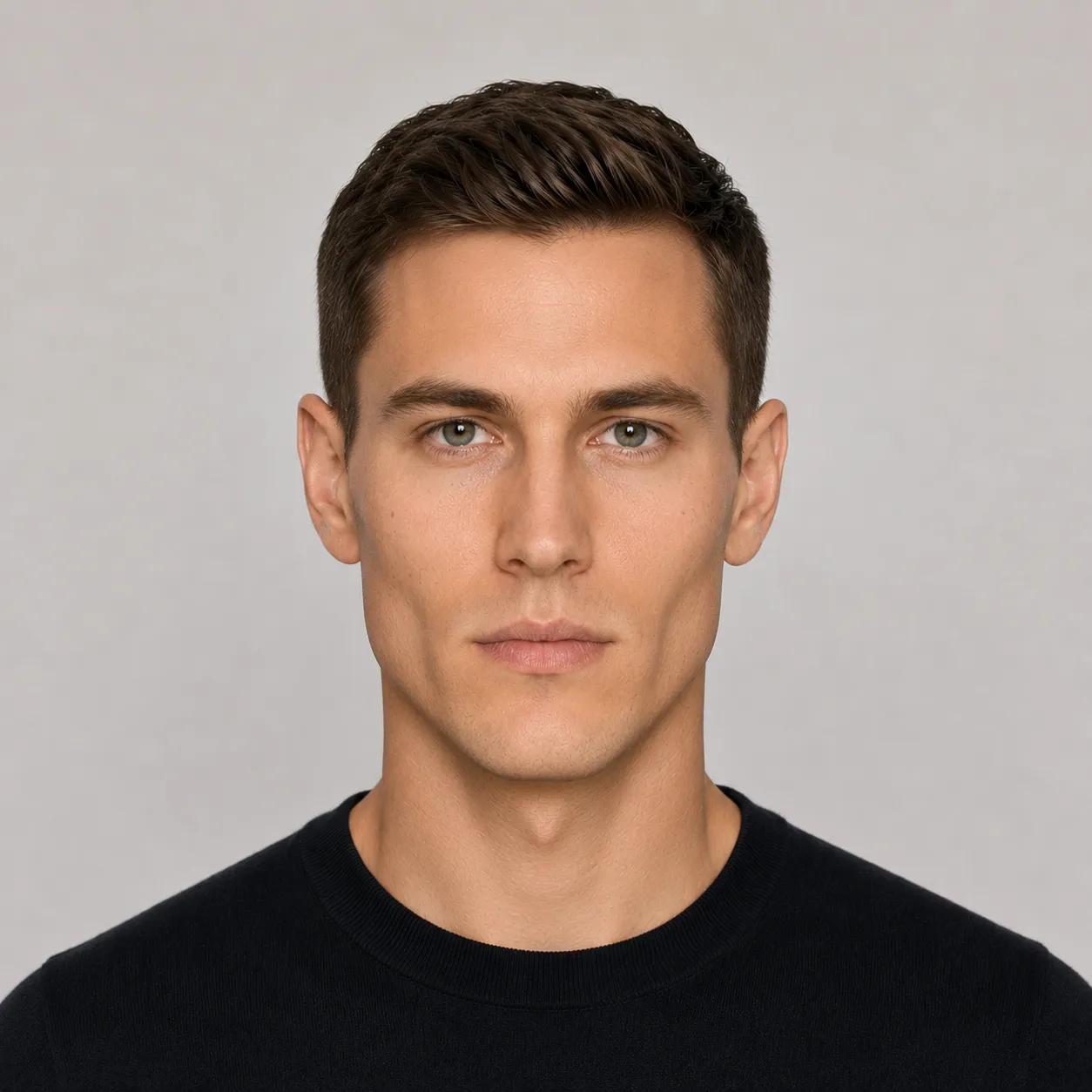
Diamond Face Shape
Diamond faces have wide, prominent cheekbones as their widest point, tapering to a narrow forehead above and a narrow, pointed chin below. The styling goal is to add width at the forehead and chin while avoiding anything that emphasizes the cheekbones further.
What Works
- ✓Volume and width at the forehead — side-swept styles and textured fringe that sits slightly forward widens the narrow forehead, bringing it into proportion
- ✓Brow-length fringe — covers the narrow forehead entirely and adds a horizontal line at the brow that reads as width from a distance
- ✓Chin-extending beard — a goatee or chin beard adds width and mass at the narrow chin, balancing the prominent cheekbones from below
- ✓Oval or rimless glasses frames — gentle curves that don't extend past the cheekbones; avoids adding emphasis to the already-prominent width
What to Avoid
- ✕Slicked-back or pulled-away styles — exposes the narrow forehead entirely and draws attention to the cheekbone width by harsh contrast
- ✕Very wide glasses extending past the cheekbones — adds emphasis to the already-prominent cheekbones rather than drawing attention to the narrower zones
- ✕Clean-shaven chin — leaves the narrow chin exposed and makes the face look unbalanced when the cheekbones are wide
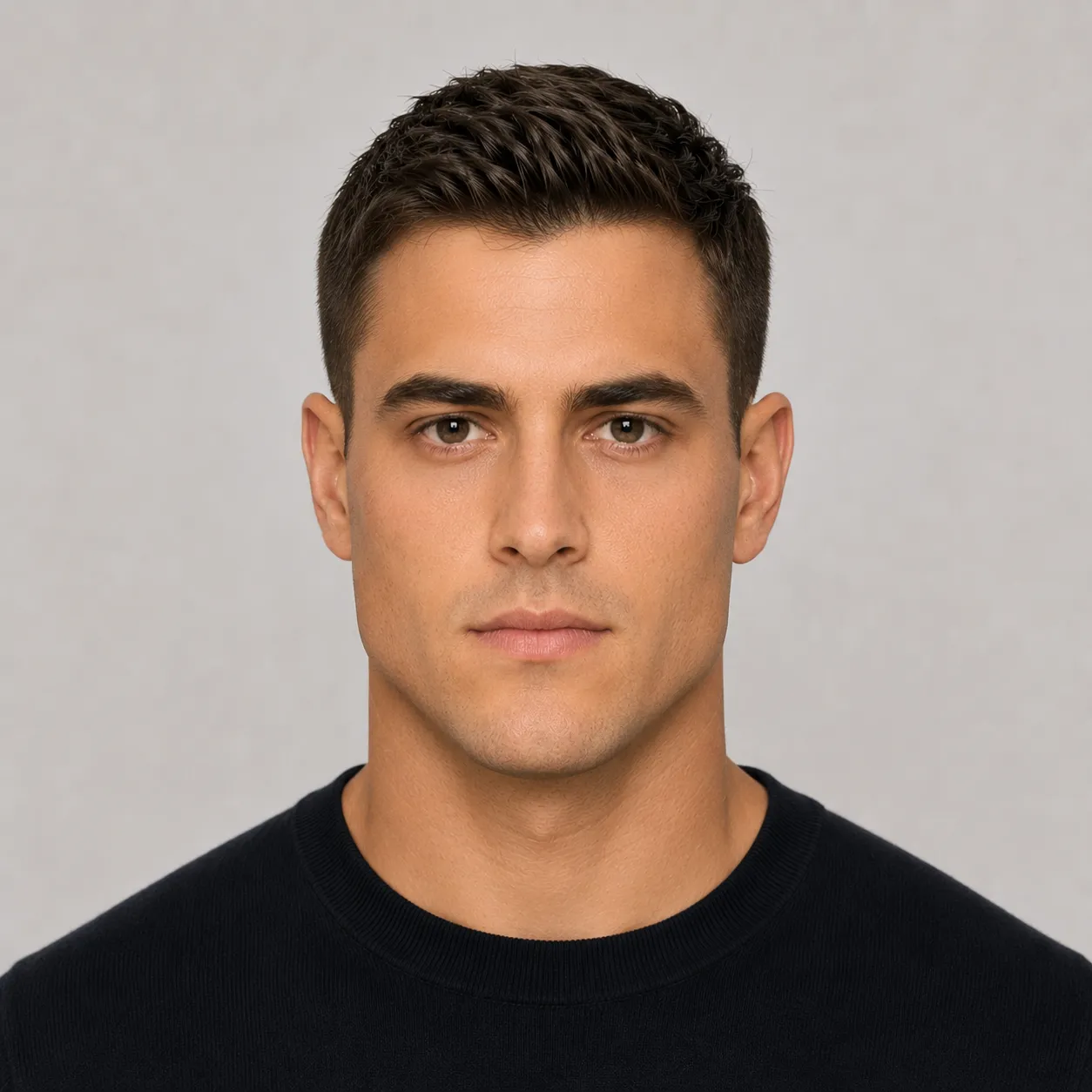
Triangle Face Shape
Triangle faces (sometimes called pear-shaped) have a wide, strong jaw tapering up to a narrower forehead. The styling goal is to add visual width at the top and reduce emphasis at the jawline — essentially inverting the face's natural proportions through deliberate style choices.
What Works
- ✓Volume and width at the crown — a pompadour, quiff, or textured top with volume swept upward and outward adds width to the narrow forehead zone
- ✓Side volume and horizontal movement — anything that broadens the upper half of the head draws the eye upward and balances the wide jaw below
- ✓Goatee or chin-focused beard — focuses beard detail centrally and draws the eye upward rather than laterally across the wide jaw
- ✓Browline or cat-eye inspired glasses — top-heavy frames widen the forehead visually and balance the strong jaw below
What to Avoid
- ✕High fade with tight sides — removes all width at the top of the head, making the jaw appear even wider by contrast
- ✕Full beard with width on the sides — adds mass at the jaw — exactly the zone that doesn't need more emphasis; worsens the inverted proportion significantly
- ✕Narrow, thin-framed glasses — provides no width at the forehead level; leaves the jaw as the dominant visual feature
The Beard Neckline: The Detail Most Men Get Wrong
Regardless of face shape, neckline placement has a significant impact on how the jaw and lower face appear. A neckline that's too high — shaved above the natural jaw level — makes the jaw look smaller and the neck look thicker. A neckline that's too low creates a heavy, unkempt appearance with no definition between the jaw and neck.
The standard guideline: place two fingers horizontally above the Adam's apple. That point — roughly where the neck meets the jaw — is where the neckline should sit. Clean everything below it. The result is a neckline that's low enough to look natural and high enough to define the jaw clearly.
Neckline Adjustments by Face Shape
- →Square face — keep the neckline at or slightly above the two-finger point to avoid emphasizing jaw width further
- →Round face — a slightly lower neckline (further down the neck) helps elongate the lower face
- →Oblong face — keep the neckline at the standard point; avoid very high necklines that reduce chin prominence
- →Triangle face — keep the neckline clean and defined; a sloppy low neckline adds mass to an already-wide jaw zone
- →Diamond face — standard two-finger neckline; let the goatee or chin beard sit naturally above it
The Most Common Face Shape Styling Mistakes Men Make
Stacking matching shapes
Round glasses on a round face. Square beard on a square jaw. When the accessory mirrors the face shape, it amplifies rather than balances. The goal of good styling is contrast — a round face benefits from angular eyewear; a square face benefits from softer, rounder frames.
Defaulting to high fades regardless of face shape
High skin fades are popular, but they're specifically suited to oval and round faces where removing side bulk is the goal. For oblong faces, a high fade makes the face appear even longer. For triangle faces, it removes upper-head width that the face needs. Match the fade level to your face shape.
Ignoring the beard-glasses interaction
Most men choose hairstyle, beard, and glasses independently. But all three interact. A full wide beard under wide-framed glasses on a round face is double the width-adding signal. Consider the combination, not each element in isolation.
Copying hairstyles from men with different face shapes
Reference images are useful, but they need to be filtered. David Beckham's undercut looks the way it does partly because of his square jaw. Copying a style without accounting for the face shape it's designed around is why the result rarely lands as expected.
Not adjusting style as the face changes
Face shapes subtly shift with age and weight changes. A style that worked at 25 may not work as well at 40 for purely structural reasons. Periodic reassessment — particularly after significant weight change — is worth doing.
How the AI Face Shape Detector Works for Men
The AI Face Shape Detector uses facial landmark detection — mapping key points across your face including jaw corners, cheekbone width, temples, and hairline. From these landmarks, it calculates the four core measurements and their ratios to classify your face shape with precision.
Where manual measurement struggles — natural facial asymmetry, jaw angle, forehead curvature — the AI accounts for automatically. It also identifies when a face sits between two shapes (common, since most men don't fall perfectly into one category) and provides recommendations for both.
For the Most Accurate Male Face Shape Result
- →Use a clean-shaven or very light stubble photo — heavy beards obscure the jawline measurement, critical for distinguishing square from oblong
- →Pull hair completely away from the face so the full hairline and temples are visible
- →Use even, front-facing natural light — harsh overhead light creates jaw shadows that affect the chin measurement
- →Keep the camera at exact eye level with the chin level — a tilted chin changes the face length reading significantly
- →Bring your shape result and its specific recommendations to the barber for the most targeted conversation
Frequently Asked Questions
What is the most common male face shape?
Can my face shape change over time?
What if I'm between two face shapes?
Do these style rules actually matter, or are they just guidelines?
Does face shape matter more for hair or beard choice?
Further Reading
Naeem Ullah
Founder, Face Shape Detector • AI & Facial Proportion Researcher
Founder of faceshapedetector.app · 4+ years in facial proportion research · 200,000+ monthly readers
Naeem Ullah is the founder of Face Shape Detector and has spent over four years researching how facial landmark geometry translates into practical styling decisions. His work draws on training principles from professional hairstyling, optician certification programs, and academic literature on facial symmetry and proportion. He built the face detection system at the core of this tool and personally writes and reviews every styling guide published on this site. His guides are read by over 200,000 users monthly across 140+ countries.