2026 Beard Trends
by Face Shape
What Works, What to Avoid, and How to Shape Your Neckline
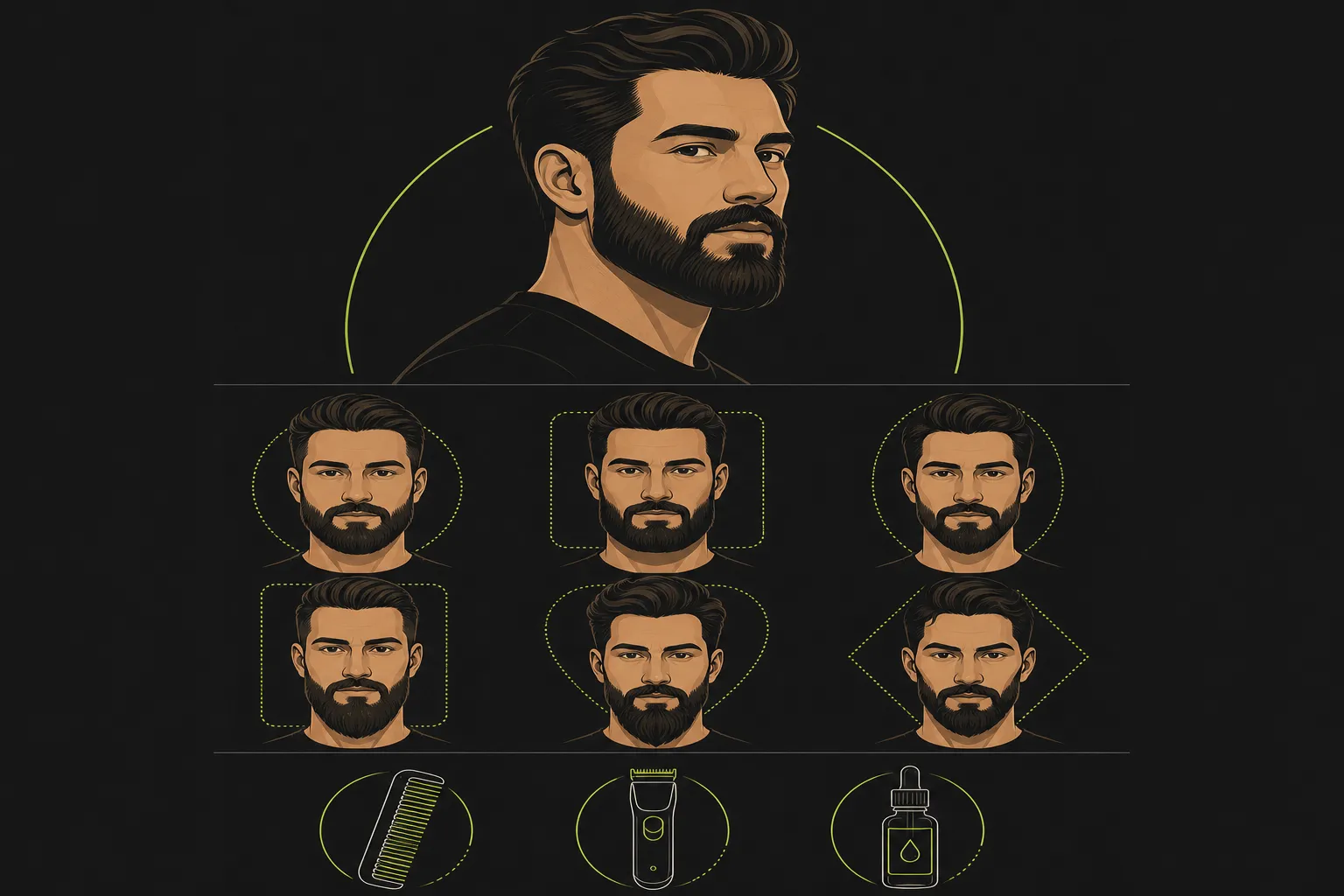
Choosing a beard style without knowing your face shape is like picking glasses frames blind — you might get lucky, but the result is rarely optimal. The right beard works with your natural proportions, balancing features that are too prominent and adding structure where the face needs it. The wrong one does the opposite.
The principle behind every recommendation in this guide is the same: a beard should push your face toward balanced, oval-like proportions. That means adding length on round or square faces, softening hard angles on square or diamond faces, and adding width on long or oblong faces — the opposite of whatever your face shape already has too much of.
Find Your Face Shape First
Every recommendation below depends on knowing your face shape accurately. Guessing from a mirror is unreliable — most people misjudge their own shape because they focus on one feature (a strong jaw, a wide forehead) rather than the overall proportions. Use the free AI face shape detector to get a precise result in seconds from a single photo, then jump to your shape below.
How a Beard Changes Your Face Shape
A beard does not sit on top of your face — it changes the apparent shape of your lower face entirely. A full beard on a round face can add length and angular definition. The same full beard on an oblong face makes it appear even longer. A sharp, close-cropped beard on a square jaw can emphasise its strength or soften it, depending on how the edges and neckline are shaped.
Beard Recommendations by Face Shape
Oval Face Shape
Oval faces are the most versatile for beards. Balanced proportions mean almost any beard style works without creating imbalance. The primary consideration is avoiding styles so wide or heavy they push the face toward a rounder appearance.
Best Beard Styles
- ✓Full beard — the balanced proportions support density on all sides without the face reading as blocky or round
- ✓Short boxed beard — clean lines that add definition without altering the natural balance of the oval shape
- ✓Stubble — subtle definition that suits virtually every styling choice — the safest and most versatile option for oval faces
- ✓Circle beard or goatee — adds a focal point at the chin that enhances the oval's natural taper
What to Avoid
- ✕Extremely wide, bushy styles — excessive width at the cheeks can make the oval read closer to round — the only real risk for this face shape
- ✕Mutton chops — heavy sideburns with no chin coverage widen the face significantly without adding vertical balance
Round Face Shape
Round faces have similar width and length with soft curves. A beard's job here is to add length and angular definition — creating vertical lines and structure the face naturally lacks.
Best Beard Styles
- ✓Extended goatee — adds a point of length at the chin while keeping the sides shorter, directly addressing the round face's need for vertical emphasis
- ✓Van Dyke — a classic option — the pointed mustache and chin beard combination creates a strong downward visual line
- ✓Short beard with defined chin point — keeping the chin beard slightly longer than the sides creates the vertical focal point a round face needs most
- ✓Sharp, defined beard edges — angular lines contrast with the face's soft curves and add the definition that round faces lack
What to Avoid
- ✕Full round beard — adds width at the cheeks to a face that is already as wide as it is long — makes the circular shape more pronounced
- ✕Mutton chops — heavy side-focused style that adds horizontal width without any vertical balance
- ✕Rounded, soft beard shaping — mirroring the face's curved outline doubles the circular impression rather than contrasting it
Square Face Shape
Square faces have a strong, angular jawline. A beard here can either soften these angles or reinforce them — the goal is softening. Styles that are longer at the chin and rounded at the jaw corners work best.
Best Beard Styles
- ✓Medium full beard with rounded shaping — coverage at the jaw corners softens their angularity while the length at the chin adds proportion
- ✓Short stubble — keeps definition without adding mass; preserves the jaw's strength while removing the hard-edged blocky appearance
- ✓Balbo beard — disconnected from the sideburns, with a chin-focused shape that avoids adding bulk to the jaw's already-prominent width
- ✓Slightly longer chin than sides — adds perceived length to a face where width and length are equal — corrects the squareness through proportion
What to Avoid
- ✕Sharp, squared-off beard edges — matching the hard lines of the jaw with equally hard beard edges reinforces angularity rather than softening it
- ✕Heavy sideburns — adds horizontal width at the jaw zone, making the strong jaw appear even wider
- ✕Very short stubble on a strong jaw — removes all softening and leaves the jaw angles fully exposed and unbalanced
Heart Face Shape
Heart faces are wider at the forehead and taper to a narrow chin. A beard adds visual width at the jaw to balance the prominent upper face.
Best Beard Styles
- ✓Full beard kept wide at the sides — adds jaw width that brings the narrow lower face into proportion with the wide forehead
- ✓Short boxed beard — fills the jaw zone cleanly; the defined lower edge adds structure to the narrow chin area
- ✓Garibaldi or fuller natural beard — the natural rounded fullness at the jaw and chin adds the volume the lower face of a heart shape needs
- ✓Volume at the jaw level — any style that adds width at the jaw level specifically addresses the heart face's width imbalance
What to Avoid
- ✕Goatee or narrow chin beard — narrows the chin further and accentuates the taper rather than adding the jaw width the face needs
- ✕Heavy at the chin point only — downward emphasis makes the narrow chin look more pointed rather than balanced
- ✕Clean-shaven — removes all lower face definition, leaving the forehead width unchallenged by any jaw structure
Diamond Face Shape
Diamond faces have high cheekbones as the widest point, with a narrow forehead and jaw. A beard adds width at the chin and reduces the visual dominance of the cheekbones.
Best Beard Styles
- ✓Full beard with rounded chin shaping — adds width and mass at the narrow chin, balancing the prominent cheekbones from below
- ✓Chin beard or goatee — targeted coverage at the chin adds the definition the narrow lower face needs without adding cheekbone width
- ✓Balbo beard — focused on the chin and mustache, adding width below the cheekbones where the diamond face needs it most
- ✓Close at the cheekbones — keeping the beard minimal at the cheeks prevents adding further width to the already-prominent midpoint
What to Avoid
- ✕Narrow pointed goatee — emphasises the pointed chin rather than adding width to it — worsens the narrow lower face effect
- ✕Heavy sideburns — adds width at the cheekbone zone, increasing emphasis on the already-prominent midpoint
- ✕Wide full beard extending past the cheeks — adds horizontal mass to the widest point of the face rather than correcting the imbalance
Oblong Face Shape
Oblong faces are significantly longer than wide. A beard should add horizontal width and avoid adding further vertical length.
Best Beard Styles
- ✓Full beard wide at the sides — horizontal mass at the cheeks adds the width an oblong face needs to reduce the dominance of its length
- ✓Short chin with fuller cheeks — keeping the chin area shorter and the sides fuller is the most effective proportion correction for oblong faces
- ✓Mutton chops — heavy side coverage adds pronounced horizontal width — more aggressive but highly effective for oblong faces
- ✓Short uniform stubble — prevents the beard from adding any further length while maintaining a groomed appearance
What to Avoid
- ✕Long chin beard — adds further vertical length to a face that is already too long relative to its width
- ✕Pointed goatee — the downward point at the chin emphasises and extends the vertical line of the face
- ✕Any style with no side coverage — chin-only beard styles provide no horizontal width and leave the elongated proportion uncorrected
Triangle Face Shape
Triangle faces are widest at the jaw. A beard's job here is difficult — it must not add further width to an already-prominent jaw. Short, close-trimmed styles or a clean shave are the most reliable choices.
Best Beard Styles
- ✓Short stubble — minimal coverage that adds some definition without adding any width to the already-dominant jaw zone
- ✓Defined chin with close sides — drawing attention to the centre of the chin rather than the sides keeps the eye away from the jaw's width
- ✓Clean shave — for triangle faces with a very strong jaw, removing beard coverage entirely is often the most balanced option
- ✓Goatee (narrow) — a focused chin-only style keeps attention central and avoids adding lateral width
What to Avoid
- ✕Full wide beard — adding mass at the sides of an already-wide jaw dramatically worsens the triangle proportion
- ✕Heavy sideburns — the most damaging choice for a triangle face — adds width at exactly the zone that needs the least emphasis
- ✕Beard wider than the forehead — visually confirms and amplifies the inverted proportion rather than correcting it
Beard Neckline Placement by Face Shape
The neckline is the most overlooked aspect of beard styling. A neckline that is too high makes the jaw look smaller and the neck look thicker. A neckline that is too low creates a heavy, unkempt appearance with no definition between jaw and neck.
The standard baseline: two fingers placed horizontally above the Adam's apple. Clean everything below this point. This sits low enough to look natural and high enough to define the jaw clearly. Each face shape then adjusts slightly from this baseline.
Neckline Adjustments by Face Shape
Oval, heart, diamond, and oblong faces can stick to the standard two-finger baseline with no adjustment. Three shapes benefit from a deliberate tweak:
- →Round — a slightly lower neckline helps elongate the lower face and adds definition
- →Square — keep it at or slightly above the two-finger point to avoid emphasising jaw width further
- →Triangle — a clean, defined neckline is essential; a sloppy low neckline adds mass to the already-wide jaw
Beard Grooming Basics That Apply to Any Shape
Whatever style you choose, a handful of grooming fundamentals make or break the result regardless of face shape.
- ✓Trim to a guard length weekly — beards grow unevenly, and a weekly trim keeps the silhouette you chose intact instead of drifting into a shapeless one
- ✓Define the cheek line — a soft, natural cheek line (not shaved too high) looks intentional at any length; shaving it too aggressively creates a harsh, unnatural edge
- ✓Wash with a dedicated beard wash — regular shampoo strips the natural oils that keep facial hair soft, leading to the wiry, unruly texture that makes any style look messier
- ✓Use beard oil on clean, towel-dried hair — conditions the hair and the skin underneath, reducing itchiness and flakiness during the first few weeks of growth
- ✓Let it grow 4–6 weeks before judging a style — most beards look uneven or patchy in the first month; the true shape and density only become clear after that
Beard Style Summary
Best Beard Approach by Face Shape
| Face Shape | Best Approach | Avoid |
|---|---|---|
| Oval | Any style — most flexibility | Extremely wide bushy styles |
| Round | Longer chin, shorter sides, angular edges | Full round beard, mutton chops |
| Square | Rounded jaw shaping, medium length | Sharp squared edges, heavy sideburns |
| Heart | Fuller at sides and jaw | Goatees, narrow chin styles |
| Diamond | Fuller at chin, close at cheekbones | Wide beard, heavy sideburns |
| Oblong | Wide at sides, shorter at chin | Long chin beard, pointed goatee |
| Triangle | Close trim, clean shave | Full wide beard, heavy sideburns |
Frequently Asked Questions
What beard suits a round face?
Does a beard change your face shape?
What is the best beard for a square face?
Best beard for a double chin?
Can a beard make my face look thinner?
Does beard style matter as much as hairstyle?
What if I can't grow a full beard?
How do I find my face shape?
Further Reading
Naeem Ullah
Founder, Face Shape Detector • AI & Facial Proportion Researcher
Founder of faceshapedetector.app · 4+ years in facial proportion research · 200,000+ monthly readers
Naeem Ullah is the founder of Face Shape Detector and has spent over four years researching how facial landmark geometry translates into practical styling decisions. His work draws on training principles from professional hairstyling, optician certification programs, and academic literature on facial symmetry and proportion. He built the face detection system at the core of this tool and personally writes and reviews every styling guide published on this site. His guides are read by over 200,000 users monthly across 140+ countries.